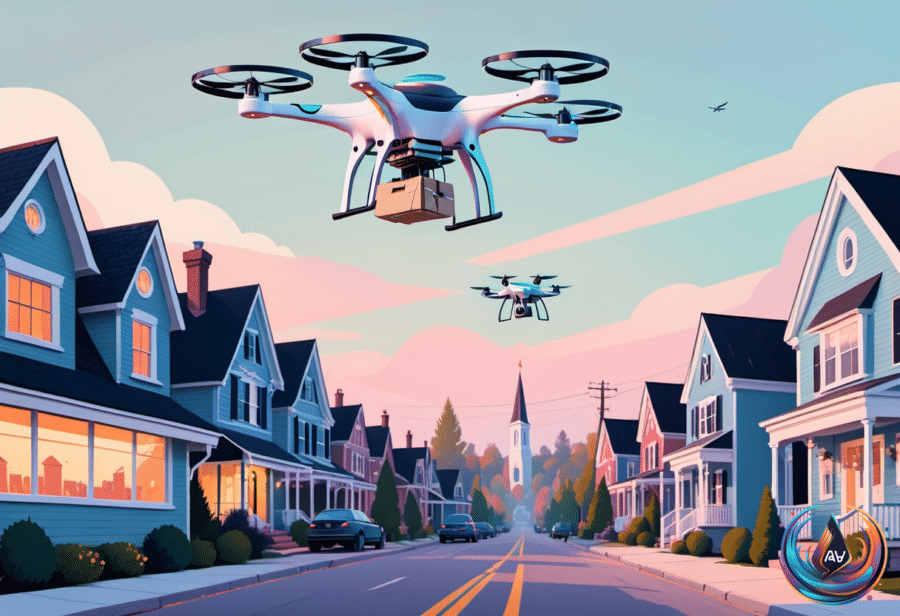
Drone delivery is moving from a limited experiment toward a much bigger part of everyday shopping and food delivery. Wing and Walmart plan to bring delivery by air to Denver and Seattle in 2027, while DoorDash prepares its own drone service for northern California.
That puts two major delivery networks on a collision course in the sky. One will carry Walmart orders from more than 270 stores, while the other will target restaurant meals that can reach a customer’s door in under five minutes on average.
Walmart’s Drone Network Expands Beyond Five Metro Areas
On Oct. 5, 2026, Wing and Walmart announced plans to bring drone deliveries to Denver and Seattle in 2027. The expansion will extend a service already available in five metropolitan areas: Atlanta, Charlotte, North Carolina, Dallas–Fort Worth, Houston, and Orlando, Florida.
The companies also aim to expand to fourteen other destinations, including Miami, Philadelphia, Los Angeles, and the San Francisco Bay Area. Across the growing network, they plan to offer delivery by air from more than 270 Walmart stores, turning store locations into launch points for small, fast orders.
Wing’s aircraft can travel at up to 60 mph and carry a payload that weighs as much as five pounds. That capacity targets the kind of smaller purchases customers want without waiting for a traditional delivery route to reach their homes.
If a Walmart order qualifies for drone delivery, customers will see the option in the Walmart app or on the website. Consumers can also place orders through Wing’s app, giving shoppers two ways to access the service as the network expands.
The next phase will test how drone delivery fits into more cities and more shopping routines. Denver and Seattle will join the existing metropolitan areas in 2027, while the fourteen additional destinations could push air delivery into an even wider national footprint.
DoorDash Builds a Food Delivery Aircraft Around Real Orders
On Sept. 30, 2026, DoorDash revealed details about its drone delivery program and announced a debut in northern California. DoorDash Air will launch with partners including Chipotle and Popeyes, bringing restaurant meals into a delivery system designed around the size, weight, and distance of actual orders.
DoorDash’s drone has six propellers and was designed and built in-house for DoorDash Air. The aircraft produces about as much cruising noise as a passing car when it reaches delivery height, a detail that points to how the company is preparing the system for regular use near homes and businesses.
About 80 percent of DoorDash’s U.S. restaurant orders are small and light enough for the aircraft to carry. Initial tests showed flights from restaurants to customers averaged less than five minutes, creating a powerful promise for meals that lose value as delivery time stretches.
“In initial tests, flights from restaurants to customers averaged less than five minutes,” DoorDash said in describing those early results. Harrison Shih, head of DoorDash Air, explained the thinking behind the aircraft: “We didn’t start with a drone and ask what would fit. We started with what people order and how local businesses actually operate, then built the entire system from there.”
That approach reaches beyond the aircraft itself. DoorDash designed loading systems, packaging, and a winch-based pickup and drop-off system to minimize extra work for restaurant employees, keeping the handoff tied to the way restaurants already prepare orders.
One Delivery Platform, Multiple Ways to Reach the Door
DoorDash’s Autonomous Delivery Platform will decide whether an order should travel by human Dasher, robot, or drone. The system weighs distance, order weight, weather, and traffic, while the drone delivery system also considers ground traffic, weather, and flight times when determining whether an order suits air transport.
This places drones inside a broader delivery network rather than treating them as a standalone replacement for people. DoorDash’s drone delivery efforts will continue alongside partnerships with Alphabet’s Wing and Flytrex, while its ground options include Dot, the company’s own delivery robot unveiled last year, along with sidewalk bots from Serve Robotics and Coco Robotics.
The company also has partnerships with Macy’s, Anthropologie, The North Face, Vans, and Timberland. Together, these efforts show DoorDash building a delivery platform that can match different products and routes with different machines.
Shih tells Axios he thinks the speed of drone delivery will encourage people to use DoorDash more often. That bet now faces a real-world test as DoorDash Air moves toward northern California and Wing and Walmart prepare their next expansion across Denver and Seattle.
The race is no longer about whether drones can carry a package or a meal. It is about which orders qualify, how smoothly stores and restaurants can load them, and whether customers choose air delivery when the option appears on their screens. By 2027, more shoppers and diners may have to make that choice for themselves.
Based on