Imagine controlling a robot using only your thoughts. That’s exactly what BrainCo, a Chinese brain-computer interface (BCI) company, recently demonstrated. Their new platform lets a person direct robots through an EEG headset that reads brain signals.
BrainCo calls this system the world’s first integrated brain-to-robot platform. It works in three steps. First, the EEG headset captures electrical brain signals. Then, AI decodes those signals into control commands. Finally, the system sends those commands to a robot.
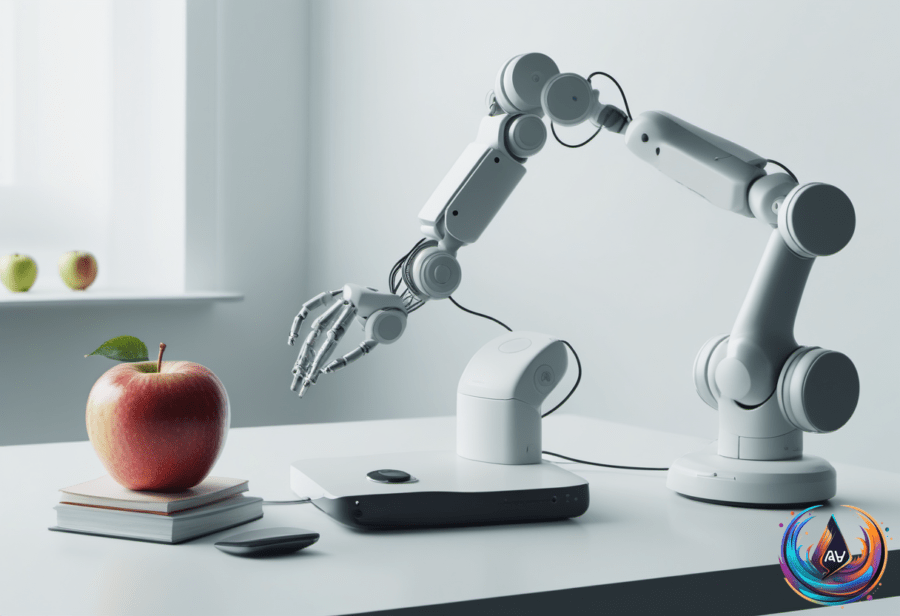
All of this happens in under 200 milliseconds. In a live demo, a robotic arm, controlled purely by thought, picked up an apple and grasped a cup. The system can work with various robots, including humanoid models, robotic arms, and four-legged robots that resemble dogs.
China’s First Commercial Brain Implant Surgery
In a related breakthrough, China completed the world’s first commercial brain-computer implant surgery. This happened in July 2026 at Huashan Hospital. Surgeons implanted a coin-sized chip in a patient with hand mobility problems caused by a spinal cord injury from 10 years ago. The implant doesn’t penetrate brain tissue but sits on the brain’s outer surface.
The device, called NEO, was developed by Neuracle Medical Technology. It reads neural signals and helps translate them into hand movements. This implant became the first commercially approved brain-computer interface device in the world. China’s National Medical Products Administration gave the green light on March 13, 2026.
Since then, production has started, hospitals have adopted it, and patients have gone through screening. The device is also included in some local commercial health insurance plans, making it more accessible.
China’s AI Ambitions and Global Context
President Xi Jinping spoke at the opening of the 2026 World Artificial Intelligence Conference on July 17. His presence raised the event’s importance and highlighted AI as a key priority for China. Xi emphasized the need for “open-weight” AI, which means AI models that developing countries can share and use.
China is pushing hard for technological independence because of US export controls on advanced chips and AI models. The US and China remain the top leaders in AI development worldwide. China’s approach includes both cutting-edge research and commercial applications, as seen in the brain implants and robot control systems.
Meanwhile, Kernel, a startup outside China, tested a brain-scanning headset priced at $117,200. This shows how advanced and costly brain-interface technology still is globally. But as companies like BrainCo and Neuracle make progress, brain-computer interfaces could become more common in healthcare and robotics.
BrainCo’s Nyx He summed it up well: “A decade of BCI research has given us the ability to decode what a person intends to do and translate that into machine action.” This is a glimpse of how humans and machines might connect in the near future.
Based on
- China’s BrainCo showed a platform that lets you control robots with your mind — thenextweb.com
- China completes world’s first commercial brain-computer interface implant | South China Morning Post — scmp.com
- Xi Jinping calls for ‘openness’, opposes ‘one country’ rule in AI – as it happened | South China Morning Post — scmp.com
- Xi seeks global influence via China’s AI boom at major conference — nbcnews.com
- We Visited Kernel to Test Its $117,200 Brain-Scanning Headset. – Business Insider — businessinsider.com