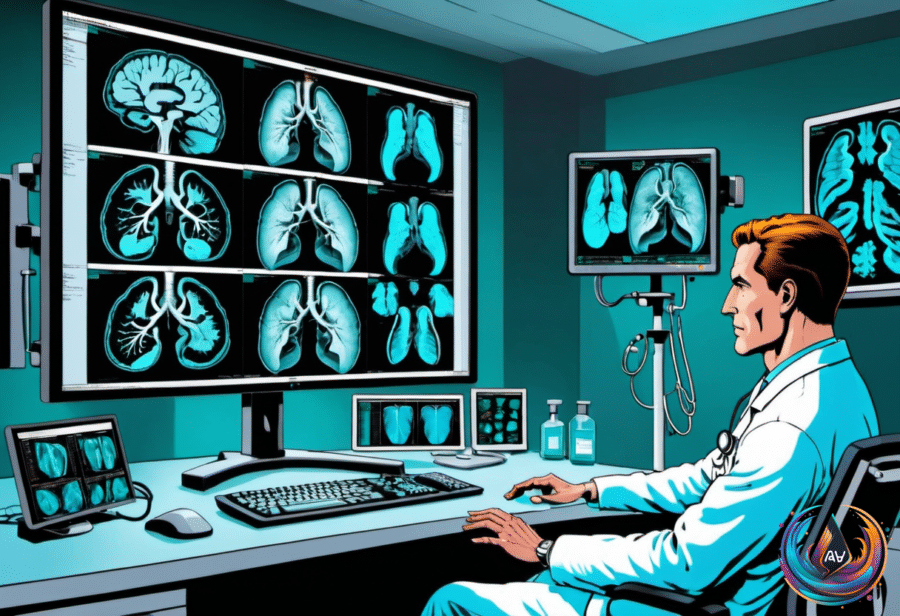
Fujifilm plans to bring RADPAIR’s Genesis agentic reporting platform into Synapse PACS, giving radiologists a way to review images and manage reports without leaving their reading workspace. The partnership, announced on November 29, 2026, covers an upcoming demonstration and beta rather than a general-availability launch.
Fujifilm plans to demonstrate the embedded workflow at RSNA 2026, the Radiological Society of North America’s annual meeting, as part of the upcoming Synapse PACS Version 7.6 release. RADPAIR’s product page labels Genesis as a beta at RSNA 2026 and says a Genesis trial is coming soon.
Reporting stays inside the reading workspace
The planned integration places Genesis inside Synapse Enterprise PACS, Fujifilm’s cloud-enabled viewer for radiology, mammography, cardiology, pathology, and other imaging departments. The platform offers specialty-specific tools, including native AI applications, and aims to provide a consistent diagnostic reading experience across locations.
Embedding Genesis is meant to keep reporting inside that environment instead of sending radiologists to separate legacy reporting tools. The workflow is designed to support image review, report creation, editing, and finalization from the same reading workspace.
That design gives the radiologist the final say. Genesis coordinates AI agents that can act on requests during reporting, while the radiologist continues to edit and finalize the report.
RADPAIR also describes an upcoming Memory agent that is designed to carry each radiologist’s reporting preferences from case to case. Together, the agent coordination and memory functions are intended to turn reporting into an interactive process inside the reading workspace, rather than a series of disconnected steps.
Genesis builds on RADPAIR’s PAIRsdk
Genesis builds on PAIRsdk, a developer framework RADPAIR introduced on November 11, 2025. PAIRsdk was designed to help imaging systems, reporting tools, and AI platforms communicate through a consistent structure, supporting radiology workflows driven by natural speech and AI agents within existing clinical environments.
Avez Rizvi, RADPAIR’s Founder and CEO, described Genesis as a rebuild of that earlier work.
“Building on the foundation of PAIRsdk, which we announced last year, we’ve completely rewritten our codebase and redesigned our architecture to unlock fully agentic workflows.”
RADPAIR describes several other capabilities across its broader reporting platform, including natural-speech punctuation and formatting, study-specific templates, near-real-time findings and impressions, and click-and-drag editing for minor revisions. The Fujifilm announcement focuses on embedding Genesis into Synapse PACS, while those features show the wider reporting environment RADPAIR is building around the platform.
A wider RSNA 2026 focus on connected imaging
The Genesis demonstration arrives alongside other imaging technology announcements tied to RSNA 2026. DeepHealth describes a “One Intelligent Experience” that unifies regulatory-cleared Clinical AI, cloud-first PACS, reporting, and workflow orchestration in one interoperable environment.
Deep integration in that environment covers dynamic case assignment, critical-case prioritization, enhanced detection and risk assessment, agentic draft reporting with visual grounding, and insights for clinical pathway management. RSNA 2026 also spotlights newly cleared AI solutions in X-ray, breast ultrasound, and mammography-based risk assessment, with capabilities for detection, diagnosis, and proactive risk management.
Other announcements focus on the imaging systems and infrastructure that support clinical work. Royal Philips introduced Philips SmartDiagnost, a premium fixed digital radiography system that combines Philips XR Workspace, DR Wireless Detector technology, UNIQUE 2 image-processing software, and lifecycle support. SmartDiagnost is designed to support radiographers through the examination process and help departments maintain system performance over time.
Fovia, Inc. announced expanded high-speed imaging capabilities with F.A.S.T.® Access and F.A.S.T.® Download. These tools enable software developers to build scalable, cloud-native or enterprise imaging products with rapid time to first image, accelerated image delivery, and high-performance visualization.
Konica Minolta Healthcare Americas, Inc. plans to introduce new enhancements to its Exa Platform to streamline clinical and operational workflows. The company will also preview a reimagined Exa Advanced Visualization experience and showcase its vision for the future of radiology reading with the Spatial Vision Reading Room.
For Fujifilm and RADPAIR, the next step is the Genesis demonstration and beta within Synapse PACS Version 7.6. The November 29 announcement sets the direction: agentic reporting will be tested inside the radiologist’s existing workspace before any general-availability launch.
Based on
- Fujifilm to Embed RADPAIR’s Agentic Reporting in Synapse PACS — unite.ai
- DeepHealth Showcases One Intelligent Experience at RSNA 2026 | Markets Insider — markets.businessinsider.com
- Philips introduces SmartDiagnost, a premium digital radiography system for today’s radiology teams | Markets Insider — markets.businessinsider.com
- Fovia Expands High-Speed Medical Imaging Capabilities with F.A.S.T.® Access and F.A.S.T.® Download | Markets Insider — markets.businessinsider.com
- UPDATE – Konica Minolta Healthcare Launches Enhancements to the Exa Platform, Showcases the Spatial Vision Reading Room in its Futures Lab at RSNA 2026 | Markets Insider — markets.businessinsider.com