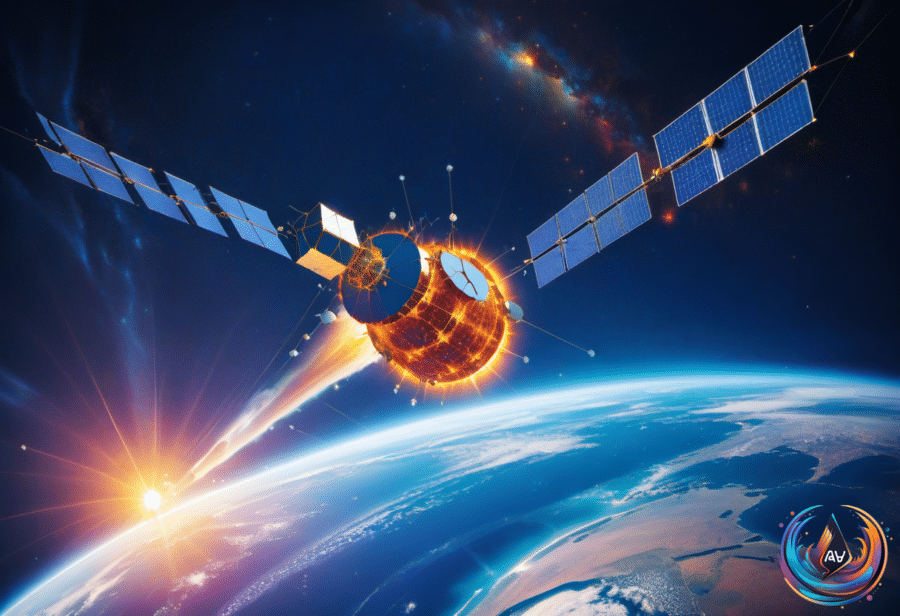
SpaceX just received permission to build a data center in orbit.
The Federal Communications Commission approved the company’s request to deploy up to 1 million satellites for Starmind, an AI orbital data center constellation. The decision came Wednesday despite objections from Amazon, Viasat, the American Astronomical Society, scientists, and industry experts who raised concerns about orbital debris, congestion, radiofrequency interference, environmental consequences, and the night sky.
SpaceX filed its application at the beginning of the year, describing Starmind as a better alternative to ground-based data centers. In its filing, the company argued that “orbital data centers are the most efficient way to meet the accelerating demand for AI computing power” because they use “solar power with little operating and maintenance costs.”
The FCC called the satellites “orbital compute modules” and said they would process massive amounts of data for use on Earth. The agency said the constellation could bring humans closer to harnessing “the full power of the sun,” which is the sort of phrase that arrives wearing a cape.
A long runway to an enormous constellation
Under the authorization, SpaceX can deploy satellites across orbital layers spanning 50 kilometers, at altitudes between 500 meters and 1,002 kilometers. The company must place at least one authorized satellite into its assigned orbit by November 25, 2033, then reach 100,000 satellites by November 25, 2035.
The authorization also lists a 500,000-satellite milestone for November 25, 2028 and requires all 1 million satellites to reach their assigned orbits no later than November 25, 2040. The schedule gives SpaceX seven years to get its first operational satellite into orbit and 14 years to deploy the full constellation, while Elon Musk has said launches will begin in 2027.
The satellites would use high-speed lasers to communicate with one another, including through SpaceX’s Starlink system. The FCC also authorized radiofrequency communications to maintain contact with and control the orbital data centers if their primary communication systems fail, and SpaceX plans to produce the chips at an upcoming Terafab facility.
Approval does not make orbital data centers imminent. SpaceX still faces the cost of manufacturing and launching 1 million satellites, cooling processors in space, financing chips destined for orbit, and clearing other regulatory hurdles. The company has also not received approval for its plan to handle satellites operating above 600 kilometers.
Existing FCC rules require satellites ending missions below 2,000 kilometers to reenter Earth’s atmosphere within five years. SpaceX asked to move some retired satellites into other orbits around Earth or even around the sun, but the FCC deferred that request, saying the company had not provided “sufficient information” about its disposal plans.
Opposition focuses on debris and astronomy
The FCC said Starmind operates consistently with its orbital debris rules and that deploying the satellites “serves the public interest.” It received a “substantial number” of public comments, including petitions to deny from Kuiper Systems, Viasat, and the American Astronomical Society, but dismissed concerns outside its authority, including environmental issues and the effects on “optical astronomy.”
Amazon called Starmind a “lofty ambition rather than a real plan” in a March petition and warned that it “risks real harm.” The company declined to comment on the approval. The American Astronomical Society said it was “disheartened and dismayed,” arguing that larger, brighter, and more numerous objects in low Earth orbit could undermine federal investment in astronomical facilities and “the ability of astronomers and the public to enjoy and study the night sky.”
Earthjustice senior attorney Jan Hasselman criticized the FCC for issuing the decision during a holiday week without an environmental review, which he said the National Environmental Policy Act required. Astrophysicist Adam Becker offered a simpler verdict: “it’s not going to happen.”
FCC Chairman Brendan Carr described the approval as a “bold new frontier” for computing infrastructure and said America was “leading the world into the era of super intelligence.” Musk replied, “Much appreciated. This will be a great asset to America and the world.”
SpaceX is not alone in chasing orbital computing. Google announced Project Suncatcher as a “moonshot to put AI in space” and launched its first chips into space on a SpaceX rocket and Planet Labs satellite in October. Blue Origin has petitioned the FCC to launch up to 51,600 satellites for Project Sunrise, which would work with its planned TeraWave service, while its first dedicated heavy-lift launch for Project Suncatcher is scheduled for 2029.
The race has begun on paper. The harder part is putting a million computers in orbit without turning the sky into infrastructure—or the infrastructure into debris.
Based on
- SpaceX gets FCC approval to deploy 1 million satellites for its AI orbital data center — engadget.com
- FCC says SpaceX can deploy 1 million satellites for data centers in space : NPR — npr.org
- SpaceX wins FCC approval for 1 million orbital data center satellites — cnbc.com
- FCC approves SpaceX plan to put AI data centers in space | TechCrunch — techcrunch.com
- FCC signs off on SpaceX’s plan to put up to 1 million data center satellites into space | The Verge — theverge.com