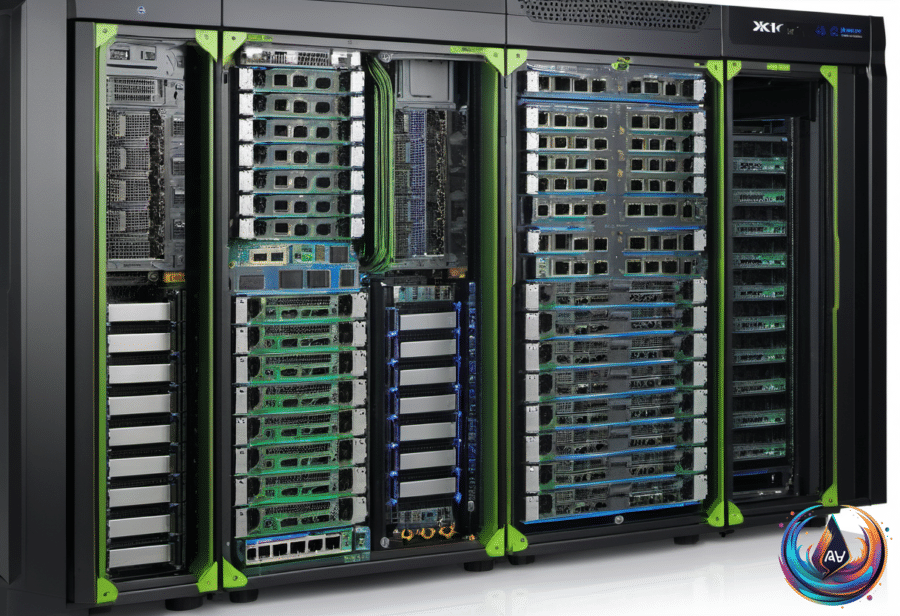
Google has added two new systems to its eighth-generation accelerator lineup: TPU 8tx and TPU 8i Max. Announced on November 9, 2026, the systems address two different problems in modern AI infrastructure—keeping sensitive workloads protected during computation and handling models with enormous context windows.
TPU 8tx targets confidential inference and small-scale training, while TPU 8i Max is built for massive context windows and higher rack density. Google said the additions make 2026 the first year in which it has introduced four TPU systems, following the arrival of TPU 8i and TPU 8t at Google Cloud Next on April 22, 2026.
TPU 8tx Keeps Private Data Inside One System
TPU 8tx is designed for regulated enterprises and governments running frontier or proprietary models, along with autonomous agents that work beside sensitive data. Its focus is confidential computing, where the goal is to protect information even while an AI system actively processes it.
The challenge starts with a gap in conventional encryption. Information can remain encrypted at rest and in transit, but computation requires it to be decrypted in memory. TPU 8tx is intended to keep sensitive data and model weights isolated during that active processing stage.
The system uses the same silicon as the training-focused TPU 8t, then pairs it with 5th Generation AMD EPYC CPU hosts. It also adopts the low-latency Boardfly network developed for real-time reasoning. Google reports up to 2x lower latency than TPU 8t, with almost no offsetting performance loss.
AMD announced that 5th Gen AMD EPYC processors power the host infrastructure for Google Cloud TPU 8tx. AMD describes its EPYC processors as the host CPU of choice across more than 10 leading hyperscalers and frontier AI labs, spanning GPUs and custom AI accelerator ASICs.
That combination gives organizations one system for running and customizing models. Teams can fine-tune models on private data, distill larger models into smaller ones and train agents through reinforcement learning, while keeping private information on the same system instead of transferring it between separate clusters.
TPU 8i Max Doubles Key Memory Resources
TPU 8i Max targets workloads where memory bandwidth becomes the bottleneck. Google points to scenarios in which dozens of agents work across a complete software codebase or hours of video at the same time, creating large demands for data access and context.
Google’s answer is a single package containing two low-latency TPU 8i chips. The package delivers double the compute, double the on-chip SRAM and double the high-bandwidth memory (HBM) bandwidth of TPU 8i, while fitting within the existing rack footprint.
The underlying TPU 8i design pairs 288 GB of high-bandwidth memory with 384 MB of on-chip SRAM. Those figures provide the baseline for the memory resources that 8i Max scales. By placing more capability in the same rack space, the package allows data centers to deploy more computing power per square foot and per watt for context-heavy workloads.
TPU 8i and TPU 8t serve different roles in the eighth-generation lineup. Google introduced TPU 8i for real-time reasoning and TPU 8t for large-scale training at Google Cloud Next on April 22, 2026. The new systems extend those designs toward confidential processing, small-scale training and workloads that require large context windows.
Google Treats Systems as Flexible AI Building Blocks
Google distinguishes these launches from the arrival of new base chips. A new chip requires billions of transistors to be laid out through a multi-year design and manufacturing cycle. A system instead determines how compute, networking, storage, packaging and security come together around that silicon.
Google’s modular AI Hypercomputer approach treats TPUs as building blocks. Engineers can adjust memory, optical networking, packaging and security for specific workloads, and Google said they can deliver specialized supercomputers in months rather than the years required for new silicon.
That approach also explains why TPU 8tx and TPU 8i Max can target different needs without becoming entirely new chip designs. TPU 8tx combines TPU 8t silicon with AMD EPYC hosts and the Boardfly network, while TPU 8i Max combines two TPU 8i chips in a package designed for more memory resources and higher rack density.
The broader TPU business spans Google Cloud infrastructure and deployments in customers’ own data centers. Google put its TPU customer count at nearly 100 across frontier labs, trading firms, retailers and universities, giving the company a customer base that reaches beyond one type of AI workload.
Together, the announcements show Google expanding its eighth-generation portfolio through system design as well as silicon. TPU 8tx focuses on protecting models and data during computation, while TPU 8i Max focuses on feeding context-heavy workloads with more compute and memory inside the existing rack footprint.
Based on
- Google Adds TPU 8Tx and TPU 8I Max to Eighth-Generation Lineup — unite.ai
- Google announced two new versions of its eighth-gen AI chips. | The Verge — theverge.com
- AMD EPYC Expands Its Leadership at the Foundation of AI | Markets Insider — markets.businessinsider.com
- AI Infrastructure: GPU, Cloud & Compute | VentureBeat — venturebeat.com
- What matters most in the AI race — edition.cnn.com