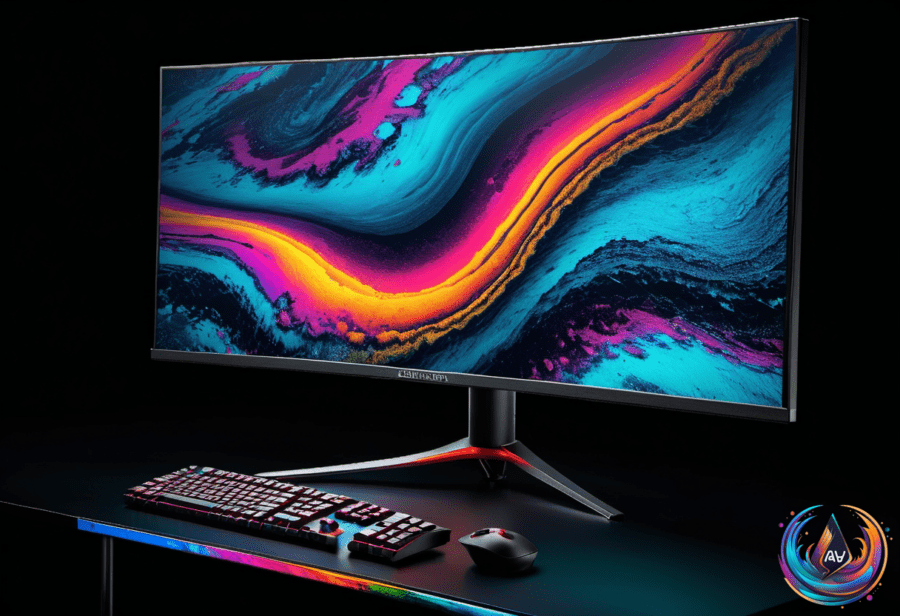
The gaming monitor race has entered a thrilling new phase: sharper OLED images, faster refresh rates, and display modes built for completely different kinds of play. Alienware, Asus, ASUS, and LG are pushing premium screens toward a future where one monitor can serve cinematic games, competitive esports, creative work, and everything between.
The Alienware 39 5K stands at the center of that shift, pairing a 5K ultrawide OLED panel with a switchable 330Hz mode. But it is not alone. Asus is bringing 4K OLED to 240Hz, ASUS is targeting esports players with panels reaching 720Hz, and LG is preparing a 1000Hz display.
Alienware Builds One Monitor For Multiple Kinds Of Play
Alienware’s 39-inch 5K ultrawide monitor aims at a rare balance between immersive image quality and competitive speed. Its native mode runs at 5K and 165Hz, giving games and other content a wide, detailed canvas. Switch to 2,560 by 1,080 pixels, and the refresh rate rises to 330Hz.
The monitor also supports several other resolution modes, including standard 4K at 165Hz, plus 24.5-inch mode at 1,520 by 855 and 27-inch mode at 1,680 by 945, both at 330Hz. That range lets the display move from a large ultrawide experience to a smaller competitive format without requiring a second monitor.
“If I had to pick one monitor to use for the next ten years, it would be Alienware’s new 39-inch 5K ultrawide display,” Devindra Hardawar said. That long-term appeal starts with the panel, which uses LG’s latest four-stack tandem OLED technology and a three-subpixel RGB stripe.
“The display is what really makes the Alienware 39 5K special,” Hardawar said. The RGB stripe is meant to deliver sharper text than earlier WOLED, or white OLED, panels, which often display purple fringing around letters.
Color and HDR push the screen beyond gaming. The Alienware 39 5K covers 99 percent of the DCI-P3 color gamut, a level Hardawar called accurate enough for professional video and photo work. HDR brightness ranges from 500 to 1,300 nits, and Dolby Vision support adds another path for HDR content.
Alienware also built in protection against OLED burn-in, including a polarizer layer and a sensor for ambient light and user presence detection. The plastic case uses a simple design, while height and tilt adjustment help users position the large screen.
Connectivity includes two HDMI 2.1 ports, one DisplayPort 2.1, one USB-C port with DisplayPort input, three USB-A 3.2 Gen 1 ports, and one USB-B port. Motion blur is minimal, and small objects are easy to make out.
Asus Pushes 4K OLED Toward Flagship Status
The Asus ROG Swift RGB Stripe OLED PG27UCWM takes a different route, placing a 26.5-inch 4K OLED panel at the heart of a 240Hz gaming monitor. Its native resolution is 3840 x 2160, with a pixel density of about 165 pixels per inch, so sharpness remains a major part of the package.
For faster competition, its dual-mode feature switches to 1080p at 480Hz. The display also supports AMD FreeSync Premium Pro, Nvidia G-Sync, and VESA Adaptive Sync, giving it broad support for smoother gameplay across compatible systems.
The high-gloss TrueBlack finish covers 94 percent of DCI-P3 and 89 percent of AdobeRGB. HDR support includes VESA DisplayHDR 400 True Black certification, brightness up to 800 nits, and Dolby Vision HDR.
“The PG27UCWM’s overall image quality is in the upper tier,” Hardawar said. He also said it performs much better than least expensive OLED monitors like the entry-level Alienware AW2726DM, which can only deliver roughly 400 nits in HDR. “The PG27UCWM is worth consideration if you want a flagship 27-inch 4K OLED monitor with the latest.”
The monitor includes two HDMI 2.1 ports, one DisplayPort 2.1, and one USB-C port with 90 watts of power delivery. Its wide stand base supports height, tilt, swivel, and pivot adjustments, while VESA mounting offers another setup option. An ambient light sensor and OLED burn-in reduction features add protection for long-term use.
Priced at $1,200, the PG27UCWM targets buyers who want top-end 4K OLED performance in a compact display.
Esports Monitors Are Chasing 720Hz And 1000Hz
ASUS is also building a separate Ace line for esports-focused gaming monitors, with 24.5-inch high-refresh-rate OLED panels. The ROG Swift OLED PG259QWS Ace reaches 720Hz with a Tandem 1080p WOLED panel, peak brightness up to 1,700 nits, and Dolby Vision support.
That model includes a “Position Sensor” that measures height and tilt, then displays those stats onscreen. It is a small but unusual addition for players who want repeatable monitor positioning during competition.
The ASUS XG259QDPG Ace reaches 560Hz and uses ASUS’ “BlackShield” film with an anti-glare coating. ASUS says the design can improve perceived black levels by “up to 40 percent.” The ASUS XG259QDNS Ace reaches 360Hz, also includes the “BlackShield” film and anti-glare coating, and offers a more affordable option.
The ASUS Ace monitors are scheduled for early Q4 2026. The PG259QWS Ace is priced at $1,099, while the XG259QDNS Ace costs $699.
LG is taking the refresh-rate contest even further with the 24.5-inch UltraGear 25G590B. It supports a native 1000Hz refresh rate at 1920 x 1080 resolution, costs $1,000, and is available for preorder starting today. LG expects it to ship as early as September 3rd, 2026.
These displays point toward a divided but exciting monitor future. The Alienware 39 5K treats one screen as a flexible all-purpose machine, Asus turns 4K OLED into a 240Hz flagship, and ASUS and LG chase extreme refresh rates for esports. The sweet spot is no longer one fixed specification; it is the freedom to choose whether the next game should look wider, sharper, brighter, or faster.
Based on