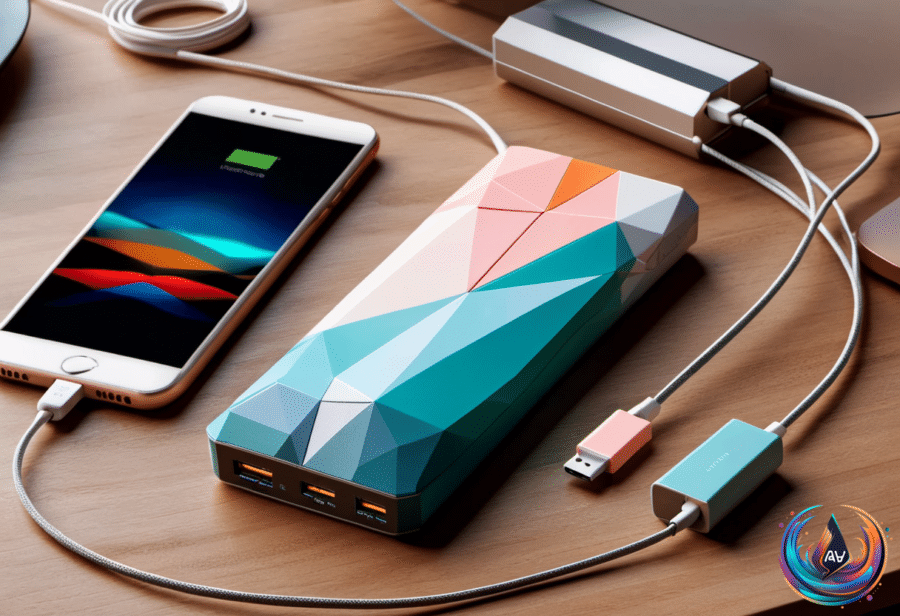
A 20,000 mAh power bank can look like a simple number, but that number becomes much more useful when it meets a phone, laptop, or handheld console. In theory, it delivers 20,000 milliamps of current for an hour; in practice, the result depends on the device drawing power and the bank’s usable energy.
That is the key to understanding how long it lasts. A 20,000 mAh unit can deliver several phone charges, one to one and a half Steam Deck charges, or a partial laptop refill, turning one battery pack into very different tools.
What 20,000 mAh Actually Stores
Most power banks store energy in lithium-ion cells at about 3.7 volts. At that voltage, a 20,000 mAh power bank stores roughly 74 Wh of energy. The same calculation places a 10,000 mAh power bank at roughly 37Wh, giving a clearer comparison between common capacities.
The 20,000 mAh figure describes the battery’s capacity, while watt-hours show the amount of stored energy. That distinction matters because devices do not all use power at the same rate. A phone, laptop, and handheld console can draw different amounts from the same bank, so each one receives a different number of charges.
The stated capacity does not always equal the energy available to a connected device. A 20,000 mAh 45W USB-C bank has an effective capacity of approximately 52Wh after 30 percent overhead. That makes the watt-hour figure, the output wattage, and the device’s own battery size important when estimating real use.
Phone and Handheld Charging Results
For an Apple iPhone 17, a 20,000 mAh power bank can provide between three and four full charges. That is a huge reserve for a phone, especially when the goal is to keep one device running through repeated charging cycles.
The Apple iPhone 17 Pro Max draws the total lower: the same power bank can provide two to three charges. The difference shows why capacity alone cannot promise one fixed runtime. Device battery size changes the answer, even when the power bank stays the same.
A Steam Deck lands in another range. A 20,000 mAh power bank can provide one to one and a half charges, so it works as a substantial extension rather than an endless supply. The bank still adds useful play time, but the larger device consumes its stored energy faster than a phone does.
- Apple iPhone 17: three to four full charges
- Apple iPhone 17 Pro Max: two to three charges
- Steam Deck: one to one and a half charges
Those figures make the main trade-off easy to see: one capacity supports multiple phone refills, yet the same capacity covers less of a larger device’s battery.
What It Means for Laptops
Laptop charging brings a tougher test. A MacBook’s battery capacity ranges from approximately 37Wh to 100Wh, while a 20,000 mAh power bank stores roughly 74Wh. That makes the bank a reasonable emergency or partial-charge option, but it does not guarantee a full MacBook top-up.
A 10,000 mAh, or 37Wh, power bank will not fully top up most MacBook batteries. A 27,000 mAh/100Wh power bank is closer to the ideal size for laptop charging needs, putting its capacity closer to the upper end of the MacBook range.
The clearest runtime estimate comes from a laptop using 14W on average. A 20,000 mAh/74Wh power bank can extend that laptop’s runtime by around 3.7 hours. A 70Wh battery, by comparison, runs for about 5 hours when it averages 14W of power usage, showing how much runtime a known wattage can represent.
That extension depends on the bank keeping pace with the laptop. A proper laptop power bank should store enough energy and charge faster than the battery drains. A high capacity number alone does not settle the question: output capacity depends on the wattage the bank can deliver.
A 50,000 mAh battery is considered large capacity, but its output capacity still depends on the wattage it can deliver. Bigger storage does not automatically mean a better laptop charger if the output cannot keep up with the computer.
Portability, Travel, and Smaller Options
There is a physical cost to carrying more stored energy. 20,000 mAh power banks tend to be chunky and are considered unwieldy for most pockets, even though they fit situations that demand several charges or emergency laptop power.
For short phone boosts, the Clutch power bank takes the opposite approach. It has a capacity of 5000mAh, weighs 3.7oz, is three credit cards thick, and includes an integrated USB-C cable. It is designed for quick boosts and small enough to be easily portable.
The Clutch’s smaller capacity makes its role clear: it is a portable quick-boost option, while a 20,000 mAh bank is built around a larger reserve. The choice comes down to whether the priority is compact carrying or repeated charging.
Travel adds another limit. In the US, 100Wh is the limit for power banks allowed on a plane without approval. That places a 27,000 mAh/100Wh power bank at an important boundary for laptop charging needs, while a 20,000 mAh/74Wh bank remains below that stated limit.
A 20,000 mAh power bank lasts as long as its stored energy allows for the device connected to it: three to four iPhone 17 charges, two to three iPhone 17 Pro Max charges, one to one and a half Steam Deck charges, or around 3.7 hours of extra laptop runtime at 14W. Match the watt-hours and output to the device, and the capacity number becomes a practical forecast instead of a mystery.
Based on