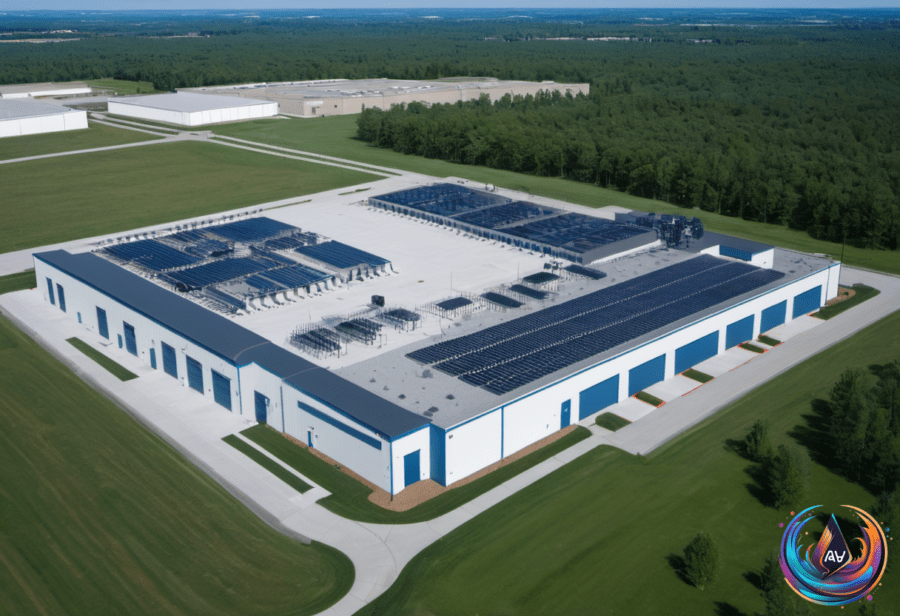
The fire exposed a data center built on unfinished promises. A blaze broke out in a still-unfinished building at the $3.2 billion Lake Mariner data center in Somerset, New York, revealing gaps in fire protection, emergency planning, ownership, and job commitments. The facility is tied to TeraWulf, Fluidstack, Google, and a corporate structure that puts the project’s responsibilities under a bright and uncomfortable light.
Firefighters found no working alarm, no suppression system, and three dead hydrants at the site. Safety documents were reported burned in the fire, leaving crews without basic information about the materials inside the building.
Steve Matisz, chief of the Barker Fire Department, said his crew went into the building “kind of blind,” facing heavy black smoke from chemicals they could not identify because the safety sheets had burned up. “It’s been a difficult situation,” Matisz said.
TeraWulf owns and operates the data center on land leased from Somerset Operating Company LLC, a company owned 99.9% by TeraWulf CEO Paul Prager. Fluidstack, a UK-based AI company, will run the center, while Google holds warrants for a future 14 percent equity stake and has agreed to guarantee Fluidstack’s lease payments.
Safety fixes arrived after the fire
TeraWulf is responsible for operational safety and emergency preparedness at the Lake Mariner Data Campus. After an after-action review, the company implemented Knox boxes, additional hydrants, and safety data sheet “go-bags.” A Knox box representative had visited the site, and a meeting was scheduled to build out that program.
The paperwork improved. The water situation did not. “As far as I know, [they] are still dry… I haven’t seen work done on them,” Matisz said in mid-August 2024.
That detail matters because the project would draw up to 500 megawatts when operating at scale. A site with that demand cannot treat emergency infrastructure as a finishing touch, especially when construction is still underway and firefighters are entering through heavy smoke without reliable information about the hazards.
Big power demand, small permanent workforce
The employment case for Lake Mariner also looks less impressive when the construction crews leave. A full buildout of the project would bring between 35 and 40 jobs, despite a 2019 promise from Somerset Operating Company that the project would create 165 permanent jobs and bring $85 million in capital investment.
The New York Power Authority reviews compliance each year and can adjust benefits if commitments are not met. Governor Kathy Hochul acknowledged the gap between the promises and actual jobs, saying, “Despite the scale of these projects and the utility demands, data centers do not deliver significant, long-term jobs.”
Pilar Thomas, a former deputy solicitor at the Department of the Interior, described the employment pattern in less diplomatic terms: “You have to be honest that it’s 600 people building the project for six, 12, 18 months, depending on how big it is. And then after that it’s three guys and a bottle of Windex… unless there’s a commitment to train up people in the local communities to take on the operations and maintenance of these data centers, which I have yet to see a data center agree to do.”
Thomas’s point reaches beyond payroll. Adding hundreds of megawatts of demand increases system costs for electricity and water supply, shifting part of the project’s burden onto the infrastructure around it while the permanent workforce remains limited.
Ownership ties add another layer
TeraWulf has also faced scrutiny over financial transactions involving entities linked to Prager. In 2023, the company paid $20.3 million in management and service fees to Beowulf E&D—about 38% of its total operating and administrative expenses that year.
In 2022, TeraWulf issued 8.5 million shares to Somerset Operating Company LLC as part of a lease amendment, valuing the shares at $11.5 million. The same company owns the land leased for Lake Mariner and is 99.9% controlled by Prager.
TeraWulf’s second-largest shareholder was an entity controlled by Bryan Pascual, who was implicated in helping Riot Blockchain’s management hide related-party transactions in 2018. Its third-largest shareholder was an entity controlled by the wife of John O’Rourke, who was charged by the SEC in a $27 million market manipulation scheme; O’Rourke has deep ties with stock promoter Barry Honig, who was barred by the SEC from participating in penny stock offerings.
The company’s environmental claims have drawn scrutiny too. TeraWulf calls itself a “zero-carbon Bitcoin miner,” but a 2024 report by Hunterbrook Media challenged that description, alleging the company could not legally substantiate its renewable energy claims without purchasing Renewable Energy Credits, which it had not done.
Prager’s energy company, Beowulf Energy LLC, revived a coal plant in Montana in 2020 to provide power for a Bitcoin mining operation. That fact sits awkwardly beside TeraWulf’s “zero-carbon” narrative—another promise that looks less durable once the infrastructure behind it comes into view.
Based on