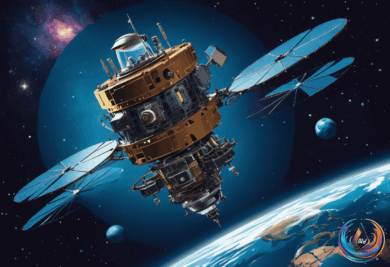
Satellites are no longer just eyes in the sky. They’re becoming smart, powerful AI workhorses orbiting Earth. For the first time ever, a satellite found what it was looking for on its own—without waiting for humans on the ground. This breakthrough is a game-changer for space tech and AI.
Satellites Smarter Than Ever
Imagine a satellite that doesn’t just snap pictures and beam raw data to Earth. Instead, it analyzes images and responds to natural language queries right in orbit. That’s exactly what Loft Orbital’s YAM-9 spacecraft does. It uses a vision-language AI model called Gemma 3, built to run on limited hardware far from Earth’s data centers.
This satellite can spot human infrastructure near natural environments or monitor railway hubs just by understanding simple language commands. No more waiting for analysts to comb through mountains of data. The AI onboard does the first pass, flagging important things instantly.
This capability opens the door to satellites that constantly patrol borders or monitor remote areas, alerting authorities only when something suspicious pops up. It’s like giving satellites their own brains in space.
Racks of Compute in Orbit
SpaceX is pushing this idea even further. Their AI1 satellite packs an entire “rack of compute in space.” Elon Musk envisions orbiting data centers powered by solar energy and fueled by next-gen AI chips. This means satellites won’t just gather data—they’ll crunch it in real time, right above our heads.
Why put data centers in space? Earth faces power limits, cooling challenges, and land shortages for building massive AI facilities. Space offers endless solar power and a vacuum that naturally dumps heat—perfect for high-powered AI processors.
SpaceX’s plan ties together reusable rockets, solar panels, and AI chips to build a sustainable compute system beyond Earth. They expect to reach gigawatts of AI compute in space within a year. That’s a massive leap for AI workloads and satellite autonomy.
Building AI Data Centers Among the Stars
Another startup, Orbital, is betting big on AI data centers in orbit. They raised $5 million to develop small, powerful satellites that work together like a giant cloud in space. Their first demonstration mission is set for 2027.
Orbital’s approach breaks the giant data center into many small satellites. Each satellite carries GPUs designed for AI inference—the fastest-growing part of AI compute demand. They aim for 100 kilowatts of compute power per satellite and dream of a constellation topping 10 gigawatts someday.
This vision is ambitious. Dumping heat in space is tough, needing huge radiators. Orbital’s distributed design helps spread out the thermal load and manufacturing challenges. But physics aside, the idea of powering AI in orbit is becoming real.
Real-Time Disaster Detection From Above
NASA is also harnessing AI in orbit for Earth’s benefit. Their AI flood detector, Prithvi, runs directly on satellites to spot floods, wildfires, and burn scars in real time. It processes massive Earth observation data right in space, cutting delays that slow disaster response.
Prithvi’s foundation model design lets NASA update it remotely with new capabilities using tiny software packages. This flexibility means the AI can learn new tasks without needing a full software overhaul. Plus, the project thrives on open-source collaboration, speeding innovation.
With NASA’s AI flood detector, we’re closer to satellites that not only watch but help us respond faster to disasters, monitor crops, and track climate changes anywhere on Earth.
What’s Next in the Space AI Revolution?
AI in space is shifting from sci-fi to everyday reality. Satellites will soon think for themselves, triage data, and run complex AI models onboard. This reduces the flood of raw data sent back to Earth and speeds up decision-making.
We’re on the cusp of a constellation era where dozens, even hundreds, of AI-powered satellites orbit Earth. They’ll monitor borders, climate, disasters, and infrastructure 24/7. They’ll enable new scientific discoveries and keep astronauts safer with AI assistants on the moon or Mars.
The biggest challenges remain power management, heat dissipation, and miniaturizing AI hardware for space. But companies are solving these puzzles step by step. The race is on to build the first truly autonomous AI data center in orbit that can power the future of exploration, defense, and environmental monitoring.
Space is no longer just the final frontier for humans. It’s becoming the next great hub for AI intelligence. The question now: how fast will this revolution take off? The stars are watching, and so are we.
Based on
- A satellite just learned to find things on its own — here’s what that means — techcrunch.com
- Inside SpaceX’s AI1 Satellite That Musk Calls ‘a Rack of Compute in Space’ — analyticsindiamag.com
- Orbital raises $5M to build AI data centres in orbit — thenextweb.com
- NASA’s AI Flood Detector: Revolutionizing Earth Observation from Orbit (2026) — opensprings.org