NTT, Inc. has announced a physics-based world model designed to check a robot’s proposed action before the robot moves. The goal is simple: catch failures such as dropped objects, collisions, and collapsing loads before they happen.
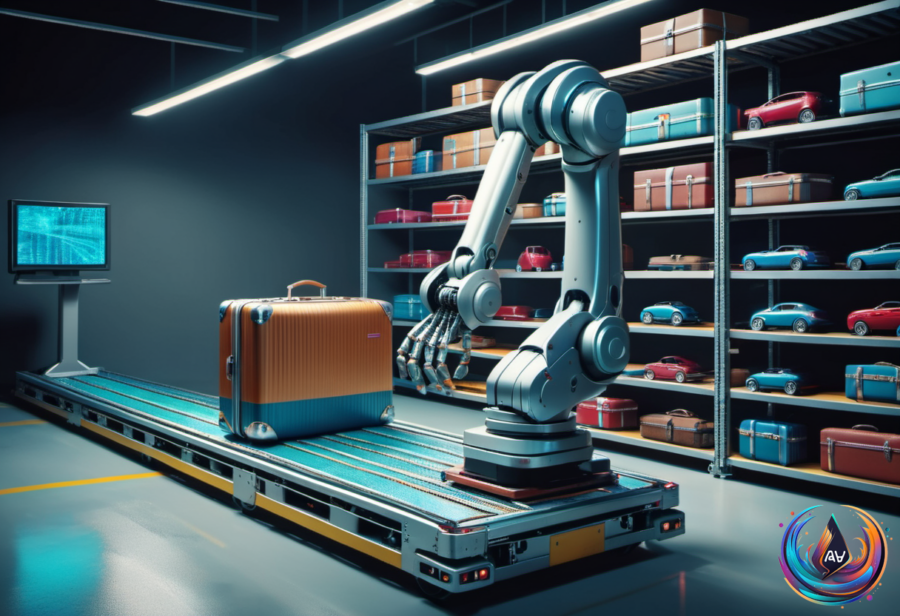
In a small-robot shelf-loading test, NTT said the system raised task success from 73.1% to 92.3%. The first planned application is automated loading and unloading of airport baggage, where luggage can vary in shape, weight, and arrangement from one item to the next.
That variation creates a problem for conventional robot control. A control system may know the movement it wants to make, but determining in advance whether that movement will drop an item or bring down a load is difficult. Collecting training data for every possible piece of luggage would also be impractical.
How the physics-based model checks each action
NTT’s technology works with existing robot control software. It adds a prediction and evaluation step before movement, giving the control program a chance to compare possible actions and select the one judged most likely to succeed.
The candidate actions can come from a vision-language-action model, which turns camera video and language instructions into robot actions. They can also come from a motion planner, which calculates the controls needed to reach a task objective. For each option, the system generates predicted video and checks for collisions, dropped objects, and load collapse before producing a score.
The key difference is how the model handles physical information. NTT says conventional world models do not represent objects’ physical quantities in a clear way, which can lead to disappearing or implausibly deforming objects in generated video. Those errors can also produce inaccurate collision predictions, while reliance on large training datasets can leave systems vulnerable to situations missing from the data.
NTT’s physics control adapter estimates each object’s position, orientation, velocity, and mass from video. It then applies physical laws to calculate what happens next and supplies those calculations to the video generation model. NTT says this approach can address situations and motions absent from the training data, while also showing the physical quantities behind a prediction so people can better understand its basis.
The company tested future-video accuracy on OBJ3D, a public benchmark containing video frames of synthetic objects colliding. NTT said its model outperformed conventional methods on Learned Perceptual Image Patch Similarity, or LPIPS. The metric compares predicted video with ground truth in a way aligned with human perception, with lower values indicating greater similarity.
A different answer to robotics’ data problem
NTT’s approach arrives as robotics companies invest heavily in the belief that enough data will solve the hardest problems in robotics. The idea is that once AI systems absorb enough demonstrations from people, robots will perform most manual tasks humans now do. Some companies even focus only on collecting training data and selling it to other robotics companies.
Whether data alone can deliver general-purpose robots remains an open question. Nobody knows how much data would be necessary, which data matters most, or whether something else is missing. The algorithms can also be difficult or impossible for people to understand, a concern for commercial robots that must be flexible, reliable, and safe.
Ken Goldberg, a professor of robotics at UC Berkeley, says, “The imitation learning paradigm has hit a plateau.” He describes imitation learning as promising for home robots, where speed and reliability matter less, but says industrial applications demand a higher level of reliability. “You get good performance from data initially, but then things go wrong,” Goldberg says. “It’s not clear that adding more data is going to get you there.”
At the 2026 Conference on Robot Learning, UC Berkeley and NVIDIA are jointly announcing an approach called agentic robotics. It uses AI coding tools to create human-readable robot programs, returning to a model-based tradition in which engineers built systems around the physics and mathematics of a robot and its environment.
Those older systems could operate fast and reliably, but they required human time and expertise. Agentic robotics aims to use language models to work with existing tools, break tasks into smaller steps, write and test code in simulation, and modify the result. In UC Berkeley testing, the approach reached success rates of up to 99 percent, compared with 20 percent for baseline imitation learning techniques.
Spencer Huang, NVIDIA’s Director of Product for Robotics, said agents can help retask robots for practical industrial work. At Wistron in Taiwan, adding a new product takes a minimum of 8 hours to retask one robot, Huang said, while agentic robotics reduces that to a minute or two. He also said semiconductor partners need component placement within 0.3 mm, a requirement that NVIDIA’s GR00T platform cannot meet with repeatability and robustness today.
The two approaches are not rivals in every setting. NTT’s system checks proposed movement through physical prediction, while agentic robotics focuses on generating and coordinating robot code. Both respond to limits in systems that depend only on demonstrations, and both raise questions about how people can verify an AI-generated decision before a machine acts.
From baggage handling to wider industry
NTT plans field trials with Mujin, Inc. for baggage handling. Beyond baggage and parcel handling, the company plans to explore logistics, warehousing, manufacturing, construction, and retail applications, including possible work with robot service providers and logistics and warehousing companies.
Reduced labor requirements and improved productivity are objectives for that expansion, not results established by the shelf-loading test. The reported result shows a rise in task success for one small-robot evaluation, while field trials will test how the system performs in working environments.
The technology is scheduled for exhibition at NTT R&D Forum 2026, an invitation-only event running November 18–20, 2026, and November 24–25, 2026. A November 25 seminar on AI robotics and the physics-informed world model lists Mujin Japan CEO Isamu Arase and NTT executive research engineer Jun Shi.
The wider robotics race is also on display elsewhere. The World Internet Conference Wuzhen Summit in Wuzhen, a canal town in eastern China, concluded on Nov 5. At the “Light of Internet” Expo, Unitree Robotics, AgiBot, and UBTECH showed robots aimed at bringing the technology closer to everyday life, including Unitree Robotics’ GD01, a machine designed for emergency-response scenarios. American content creator Evan Kail posed for a photo with the GD01.
For NTT, the central bet is that robots need more than a large library of examples. They also need a way to test what their actions mean in the physical world before taking those actions.
Based on