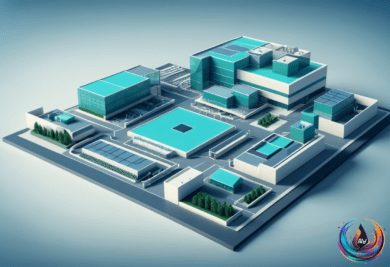
Samsung is betting its next lead on a semiconductor complex in Pyeongtaek. The South Korean company is building a manufacturing hub designed to meet memory-chip demand driven by AI applications. Three fabs already operate around the clock, and a fourth is coming online.
The complex covers an area about the size of New York City’s Central Park, giving Samsung room to expand its push into the AI memory boom. Its new fabs are built to support demand from AI applications, where memory chips form part of the hardware needed to run those systems.
Samsung halted construction of a fifth fab during a drop in memory-chip demand in 2024. Then demand surged because of the AI boom, and construction restarted. Nothing focuses a semiconductor company quite like customers suddenly wanting more chips.
A construction pause becomes a memory-chip bet
Samsung predicts that demand for memory chips will continue to surge through 2028. That forecast gives the Pyeongtaek build-out a clear purpose: reclaim the company’s lead on memory chips by adding manufacturing capacity when AI demand is reshaping the market.
The strategy also places Samsung in a contest with SK Hynix, its domestic rival in the memory-chip market. TSMC, the Taiwanese chipmaker with a foundry business, is part of the wider semiconductor landscape, but Pyeongtaek centers on Samsung’s effort to strengthen its position in memory.
The project’s scale is matched by a visual identity that refuses to hide in the background. Samsung’s fabs are clad in Mondrian-style panels of red, yellow, and blue, turning a giant industrial complex into something that looks as if a semiconductor plant has developed opinions about interior design.
The people building the capacity
Construction at Pyeongtaek depends on workers who keep the expansion moving as Samsung brings new fabs online. Choi Hye-rin, a safety officer at Samsung’s fab site, is paid 140,000 won ($97) a day.
“The rate here is higher than other construction sites, and the work is relatively easy,” Choi Hye-rin said. The pay figure offers a small view of the labor behind a project measured in fabs, forecasts, and AI demand rather than ordinary construction-site terms.
Choi also described the routine in four words: “You just keep coming back.” It is a fitting summary for a complex that already runs three fabs around the clock, prepares a fourth to come online, and has restarted work on a fifth after the 2024 slowdown.
Samsung’s Pyeongtaek expansion is therefore more than a collection of new buildings. It is a long-term response to the company’s prediction that memory-chip demand will surge through 2028, with the AI boom providing the pressure behind the restart.
The timing carries risk, because Samsung paused the fifth fab when demand fell. But the company has chosen to build for the next demand cycle, betting that AI applications will keep memory chips moving from a temporary opportunity to the center of its manufacturing strategy.
Based on