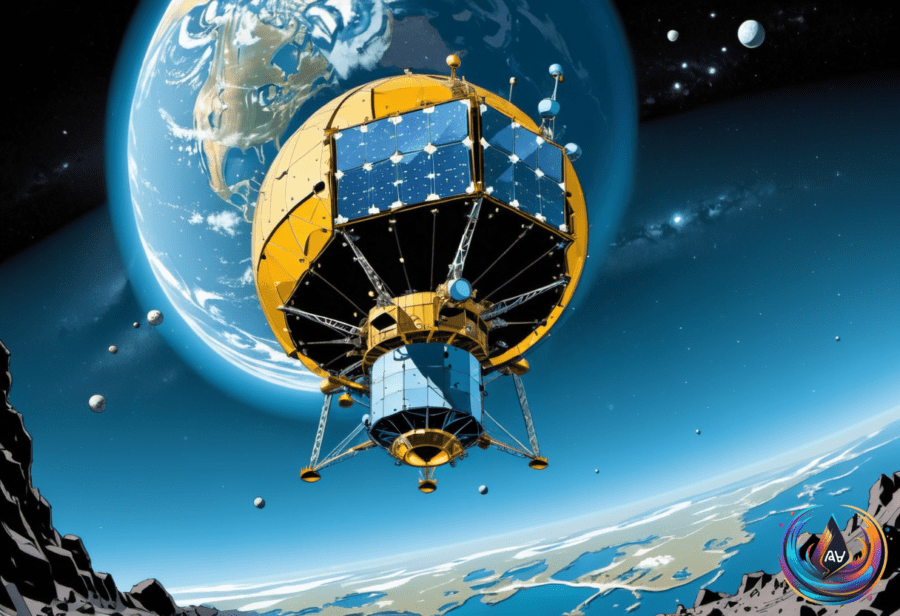
Space mirrors are preparing to make the night sky everyone’s problem. Later this year, Reflect Orbital plans to launch a test satellite carrying an 18-by-18-meter mirror that will extend in orbit, with the company aiming for a future fleet of up to 50,000 larger satellites.
Reflect Orbital says the mirrors could reflect sunlight to Earth on demand, extending the time available for solar panel charging, emergency response, and military activities. The practical pitch is easy to understand: put sunlight where it is needed, when it is needed.
The unwanted side effect may be harder to sell. New research suggests the giant beams could shine as bright as 10,000 full moons and scatter light over tens of kilometers, brightening the night sky for many more people than intended. Humanity spent centuries trying to control darkness; now it may need regulations for artificial daylight from orbit.
AI Can Discover a Drug, But It Cannot Be an Inventor
Insilico Medicine used computer models to propose a promising drug for pulmonary fibrosis and claimed the molecule had been “discovered by” generative AI. When the company filed a patent, however, it named five humans as the drug’s “inventors” and made no mention of AI.
That split is not a contradiction in the paperwork. Patent law says humans—and only humans—can take credit for inventions, no matter how fundamental an AI system was to the discovery. The machine can generate the candidate; the humans get the legal status, the signatures, and the future argument over who did what.
The question is becoming harder to avoid because AI use now reaches far beyond obvious chatbot output. A new study suggests that 90% of biomedical papers show signs of AI use, while a third of new web pages involve AI authorship. The internet is filling with machine-assisted work faster than institutions can agree on how to label it.
Moon Missions, Drone Politics, and One Expensive Castle
China plans to make the first landing at the moon’s south pole this year with the Chang’e 7 mission. The mission will hunt for lunar ice and deploy robotic landers, rovers, and “hopping” probes—an ambitious lunar toolkit aimed at a region that may matter to future exploration.
Research into aging offers a different kind of frontier. It estimates that humans could live for 194 years if every theoretically curable cause of aging were cured. That is less a promise than a reminder that the phrase “curable causes” is doing a remarkable amount of work.
On Earth, Mark Zuckerberg has bought an Irish castle and a 440-acre estate, with the reported price reaching up to €30 million. The purchase adds an old-world property to a technology story otherwise crowded with orbital hardware, lunar robots, and computational biology.
Military technology remains part of the same churn. Musk is associated with approval to use Starlink-equipped drones in Russia, while Kyiv is interested in AI-guided drones. The details here are stark: satellite connectivity, autonomous systems, and battlefield decisions now occupy the same technological space.
Even the surrounding commentary has acquired its own strange theater. Darth Vader—or, at least, a man in his costume—said: “The emperor is a fan of Flock, and we must continue utilizing Flock technologies so that we can follow and surveil the rebel scum.” The quote is absurd on its face, but surveillance technology rarely needs much help sounding dystopian.
Taken together, these developments point to a technology sector expanding in every direction at once. Space companies want to reshape daylight, AI systems are entering scientific authorship, China is targeting lunar ice, and patent law is clinging to human inventors. Progress continues—often before anyone has finished deciding what should count as progress.