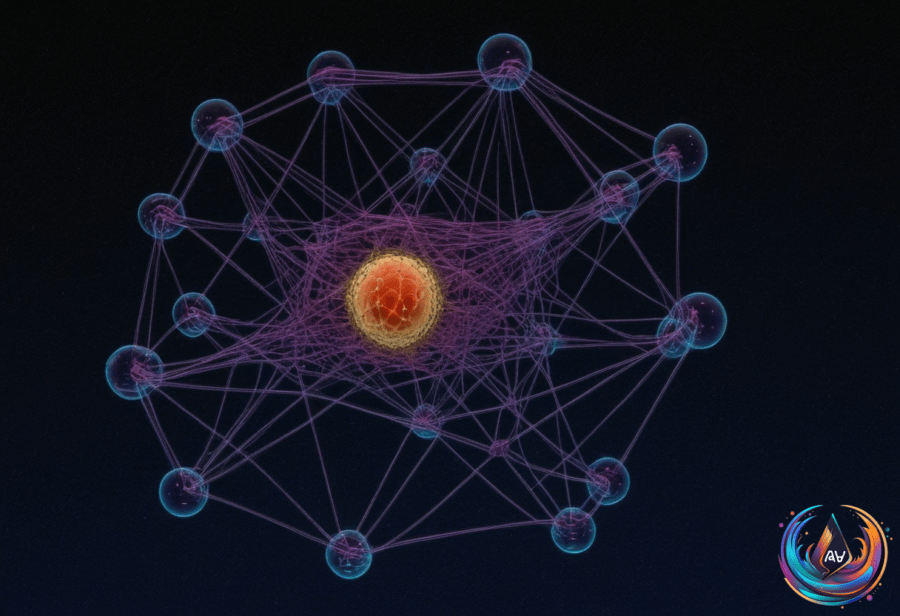
Mostik, a startup, has developed a way for AI models to communicate without using words. Instead, the models exchange mathematical values held in their weights, creating a bridge between systems with different sizes and capabilities.
The idea has already produced a working result. Mostik used its approach to build a model that ranked at the top of ARC-AGI 3, then created a connection between the largest version of GLM-5.2 and a much smaller version of Qwen-3.5.
A bridge between 753 billion and 4 billion parameters
The two models sit at opposite ends of the size range described by Mostik. The largest version of GLM-5.2 has 753 billion parameters, while the Qwen-3.5 model in the pairing has 4 billion parameters. Mostik’s system links them without asking the models to communicate through ordinary words.
That link creates a hybrid system with a striking cost advantage. It costs one-twentieth of the full GLM model, while its performance lands exactly halfway between the two models. The result does not match the largest model, but it also does not remain limited to the smaller one.
Sasha Malysheva, Mostik’s CEO, described the idea through a familiar machine-learning principle: “It’s well-known in machine learning that ensembles of models perform better than individual ones.” The startup’s approach applies that principle to models that do not share the same size or capabilities.
Malysheva compared the process to estimating the weight of a pig. “In math circles, it’s well-known that a handful of random people can more accurately estimate a pig’s weight than an expert when their guesses are combined and averaged,” she said. For Mostik, the important step is finding a mathematical way to combine what different models know.
Why model-to-model communication is difficult
AI models cannot simply be connected and expected to understand one another. Their internal weights do not automatically provide a shared language, even when the models perform related tasks.
Stanislav Smirnov, Mostik’s chief scientist, put the problem plainly: “Finding common ground between two AI models is surprisingly difficult. There seems to be no appropriate mathematical language yet.” Mostik’s system addresses that gap by working with the mathematical values inside the models rather than relying on word-based exchanges.
Smirnov also said, “Mostik’s approach is a way to quite literally bridge the gap.” That bridge matters because it allows a smaller model to work alongside a larger one, instead of forcing one system to handle every part of a task alone.
Karl Tuyls, a former Google DeepMind scientist, described the possible advantage in practical terms: “You can approach large-model quality without the large model handling the entire loop, giving you substantial improvements with just a smaller model running alongside.” The hybrid result involving GLM-5.2 and Qwen-3.5 offers a concrete example of that idea, with performance between the two models and a cost of one-twentieth of the full GLM model.
More specialized models working with larger systems
Vladimir Arustamian, tech lead at Lovable, sees the method as a way to connect broad, powerful models with systems built for narrower areas. “Mostik makes it possible to pair frontier models with domain-specific models—think biology, physics, and so on—many more specialized models would be trained,” he said.
That vision depends on the same basic challenge: creating common ground between models. A large model could be paired with a smaller system designed for a specific area, while the mathematical bridge lets their internal information move between them. The facts from Mostik’s GLM-5.2 and Qwen-3.5 test show how the arrangement can trade some performance for a much lower cost.
Mostik’s work also raises questions about what model weights represent and how separate systems can share useful information. Smirnov said the work could reveal new things about how AI models function and how their workings compare with the human brain.
Malysheva’s own path into mathematics adds a personal note to the story. “I only discovered a talent for math after my older brother told me I wouldn’t be able to solve the Math Olympiad problems he was studying,” she said.
As of Sep 2, 2026, Mostik’s method offers a clear example of AI collaboration without word-based conversation: a 753-billion-parameter model, a 4-billion-parameter model, and a mathematical connection between them. The system’s halfway performance and one-twentieth cost show why that connection matters.