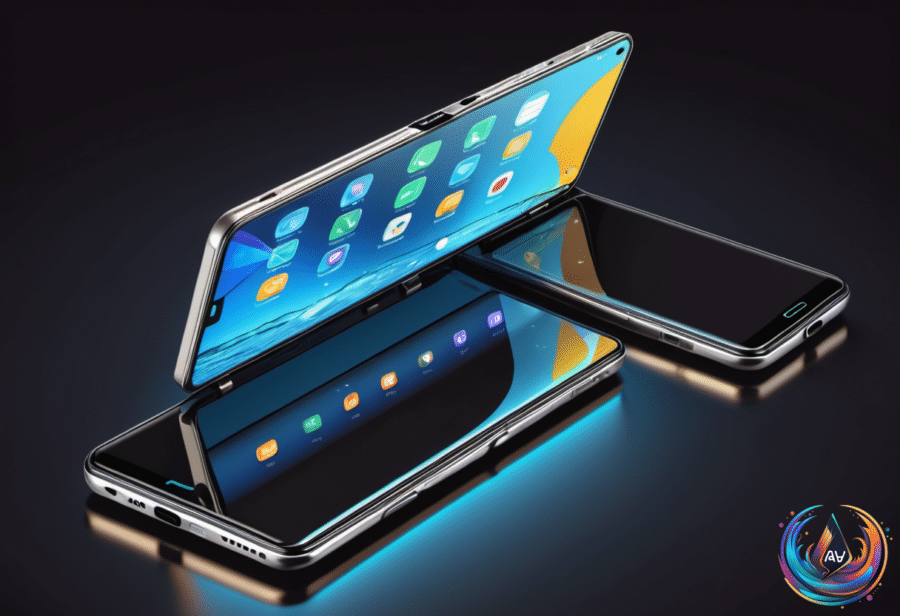
Foldable phones have outgrown the novelty act. The category began with fragile prototypes and awkward compromises, then pushed toward stronger protection, larger screens, and prices that still require serious commitment. The latest contest puts Apple’s iPhone Duo against Samsung’s Galaxy Z Fold8 and Xiaomi’s China-only 18 Fold.
The earliest landmark arrived at CES 2019, when Royole presented the FlexPai as the world’s first commercially available foldable smartphone. Royole, a Chinese display manufacturer, created a device that made the basic promise obvious: a phone could unfold into a larger screen without becoming a tablet in your pocket.
Samsung released its Galaxy Fold in February 2019, but the launch exposed the category’s weak points. Screen fragility led to delays and recalls in 2019, reminding everyone that a clever hinge does not matter much when the display cannot survive ordinary pressure.
Huawei presented the Mate X at MWC 2019 with a different design. It folded outward, and it was never sold in the United States because of sanctions imposed by Donald Trump. The hardware race had already acquired a geopolitical lane — because apparently one hinge was not enough complexity.
From fragile screens to practical protection
Between 2020 and 2025, many foldable phone models reached the market, with manufacturers improving protection against pressure, water, and dust. Samsung’s Galaxy Z Flip introduced ultra-thin glass in 2020, while the Galaxy Z Fold 3 and Z Flip 3 arrived in 2021 with IPX8 water resistance.
Those changes did not erase every compromise. Samsung’s Galaxy Z Fold 4 still faced size and camera limitations, despite a price just under $2,000. The category moved forward, but each generation kept negotiating between a larger display, a manageable body, and the cost of making both survive daily use.
Samsung’s Galaxy Z Fold8 is now the company’s latest foldable smartphone, and interest in it rose after Apple announced the iPhone Duo. Richard Chang, Samsung’s Corporate Vice President for the Mobile Division at Samsung U.K. and Ireland, put the company’s position plainly: “Samsung’s foldable momentum is undeniable.”
Apple enters with familiar pressure on the category
The iPhone Duo has a 5.4-inch outer display and a 7.6-inch inner display, matching the Xiaomi 18 Fold’s screen dimensions. Xiaomi’s outer screen adds a 120Hz refresh rate, while its peak brightness reaches 4,000 nits; the iPhone Duo reaches 3,000 nits.
Apple addresses two persistent foldable concerns with a nano-textured layer on the inner screen, designed to reduce glare and make the crease less visible. The iPhone Duo also uses a titanium frame and Ceramic Shield glass, with IP68 certification for water and dust resistance.
Xiaomi uses an aluminum frame with Shield Glass 3.0, but it has disclosed no IP rating for the Xiaomi 18 Fold. The Xiaomi model weighs 219 grams, compared with 254 grams for the iPhone Duo — a difference users will notice before any benchmark does.
Inside, Apple’s phone runs on the A20 Pro chip, built on a 2-nanometer architecture, and includes 12 GB of RAM. Xiaomi’s XRING O3 chip uses a 3-nanometer architecture, paired with 16 GB of RAM.
The camera comparison also favors different priorities. The iPhone Duo uses two 48-megapixel sensors, while the Xiaomi 18 Fold combines a 200-megapixel main sensor with two 50-megapixel sensors.
Xiaomi also offers a 6,000mAh battery, up to 67W wired charging, and 50W wireless charging. Apple has not disclosed the iPhone Duo’s battery specifications, which leaves a conspicuous gap in a phone already priced at $1,999.
The iPhone Duo runs iOS 27, with Split View multitasking, Siri AI, and Apple Pencil support. It starts at $1,999 for the 256GB model, opens for pre-orders on October 16, 2026, and goes on sale October 23, 2026.
The Xiaomi 18 Fold starts at 10,999 yuan, about $1,640, but remains China-only. That gives Xiaomi a lower starting price and a lighter body, while Apple offers stronger disclosed water and dust protection, a titanium frame, and software features tied to its broader device ecosystem.
Foldables have come a long way from the 1984 brick phone, which weighed 1.7 pounds and cost $3,995. The modern versions are thinner, smarter, and more capable — but the iPhone Duo proves the category has not abandoned the old tradition of making the future expensive.
Based on
- From the Royole FlexPai to the iPhone Duo: How the modern foldable phone has evolved — engadget.com
- Apple’s iPhone Duo Debut Drives 300% Spike In Samsung Galaxy Z Fold8 Searches — forbes.com
- iPhone Duo Vs Xiaomi 18 Fold: How These Foldables Stack Up — engadget.com
- All the news about the iPhone Duo | The Verge — theverge.com