Humanoid robots are moving into a new price range. On October 15, 2026, Faraday Future announced the joint launch of FF Nova and FF Nova Mini, bringing two compact machines into its “One Brain, Multi-forms, Multi-capabilities” FF Robot World 2.0 lineup.
FF Nova costs $2,490, while FF Nova Mini costs $299. The launch gives developers, schools, families, and educational institutions two new ways to explore Physical AI, with each robot aimed at a different point in the emerging humanoid market.
FF Nova Packs Physical AI Into A Small Frame
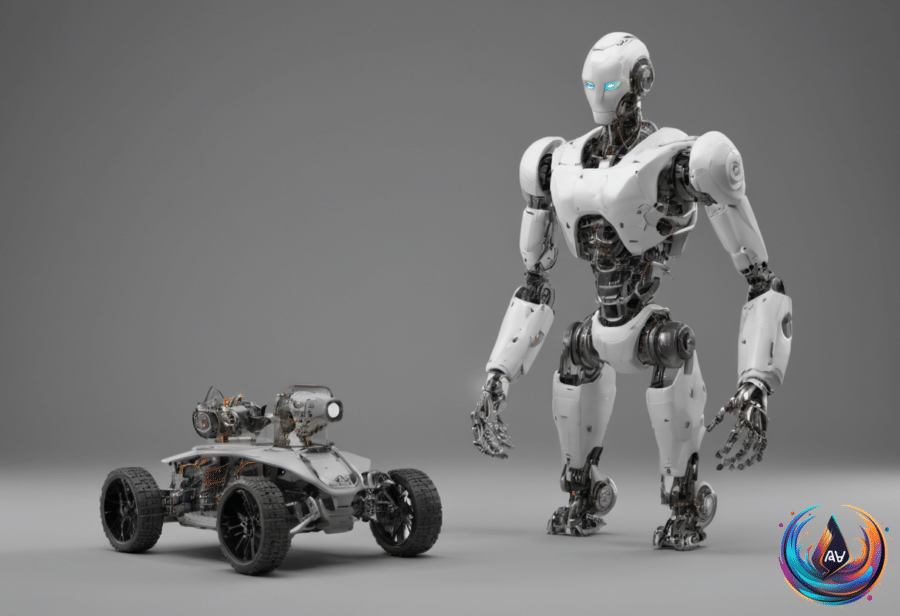
Faraday Future describes FF Nova as America’s first embodied AI humanoid robot priced below $2,500. The robot stands 49.7 centimeters tall and weighs 2.8 kilograms, but its small body supports 20 full-body degrees of freedom that allow it to move through several basic actions.
Nova can walk, turn, wave, and return to its feet after being knocked over. It offers two movement modes: bipedal walking at 0.1 meters per second, or riding a detachable wheeled base at 0.8 meters per second. The robot can also handle obstacles up to two centimeters high.
Inside, Nova runs on 10 TOPS of on-device compute with 8 GB of RAM and 32 GB of storage. Its sensor suite combines a top-mounted 2D LiDAR, a roughly four-megapixel wide-angle camera, a 3D time-of-flight sensor, and a three-microphone ring array.
Nova also includes a 2-inch, 240-by-296-pixel face display, dual-band Wi-Fi 6, and Bluetooth Low Energy 5.4. These components give the robot a compact hardware base for movement, sensing, communication, and interaction.
A Robot Platform Built For Developers
Nova connects to a large voice AI model for natural conversation and voiceprint recognition. It also supports AI Agent integration for cloud-based operation, expanding its role beyond fixed movements and into voice-driven interaction.
The developer platform includes an open SDK, a ROS 2 development workflow, and over-the-air updates. That combination positions Nova as a platform for building and testing applications, not only as a finished robot with a set list of actions.
Faraday Future is releasing Nova in phases. Phase One is a limited, invitation-only run of 100 units, and the first 20 units are ready for immediate delivery. Developers who want to apply must submit applications through developer.ff.com within a seven-day window.
The robot’s Developer Skills Package costs $390. That package adds another layer to the Nova proposition: buyers are not only receiving a physical machine, but also a path toward developing new skills through the company’s platform.
Nova Mini Targets Physical AI Education
FF Nova Mini takes a different route into the same lineup. Faraday Future describes it as America’s first foundational Physical AI education platform built around a true bipedal humanoid, and the robot costs $299.
The accompanying curriculum costs $499. Together, the robot and curriculum create an education-focused offering within the FF Robot World 2.0 lineup, giving schools and families a lower-cost entry point than Nova’s developer platform.
Jerry Wang said the launches mark “an important step for FFR in bringing Physical AI from the laboratory to real-world applications accessible to developers, educational institutions, schools, and families.”
That focus arrives as the humanoid robotics industry expands beyond research demonstrations. An October 10, 2026 article stated that about 7,000 full-size humanoids taller than 4 feet 7 inches were sold in 2025 for business use, according to the International Federation of Robotics.
Tesla, Boston Dynamics, and UBTech are also involved in humanoid development, adding to a field that now spans industrial systems, education platforms, developer tools, and consumer-facing machines. Against that backdrop, FF Nova and FF Nova Mini stand out through their compact dimensions and listed prices.
A Wider Door Into The Humanoid Robot Market
The two launches show how one robotics lineup can target different users without abandoning a shared technical direction. Nova focuses on motion, sensing, voice interaction, AI Agent integration, and developer access, while Nova Mini centers on a foundational Physical AI education platform.
The pricing gap makes the contrast clear. At $2,490, Nova sits below the $2,500 mark highlighted by Faraday Future, while the $299 Nova Mini reaches a much lower price point. The separate $390 Developer Skills Package and $499 curriculum give each robot its own supporting path.
FFR’s limited first phase will reveal how developers respond to a small humanoid with open software tools, ROS 2 support, cloud-based operation, and over-the-air updates. At the same time, Nova Mini brings the bipedal form into an education offering built for schools and families.
Physical AI is no longer presented only as a laboratory concept in this launch. With FF Nova and FF Nova Mini, Faraday Future is pushing humanoid robotics toward development, education, and everyday access—and the next phase begins with 100 invitation-only Nova units.
Based on