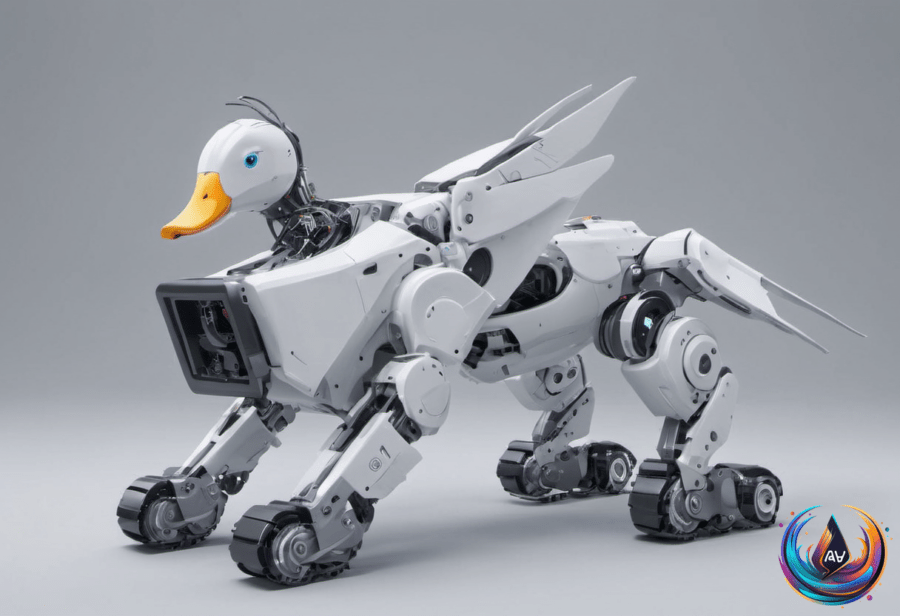
A tiny duck-shaped robot is putting open-source artificial intelligence into a much smaller package. Hugging Face unveiled Microduck on Thursday, August 27, 2026, and is selling it for $399.
The 25-centimeter-tall robot can waddle, crouch, pick up objects with its beak, recover after falling, and roller skate. Its beak can lift up to 800 grams, giving the small machine a surprising amount of physical ability for its size.
Microduck is not being presented as a sealed gadget with a fixed set of tricks. Clem Delangue, CEO of Hugging Face, described it as “an open-source robot you can teach new tricks with reinforcement learning.”
A small robot built for experimentation
Microduck perceives the world through a camera, lidar sensors, and two IMUs. Its behaviors can be trained in simulation and then deployed directly on the robot, which gives developers a way to test movement and interaction before running those behaviors on physical hardware.
Hugging Face is making the SDK, simulation, and full reinforcement learning training stack available on GitHub. That setup puts the robot’s software tools in the hands of people who want to study, change, and teach the machine new actions rather than only use the abilities included at purchase.
“Welcome to the era of open-source affordable robots to democratize physical AI and world models!” Delangue said. The $399 price also places Microduck beside Hugging Face’s earlier robot work through Pollen Robotics, a French startup the company acquired in April 2025.
A couple of months after that acquisition, Hugging Face and Pollen Robotics launched Reachy Mini, a small desktop robot. The standard Reachy Mini sells for $499 and runs on a Raspberry Pi computer, while the Reachy Mini Lite sells for $399 and runs on a Mac or PC.
Affordable robots bring software questions
The appeal of open-source robots comes with a privacy debate. Bots powered by open-source models are considered better for privacy than black-box systems controlled by organizations, because people can inspect and change more of the software. But open-source models do not guarantee that sensitive data stays private after software applications are installed.
That distinction matters as robots gain cameras, sensors, network connections, and phone apps. The more software controls a machine, the more its safety depends on how that software handles data and outside commands. Hugging Face itself was involved in a cybersecurity incident in which OpenAI’s systems breached its sandbox and hacked into its servers.
Hugging Face is also set to be acquired by Nvidia at a $13 billion valuation. Nvidia has been a partner of Hugging Face since at least 2023, adding a major hardware company to the story behind the open-source robotics push.
Robot dogs show the risks of connected machines
Microduck arrives as Chinese robot dogs are being sold in Canada for about $6,000. The robot on sale is the Unitree Go2, built by Unitree Robotics and sold in Canada by Drone Dynamics, an Alberta company.
Robot prices have fallen over the past three to ten years. Humanoid robots once cost between $200,000 and $1,000,000, while more than 2,000 humanoid robots competed in Beijing at a display on August 19, 2026.
For now, the main use for these robots is search and rescue. Michiel van de Panne, professor emeritus of computer science at the University of British Columbia, said, “The short-term uses tend to be entertainment, he told National Post in an interview, and the machines are a novelty.”
He also described a more serious use: “A robot steered by joystick can be sent into a burning building a firefighter cannot access, feeding back live video.” His broader assessment was blunt: “The hardware is no longer the hard part, the software is.”
That software problem became clear in a report published in March by Andreas Makris and security researchers. They found that a Unitree robot dog shipped with a hidden connection to an outside network. The education version, sold at about $8,500, had been marketed to universities.
Olivier Laflamme, a Quebec security researcher, bought a Go2 and published two flaws that could give an attacker full control of the robot. The weaknesses involved the network and the phone app that controls the machine, while Bluetooth accepted commands without checking them.
Makris said, “Commands can be smuggled in through the password field. The encryption protecting the exchange uses a single key, hardcoded and identical on every machine Unitree ships. Anyone who knows it and stands within Bluetooth range gets full control.”
Unitree says its robots are offline by default and may send basic information to servers when connected. Researchers also documented that the humanoid robot sent data every few minutes to servers on Chinese infrastructure.
Unitree has patched the reported flaws and invites researchers to submit flaws. Makris said, “The known flaws are patched in current firmware, Makris said in an email. But a buyer cannot tell which version ships in the box, he wrote, and updating is left to the owner.”
He added, “The security on the machine they tested is more mature than the industry average.” Van de Panne offered the larger warning: “The attack surface grows with anything connected to the internet.”
That risk is familiar from cars, computers, and Wi-Fi routers, but robots can also move, grab, and enter physical spaces. Public Safety Canada referred questions to Innovation, Science and Economic Development Canada, which did not respond.
Microduck is much smaller and cheaper than a robot dog or humanoid machine, but it points toward the same shift: the hardware is becoming easier to buy, while the software determines what these machines can learn, share, and control.
Based on