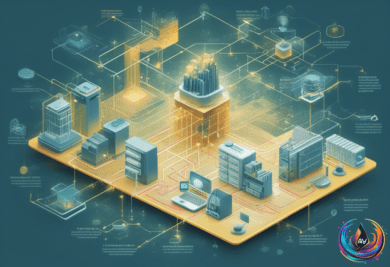
AI is moving past the moment when a system gives one answer and stops. Agentic AI pursues a goal through planning, tool use, observation, and adaptation, turning a request into a process that can continue until the work is complete, a limit is reached, or control returns to a person.
That shift changes the central question. Instead of asking only what an AI model can say, we can ask what it can decide, what tools it can use, what results it can observe, and how it responds when the first plan does not finish the job.
From One Response to an Ongoing Control Loop
Agentic AI is artificial intelligence that pursues a goal by deciding what to do next, using tools, observing the result, and adjusting its approach. The system does not treat its first response as the end of the task. It operates through a control loop that guides the work forward.
The loop gives agentic AI its defining behavior. An agent can build a plan, select an action, examine what happened, and choose whether to continue, change direction, or stop. That cycle creates a clear difference between an AI system that responds to a prompt and one that works toward an outcome.
A request becomes an outcome through five observable operations:
- Receive a goal
- Build a plan
- Choose a tool
- Observe the result
- Adapt or stop
These operations do not describe a single response. They describe a system that keeps track of progress and makes decisions over an extended period. When the task reaches completion, the system can write a response. When it reaches a limit, or has no tool authority, the process ends or returns the work to a person.
The same pattern can be described through four recurring stages: a defined agent selects actions, those actions change the environment, and the agent writes a response or operates without tool authority. The boundary matters because it shows where the system can act and where it must stop.
Agency Exists Across Several Dimensions
Agentic AI does not represent one fixed level of autonomy. Agency exists on a spectrum, beginning with answering a prompt and extending to receiving a broad objective, breaking it into steps, selecting tools, reacting to new information, and continuing over an extended period.
That spectrum makes autonomy multidimensional. Five elements shape how much freedom an agent has and how much control people must retain:
- Planning freedom
- Tool access
- Operating duration
- Reversibility
- The consequences of an error
A system with more planning freedom can decide more of the path toward a goal. A system with greater tool access can act across more kinds of work. Longer operating duration gives the control loop more time to continue, while reversibility determines whether an action can be undone. The consequences of an error define the stakes when the system chooses poorly.
That combination explains why the word “agent” needs a clear boundary. The defining mechanism preserves authority and evidence. The shortcut removes the boundary that makes the term meaningful. If a system cannot show what it was allowed to do or what happened after an action, people lose the structure needed to understand and control its work.
The Building Blocks Behind Production Agents
Most production agents combine five elements: a model, instructions, tools, state or memory, and a control loop. Each element supports a different part of the process, but the loop connects them into a system that can pursue a goal rather than produce a single isolated answer.
The model supports decisions inside the process. Instructions define the agent’s direction. Tools give it ways to act, while state or memory helps preserve information across the work. The control loop brings those elements together, allowing the agent to observe results and adapt or stop.
The most consequential AI systems are moving beyond conversation. They can search across sources, query databases, run code, operate software, update business systems, and coordinate other agents. Those capabilities expand the work an AI system can pursue, because the system can connect decisions to actions and then evaluate what happened.
That reach also raises the importance of control. Greater autonomy can unlock more useful work, but it makes reliability, permissions, monitoring, and human control more important. The broader the goal, the wider the tool access, and the longer the operating duration, the more carefully the boundary must be defined.
Agentic AI therefore is not only about giving systems more capability. It is about giving them a structured way to decide what happens next, collect evidence from the result, and remain inside the authority they were given.
Why the Control Boundary Matters
The strongest promise of agentic AI comes from its ability to carry work across multiple steps. A system can receive a goal, create a plan, choose tools, observe outcomes, and continue until it completes the task or reaches a stopping point. That process turns AI from a response engine into an active participant in a larger workflow.
Yet the same loop creates new demands. Reliability must cover more than the quality of one answer. Permissions must define which actions the system can take. Monitoring must show what the agent did and what results it observed. Human control must remain available when the system reaches a limit or needs the work handed back.
The future of agentic AI will be shaped by that balance between action and authority. Systems that plan, use tools, and adapt can pursue goals with far greater reach, but their value depends on preserving evidence, setting boundaries, and keeping people in control when the loop should stop.
Based on
- What Is Agentic AI? How Systems Plan, Use Tools, and Complete Tasks — unite.ai
- Agentic AI Is A Leadership Test — forbes.com
- Five Questions For Enterprise Leaders Before Investing In Agentic AI — forbes.com
- How To Design Multi-Agent Workflows That Actually Work — forbes.com
- Cut Through The AI-Wash: How To Tell Whether AI Is Truly Agentic — forbes.com