The Moon is gaining an open-source AI system built to read its surface at a new scale. NASA and IBM released the NASA-IBM Lunar Foundation Model on September 10, 2026, giving researchers a tool that can map possible ice and classify lunar craters.
The model is available to download from Hugging Face, along with the SomBench dataset used to train it. Together, they turn decades of lunar observations into an open platform for studying patterns across the Moon.
A Lunar Model Built From Millions of Data Points
The NASA-IBM Lunar Foundation Model draws on tens of thousands of images and instrument data from NASA’s Lunar Reconnaissance Orbiter (LRO), GRAIL, and Japan’s Selenological and Engineering Explorer (SELENE) missions. The dataset contains more than two million co-registered data points, including roughly 2 million co-registered lunar tile bundles.
That combination gives the model several ways to examine the same lunar regions. Instead of relying on one image or one instrument, the system connects observations collected through different missions and data sources, creating a larger record for mapping surface features.
Its architecture is a ViT-B encoder-decoder trained from scratch on SomBench data. The model can identify areas on the lunar surface where there might be ice, a capability tied to one of the most important mapping tasks in lunar exploration.
Juan Bernabé-Moreno, Director of IBM Research Europe, described the goal in clear terms: “The model gives scientists a foundation to explore the Moon at scale, connecting observations across instruments, revealing patterns that are difficult to see in isolation, and providing an open platform the global research community can build on.”
Stronger Maps With Less Crater Training Data
The model’s results point to a major advantage in lunar surface analysis. When compared with a map made using a published scientific workflow, it reduced errors by 23 percent.
It also outperformed SwinV2-B by 19 percent in crater classification while using half the training data. That result places the model ahead of the listed baseline in a task that depends on recognizing geological structures across complex lunar images.
These gains matter because lunar images are not simple photographs. Shadows stretch across the surface, and the way images are captured creates challenges for training. The same crater or possible ice area can look different depending on the observation conditions and the data used to represent it.
IBM’s attempts to train the model in the traditional way were a “complete disaster,” according to the verified account of the project. The team had to deal with shadows on the Moon and the way images are captured before the model could deliver its results.
Then the approach worked. “It worked fantastically,” Bernabé-Moreno said.
From Lunar Flyby Data to a New Crater
The release arrives during a year packed with lunar activity. Artemis II completed a lunar flyby on April 6, 2026, and a SpaceX Falcon 9 crashed into the Moon on August 5, 2026.
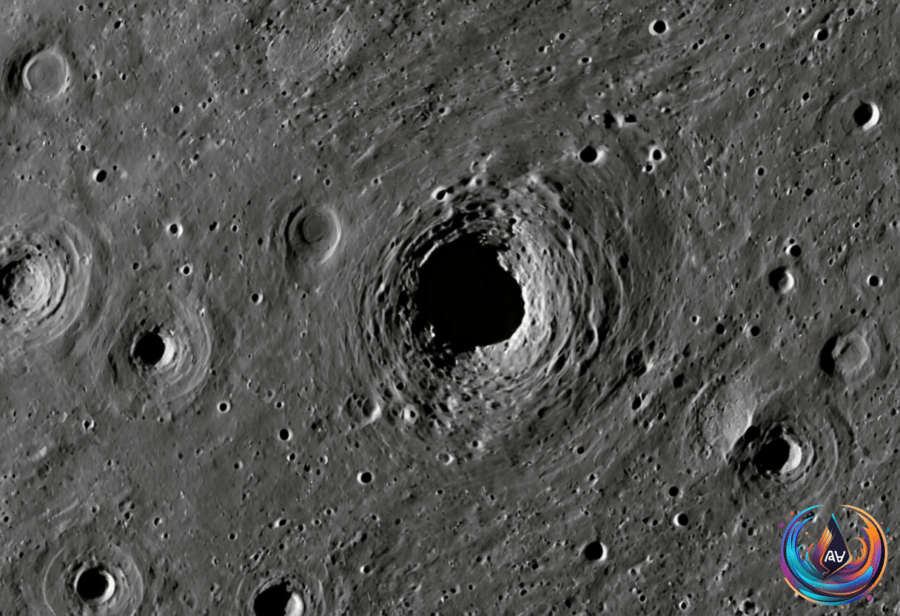
The crash site became a direct test for the model. From an image of the rocket crash site, the system correctly identified a new crater on August 5, 2026, showing how the model can help detect surface changes and features in lunar imagery.
That example connects the model to a clear scientific workflow: observations become mapped features, and mapped features can reveal something that was not identified before. The model’s ability to classify craters and locate areas where there might be ice gives researchers two different ways to examine the Moon’s surface.
Kevin Murphy, chief science data officer at NASA Headquarters, framed the challenge behind the project: “NASA has spent decades building an extraordinary scientific record of the Moon, but collecting data is only part of the job.”
Why Open Access Changes the Next Phase
NASA and IBM are releasing both the model and the dataset as open-source resources. With the model available through Hugging Face, researchers can access the NASA-IBM Lunar Foundation Model instead of treating it as a closed system.
The open release also places SomBench data at the center of future lunar analysis. Its tens of thousands of images, mission instrument data, more than two million co-registered data points, and roughly 2 million co-registered lunar tile bundles provide the training foundation for a model designed to connect lunar observations.
That foundation gives scientists a way to explore ice candidates, map craters, compare data from LRO, GRAIL, and SELENE, and study new images such as the rocket crash site observation. The model does not replace the lunar record; it gives researchers a new way to search through it.
NASA and IBM have put an open lunar AI system into researchers’ hands at a moment when new missions, flybys, and surface events continue adding data. The next discoveries may come from the images already collected, once a model can connect the clues across the Moon.
Based on