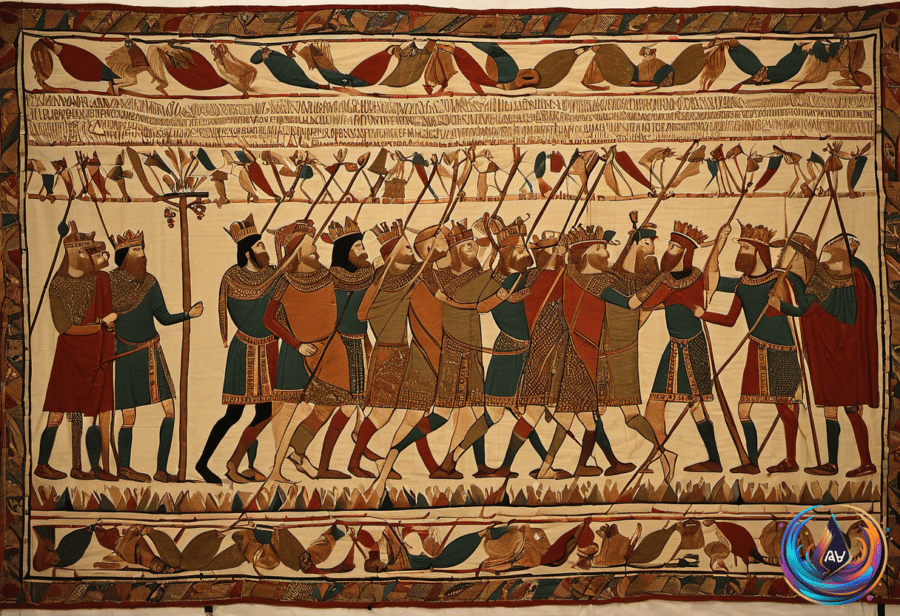
The Bayeux tapestry is receiving two different kinds of attention in 2026: a modern artistic response from Edith Pritchett and an exhibition of the 11th-century tapestry at the British Museum. Together, they place the historic work alongside a new interpretation created for the present day.
Ben Jennings wrote about the Bayeux tapestry in The Guardian on September 10, 2026. His piece included language that connected wealth, technology and the forces shaping modern life, bringing a contemporary voice to a subject rooted in the 11th century.
A historic tapestry meets a modern interpretation
Edith Pritchett created a modern take on the Bayeux tapestry in 2026. The work is titled ‘Bayeux’ tapestry cover, giving the familiar name a new form while keeping the connection to the original tapestry clear.
The modern version was published or created in 2026, the same year that the British Museum scheduled its exhibition of the 11th-century Bayeux tapestry. That timing puts the two works in the same cultural conversation, with the historic tapestry presented through an exhibition and Pritchett’s work offering a modern response.
The available details do not describe every scene in Pritchett’s version, but its title establishes the central idea: a contemporary take on the Bayeux tapestry. It is not presented as the original work. Instead, it is identified as a modern version created by an artist in 2026.
That distinction matters because the two works belong to different moments. The British Museum exhibition was scheduled to show the 11th-century tapestry, while Pritchett’s work was created in 2026. One is the historic object named in the exhibition, and the other is a new interpretation linked to it.
Cartoon language for a changing world
Jennings’ writing adds another modern layer to the story. The language associated with his piece turns toward wealth and technology, including the line: “The rich waxed richer still, before conspiring to flee our befouled earth”. The wording gives the article a satirical edge while connecting its subject to present-day concerns.
A second line focuses on the relationship between people and machines: “Some fell in love with these very machines. We became thralls to the glowing screen”. Together, the two quotes bring technology and screens into a discussion about the Bayeux tapestry, even though the tapestry itself dates from the 11th century.
Ben Jennings wrote about the tapestry on Thu 10 Sep 2026 18.17 BST. The dates listed alongside the material also include Sat 5 Sep 2026 08.00 EDT and Sat 5 Sep 2026 08.02 EDT, placing the discussion and Pritchett’s modern work within the same 2026 period.
The result is a year in which the Bayeux tapestry appears through several forms: the original 11th-century work scheduled for exhibition at the British Museum, a modern version by Edith Pritchett, and writing by Ben Jennings. Each reference keeps the tapestry at the center while presenting it through a different format.
Why the 2026 pairing stands out
The connection between the exhibition and the modern take is simple but striking. The British Museum scheduled an exhibition of the historic tapestry, while Pritchett created ‘Bayeux’ tapestry cover in 2026. The two facts show how one named work can remain present through both preservation and reinterpretation.
Jennings’ quotes add another point of contrast. “The rich waxed richer still, before conspiring to flee our befouled earth” speaks about wealth and the earth, while “Some fell in love with these very machines. We became thralls to the glowing screen” speaks about machines and screens. Those lines give the modern discussion a clear focus without changing the identity of the historic tapestry.
There is no need to treat the original and the modern version as competing works. The facts place them side by side in 2026: one connected to an exhibition at the British Museum, the other created by Pritchett, with Jennings writing about the Bayeux tapestry during the same period.
That is the central story of the 2026 material. The Bayeux tapestry remains an 11th-century work scheduled for exhibition, but its name also becomes the basis for a modern take and a contemporary cartoon discussion. History supplies the subject, while 2026 supplies new ways to present it.
Based on
- Ben Jennings on the Bayeux tapestry – cartoon — theguardian.com
- The trollers v the scrollers: Edith Pritchett’s Bayeux tapestry for the modern age | Bayeux tapestry | The Guardian — theguardian.com
- Tell us your experience of seeing the Bayeux tapestry at the British Museum | Bayeux tapestry | The Guardian — theguardian.com