Analog television is gone from US broadcast stations. The FCC mandated that every station fully transition to digital television by 2009, ending a broadcast system that had remained the predominant form of television for roughly six decades.
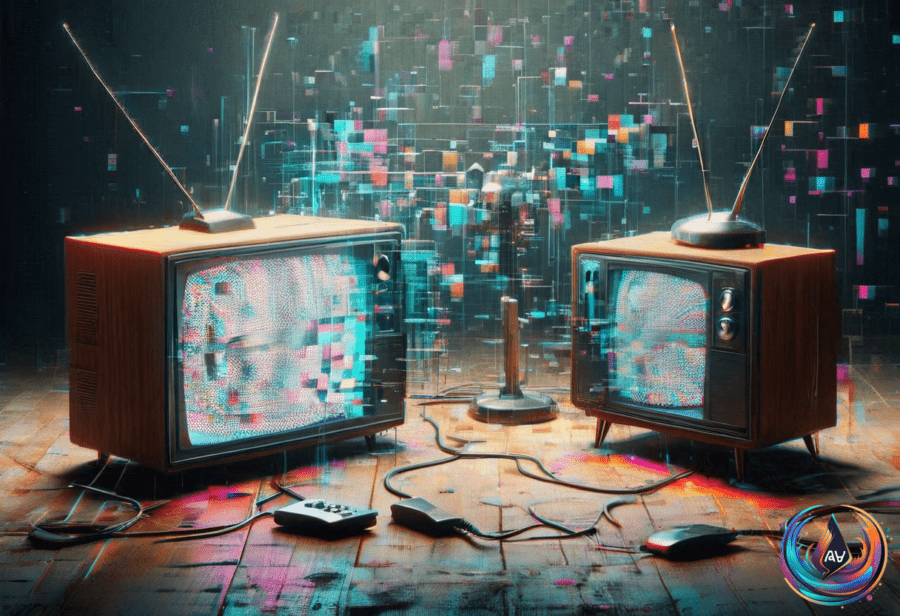
That change did not simply replace one kind of television box with another. Analog television transmitted video and audio signals through Very High Frequency and Ultra High Frequency channels, and viewers received those broadcasts through antennas that tapped into the analog signal.
Analog signals are continuous relays of information, with values that can vary smoothly across a range. Analog video cameras convert light into electrical signals and typically capture images at 30 frames per second in the US, creating the source material for that broadcast chain.
What Digital Television Changed
Digital broadcasting moved television away from continuous signals and brought improvements such as high definition television and more consistent feeds. Analog television persisted beyond the era of small television boxes, but the FCC’s 2009 deadline made the digital transition a requirement rather than a matter of consumer preference.
The change also arrived as television viewing began to spread across more formats. In April 2026, Nielsen found that streaming accounted for roughly 47.6% of US viewing habits, a figure that puts traditional broadcasting in a crowded field—even if the broadcast signal itself has become more capable.
Digital television is not the final stop. NextGen Television, also known as the ATSC 3.0 standard, adds internet protocols to digital broadcasting and promises 4K resolution, enhanced multicasts, better audio, and expanded channels. The name sounds like a product launch from a committee, because it is, but the technical shift matters.
Digital broadcasting can now carry more than a cleaner picture. Its development points toward a broadcast system that combines television transmission with internet protocols, while the older analog model remains defined by continuous signals, antenna reception, and VHF and UHF channels.
Bluetooth, Wi-Fi, and 2.4G Are Not Interchangeable
A similar confusion surrounds short-range wireless devices. Bluetooth is a wireless technology, while 2.4G is a radio frequency; both provide short-range data transfers, with maximum ranges of around 10 to 30 meters.
Wi-Fi serves a different purpose. It creates a local wireless network with a signal range of up to 50 meters, supports network connections, and can handle dozens of connections at once. Bluetooth and 2.4G do not provide that kind of network access.
The bandwidth gap is also substantial. Wi-Fi 7 supports several Gbps, while Bluetooth reaches around 3 Mbps and 2.4G normally stays under 10 Mbps. Wi-Fi offers longer range than Bluetooth, often reaching up to 50 meters compared with 10 meters, but that reach and capacity require more power.
Wi-Fi connections are more power-hungry than Bluetooth or 2.4G, making Bluetooth a better fit for low-power, simple device pairing such as wireless headphones or peripherals. It is the convenient option when a device needs to connect without building a network.
2.4G makes a different tradeoff. It offers less latency than Bluetooth, with some gaming mice tracking at around 1–5ms while Bluetooth devices can reach up to 30ms. Devices that use 2.4G wireless dongles also provide a more stable experience than Bluetooth, with less chance of connection drops.
The practical divide is clear: Wi-Fi connects devices to a network, Bluetooth handles simple low-power pairing, and 2.4G prioritizes low latency and stable peripheral connections. Digital television follows the same broad lesson—technology labels matter less than the signal, range, bandwidth, and job each system is built to handle.
Based on