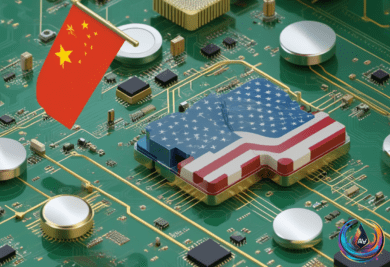
Apple is asking the US government for permission to buy memory chips from CXMT. CXMT is China’s largest DRAM manufacturer. This move comes amid rising memory prices and shifting supply chains.
CXMT first contacted the Commerce Department more than a month ago. They want to clear regulatory hurdles to supply Apple. CXMT is not currently banned from selling chips to US companies. Yet, it appears on the Pentagon’s 1260H list. This list flags companies with alleged ties to China’s military. Being on it limits Defense Department contracts but does not block trade.
The more restrictive Entity List, managed by the Commerce Department, would require licenses for business deals. CXMT is not on that list. That means CXMT can still do business with Western firms. It already supplies DDR5 memory to brands like Corsair. Dell and HP also use CXMT chips in some products. CXMT has secured patent licenses from WiLAN and Rambus. This gives it a clean intellectual property position, which helps Western brands feel safe using its chips.
Rapid Growth and Market Gains
In the first quarter of 2026, CXMT reported revenue of 50.8 billion yuan. That’s a 719% increase compared to the same period the year before. It swung from a 2.8 billion yuan loss to a 35.4 billion yuan profit. Their operating margin hit 70%, higher than TSMC’s typical 45%. This growth helped CXMT increase its global DRAM market share from 3% in early 2023 to about 8% by Q1 2026.
CXMT manufactures on roughly 16nm-class nodes using deep ultraviolet lithography. This is behind Korean leaders Samsung and SK Hynix, who use about 12nm nodes. CXMT’s cost per gigabyte is higher, but market conditions gave it strong margins. The company plans to expand wafer capacity from 100,000 per month to 300,000 by the end of 2026. It also aims to produce HBM3 memory for China’s AI infrastructure.
Chinese Memory Makers Amid US Restrictions
Another Chinese memory firm, YMTC, faces heavier restrictions. YMTC was placed on the US Entity List in 2022. This cut off its access to Western equipment suppliers. YMTC responded by replacing over half of its Phase 3 fabrication tools with Chinese-made gear. By early 2026, YMTC held an estimated 11–13% of the global NAND flash market. It plans to allocate up to half of its new Wuhan fab capacity to 3D DRAM production.
The US government introduced the MATCH Act in April 2026. This law aims to ban DUV immersion lithography and advanced etching tools from Chinese fabs. The goal is to curb China’s ability to produce advanced chips. At the same time, the Chinese government supports CXMT and YMTC to boost their capabilities and reduce reliance on Western tech.
Apple’s push to buy from CXMT highlights a key tension. The US wants to restrict Chinese chipmakers for security reasons. But some Chinese firms are growing fast and gaining market share. CXMT’s rise shows China’s chip industry is catching up. Meanwhile, Apple faces rising memory prices and supply challenges. On June 25, 2026, Apple announced price hikes for major products. The next day, shares of memory-chip makers like Samsung, SK Hynix, and Kioxia dropped.
This makes Apple’s move to secure CXMT chips even more urgent. If approved, it could help Apple manage costs and diversify suppliers. It also shows how global chip supply chains are shifting under political pressure. The battle over advanced memory is not just about technology. It’s about trade, security, and who controls the future of semiconductors.
Based on
- Apple wants US approval to buy chips from CXMT as memory prices quadruple — thenextweb.com
- AI: US hamstrung on Memory Chip Supply via China. AI-RTZ #1128 – HCNTimes.com — hcntimes.com
- Memory-Driven Price Shock Starts as Apple Raises Prices by as Much as 29% After Samsung — en.bloomingbit.io
- The AI Boom Is Accidentally Funding China’s Memory Independence | by Noah Bean | Jun, 2026 | Medium — medium.com
- China’s CXMT, YMTC cement fourth-place positions in global DRAM, NAND markets – The Herald Business — biz.heraldcorp.com