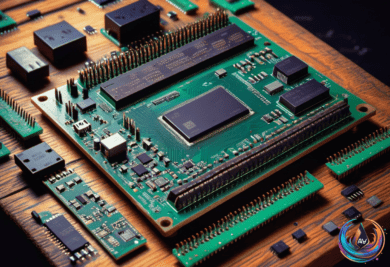
Imagine chips that think more like our brains. They use sound waves and ions instead of just electricity. This new approach could make AI faster and far less power hungry.
Traditional AI chips struggle because they separate memory and processing. Data shuttles back and forth, wasting energy and time. The brain works differently. It stores and processes information together, cutting down delays and power use.
Researchers have developed devices that mimic brain synapses with sound waves. These acoustic synapses can hold multiple bits of information in the wave’s phase. This allows parallel processing, like the brain’s massively connected neurons. The result: chips that handle complex tasks with less wiring and lower energy.
At the same time, ionic computing is gaining attention. Instead of electrons, it uses ions to carry signals. This mimics how real neurons communicate. Ionic devices blend memory and processing seamlessly, just like our brains do. They also promise better compatibility with biological systems, opening doors for brain-computer interfaces.
New Memory Designs Inspired by the Brain
One of the biggest challenges in AI hardware is how to remember and learn over time without losing old knowledge. Scientists created a dual memory system that separates short-term and long-term memory, similar to how our brains work.
Short-term memory allows quick adaptation to new information. Long-term memory helps keep learned facts stable. This split reduces the problem of “catastrophic forgetting,” where AI systems overwrite old memories when learning new ones.
This memory approach pairs with advanced materials like resistive RAM. These components store information with low power and high density. The combined hardware and algorithm design allows AI to learn continuously without losing accuracy.
Energy Efficiency Meets Practical AI
Another breakthrough uses a device that merges sensing and memory in one unit. It uses an oxide semiconductor layered with an organic photosensitive material. This setup remembers past signals by trapping electrical charges, similar to how the brain adjusts memory strength.
The trapped charges can move closer or farther from the transistor channel. This changes how strong the memory effect is, allowing the AI to control forgetting and remembering dynamically. This design could enable smarter, energy-saving sensors for vision and other tasks.
These new devices promise AI systems that run faster and use far less power than current chips. That’s a big deal for devices at the edge, like smartphones, robots, and autonomous cars that can’t afford big batteries or constant cloud connections.
What This Means for AI and Beyond
Neuromorphic computing aims to break the limits of today’s AI hardware by copying how the brain processes information. It integrates memory and processing to avoid energy-hungry bottlenecks. Ionic and acoustic technologies bring us closer to this goal with natural, brain-like operations.
Besides boosting AI performance, these advances may help brain-computer interfaces and medical devices. Their biocompatibility means they could interact directly with neurons. This could lead to new ways to treat neurological disorders or enhance human cognition.
The future of AI hardware lies in blending materials science, electronics, and brain science. Teams worldwide are working on scaling these concepts for real-world use. If successful, we could see AI that learns continuously, adapts to new tasks, and runs on tiny amounts of power.
In short, the next generation of AI chips won’t just compute. They will remember, adapt, and evolve more like the human brain. This shift could change how we build and use intelligent machines for decades to come.
Based on
- Sound Waves Give Neuromorphic Chips a Brain-Simulating Edge — spectrum.ieee.org
- Neuromorphic Ionic Computing: Revolutionizing AI Efficiency (2026) — gikmorf.com
- Neuromorphic Networks Co-Designed with Dual Memory — bioengineer.org
- AI Gets a Brain Boost: New Memory Device Revolutionizes Energy Efficiency! (2026) — prairiecomputer.com
- AI Frontiers: Neuromorphic Computing and Cognitive Impact – Archynewsy — archynewsy.com