Apple is developing a smart home security camera with a striking promise: it can analyze activity without recording video footage of anyone in your home. Instead of delivering video clips, the device would use AI to study movement and send text descriptions.
That approach could reshape what people expect from a home security camera. The device would still detect activity, recognize faces, and identify when someone enters a room, but it would not pull in real video footage or offer video recording as a feature.
A Camera Designed Around AI, Not Video
The camera will use a sensor and AI to analyze movement in and around your home. Its very low frame rate means the device would not function like a standard camera that captures a continuous stream of footage. Apple’s system would focus on understanding activity rather than preserving a visual record.
Facial recognition would let the camera detect when someone enters a room. If it identifies a person walking into that room, it can notify you about whether you know that person or not. The alert would arrive as a text description, with no video attached.
Mark Gurman described the central feature in direct terms: “No video recording. So it’s a sensor that cannot actually pull in real video footage. It’s analyzing your environment in your home and around your home simply using AI.”
That distinction drives the entire product concept. The camera can analyze your environment, but you would not receive recorded footage from the device. As Gurman put it, “You’re not getting anything but text descriptions. There’s nothing you can do with it. There’s no video recording.”
Small Cylinders Around the Home
The camera will be a companion product to Apple’s unannounced smart home display, referred to internally as J490. The cameras will form part of a new Apple smart home ecosystem alongside a rumored smart home hub, giving the company a broader system for connecting displays, sensors, and home security products.
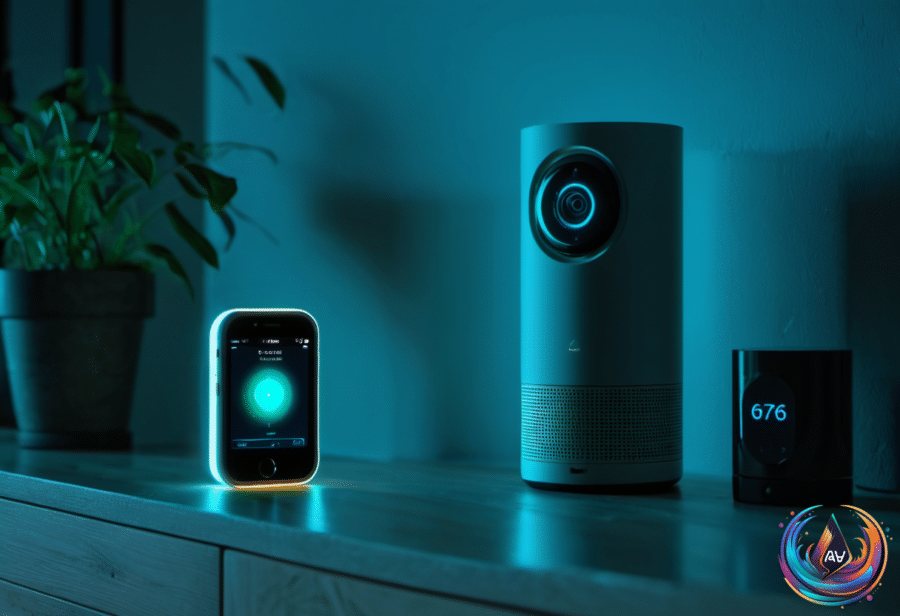
These devices can be installed around your home, and their physical design will apparently be cylindrical. Gurman compared the shape to a giant metal chapstick, pointing to a small product that could sit in different rooms without looking like a traditional security camera.
Gurman described the hardware this way: “They’re also building home security products, both first-party and third-party home security products. And the biggest thing is a program called J450. And this is an offshoot and a companion product to the J490 smart home display. And these are little cameras that you can put around your house. They have very low frame rate. It looks like a cylinder. It looks like a metal giant, you know, chapstick.”
The J450 program would place these small sensors throughout the home, where each one could analyze movement and detect when someone enters a room. Because the cameras would not record video, their value would come from the AI analysis and the text descriptions sent to you.
An Apple Strategy Built on Low-Resolution Vision
The smart home camera will use technology similar to what Apple is developing for a pair of AirPods with cameras. Those camera-equipped AirPods will have tiny embedded cameras that capture extremely low resolution RGB still images for analysis using Visual Intelligence.
Apple’s camera-equipped AirPods reportedly will not be able to take pictures or record video. That creates a clear connection between the two projects: both use limited visual input to support AI analysis without operating as conventional video-recording products.
The difference is in the setting. The AirPods would use tiny embedded cameras and extremely low resolution RGB still images, while the smart home camera would monitor activity around rooms and analyze movement through a very low frame rate. Both concepts limit the visual data they capture and focus on what AI can understand from it.
- The smart home camera will analyze activity using AI.
- The device will use a very low frame rate.
- Facial recognition will detect when someone enters a room.
- Notifications will arrive as text descriptions.
- The camera will not record video footage.
- The product will connect with Apple’s smart home ecosystem and J490 display.
Apple’s plan puts the camera between a sensor and a traditional security device. It can recognize activity and faces, yet it will not provide video playback or recorded footage. That could make the product’s usefulness depend on how much information its AI can explain through text.
The planned camera, J450 program, J490 smart home display, and rumored smart home hub point toward a larger Apple home strategy. Instead of building the ecosystem around stored video, Apple is developing a system that interprets activity and delivers descriptions. The next phase of smart home security may focus less on watching everything and more on understanding what matters.
Based on