Bihar is putting teachers at the center of its next big technology push. The Education Department has partnered with 11 IT firms, including Google Education, to train government school educators in artificial intelligence and digital technologies while preparing students for earlier exposure to computer education.
The plan reaches beyond a single training programme. Bihar wants computer education to become compulsory from 6th standard in all government schools from the next academic session, with smart classrooms planned for 700 model schools. The state is building a technology pathway that starts with teacher skills, moves into student learning, and expands through new school infrastructure.
Teachers Will Lead Bihar’s AI Transition
Bihar Education Minister Mithilesh Tiwari said the training would prioritise AI, with the goal of improving teaching quality. The programme will include practical IT training designed to help educators develop digital skills they can use in school settings, rather than treating technology as a subject separate from everyday teaching.
The Union government’s skill development department will support the initiative, while the State Council of Educational Research and Training, or SCERT, will host the centralised training at its campus. The participating companies will conduct sessions in separate batches, and school principals will nominate teachers for the programme.
The state aims to have the training arrangements in place by January. The number of participating teachers and the length of the training remain unspecified, leaving those details to be settled as the programme moves toward implementation.
That structure gives Bihar a clear starting point: train educators first, then bring stronger digital learning into classrooms. Teachers will need to guide students through AI tools, computer education, and online learning while making sure technology supports understanding instead of replacing it.
Compulsory Computer Education Meets New Infrastructure
Computer education will become compulsory for students from 6th standard and above in government schools from the next academic session. The move is intended to introduce students to digital learning earlier in their schooling, giving them access to computer skills as part of their regular education.
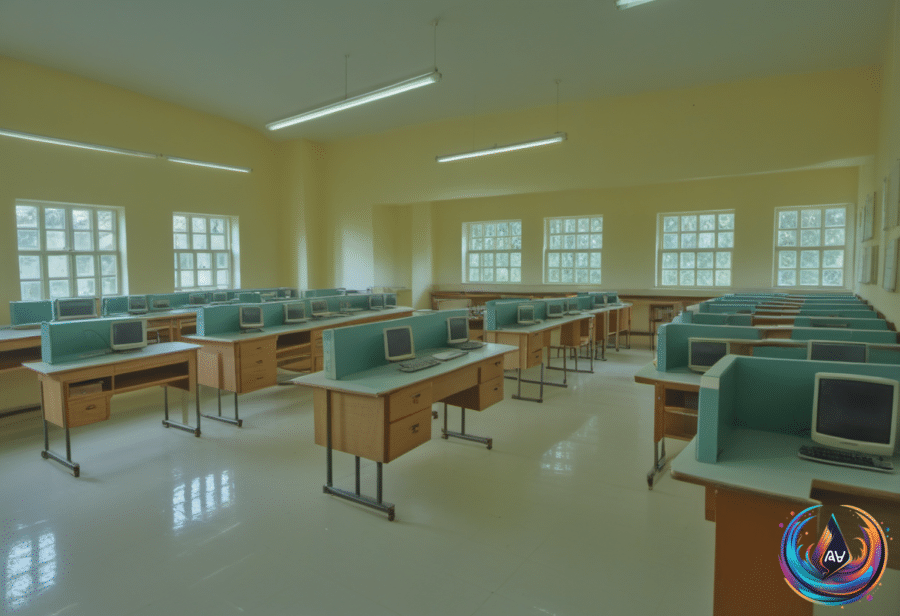
The Education Department also plans to strengthen IT infrastructure to support that expansion. Smart classrooms are planned for 700 model schools, and those facilities are expected to extend to other government schools in phases. Teacher training, compulsory computer education, and smart classrooms form one connected plan to expand technology use across the state.
The challenge now shifts from announcing the programme to delivering it. Bihar’s progress will depend on putting the training arrangements in place, ensuring nominated teachers receive useful instruction, and installing the infrastructure required for computer education and smart classrooms.
The broader question is not whether AI can enter schools. It is how schools can use it without weakening the skills students need to develop on their own.
Why AI Training Needs Careful Classroom Guidance
Evidence from outside Bihar shows why teacher preparation matters. Data from the Pew Research Center says one in five teenagers from families with an annual income of less than $30,000 does all or almost all of their homework with chatbots. Among teenagers from families earning $75,000 or more, that figure is 7%.
An experiment by the Wharton School also showed that AI can harm learning when students depend on its help. About a thousand Turkish high school students solved math problems with regular ChatGPT, a tutoring version of the bot, or without AI. During practice, both bots improved results, but the outcome changed during an exam without the bots.
The group that used regular ChatGPT fell behind the group that worked without AI by 17%. The students had grown used to hints and had not learned to solve problems on their own. That result gives Bihar’s teachers an important role: AI training must cover not just how to use tools, but when to use them and when students should work without them.
The U.S. Department of Education has included AI development among its priorities for federal grants to schools, with the document naming AI tutors and assistance for students falling behind in the curriculum. At the same time, UNESCO predicts that the world will need an additional 44 million teachers by 2030, including 4.8 million in Europe and North America. The United States alone has 56,000 unfilled teaching positions, while teacher salaries account for nearly 30% of all costs for American public schools.
These pressures explain why AI is attracting attention in education, but they also raise questions about oversight and dependence. A bipartisan pair of senators, Richard Blumenthal and Josh Hawley, sent a letter to Google CEO Sundar Pichai seeking answers about how the company’s artificial intelligence tools affect children in school. “Google is forcing their A.I. products into classrooms across America, and children are paying the price,” the pair wrote.
Dmytro Korchevskyi, a Doctor of Pedagogical Sciences and founder of a network of general education schools in Ukraine and an IT education network operating in 26 countries, including the U.S., is part of the wider education debate around digital tools. Sal Khan has promised a personal AI tutor for every student on the planet, while Hammad Ali Nasir, co-founder of Adcelerate360°, described the direction of education this way: “The classroom of the future isn’t a building; it’s a layer sitting on top of whatever room a student happens to be in.”
Bihar’s initiative now gives that future a concrete test. If teachers receive practical training, students gain computer education from 6th standard, and the planned infrastructure reaches schools in phases, the state could create a stronger foundation for digital learning. The next milestone is January, when the training arrangements are expected to be in place.
Based on
- Bihar Partners with IT Cos to Train Government School Teachers In AI — analyticsindiamag.com
- Every child will get AI. Not every child will get a teacher | Fortune — fortune.com
- What AI Can Teach, And What It Can’t Replace — forbes.com
- Senators press Google on AI in classrooms – Live Updates – POLITICO — politico.com