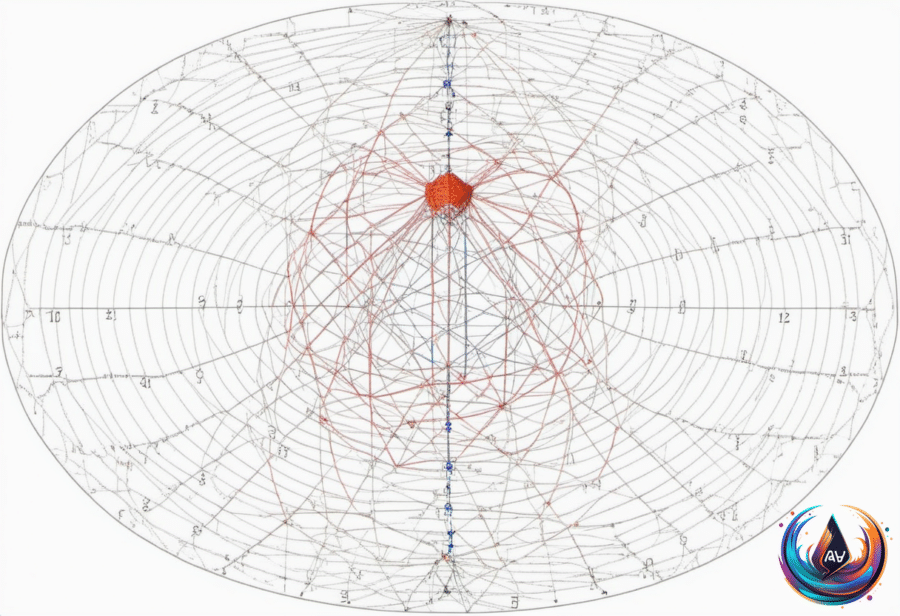
A 167-year-old mathematical mystery now has a startling new challenger: Claude. On November 20, 2026, Anthropic mathematician Levent Alpöge claimed that he and the LLM discovered a proof of the Riemann Hypothesis, one of the most famous open problems in mathematics.
Alpöge posted the claim on his website at 4:30 pm, writing, “I believe I have, working with Claude, discovered a proof of the Riemann Hypothesis.” The proof was coded in Lean, a programming language that checks the mathematical correctness of each argument. That detail gives the announcement a powerful edge, because the claim is not only an AI-generated burst of insight; it includes a formal verification path that mathematicians can examine.
A Claim About the Prime Numbers
Bernhard Riemann first proposed the hypothesis in 1859. At its heart, the problem concerns the locations of prime numbers along the number line, suggesting that those locations follow an intricate, meaningful order rather than appearing without structure.
The conjecture became the North Star of number theory and stands as the most famous open problem in math. The Clay Mathematics Institute placed a million-dollar bounty on it as one of the few major problems that remain unsolved, while progress toward a solution became so rare that most top experts spent little of their time working directly on it.
That long silence began to change in October, when one proof from OpenAI’s massive dump of mathematical results made significant progress toward making sense of the primes. Alpöge’s announcement now pushes the AI mathematics story into a new phase: from partial advances toward a claim of a complete proof.
Alpöge also says the method reaches beyond the original problem. “In fact, the method easily extends much further, resolving the so-called Generalized Riemann Hypothesis, and I expect, with more time, the Extended Riemann Hypothesis too,” he wrote.
Why Lean Changes the Conversation
Alpöge says he and Claude formalized the arguments without assumptions. “Claude and I have also formalized the arguments without assumptions,” he wrote, pointing to Lean as the system used to encode the proof and verify each step.
Formalization does not end the discussion. The proof still needs to be checked, understood, and assessed by mathematicians, but Lean gives that process a precise structure. Every argument must fit inside a system built to test mathematical correctness, turning a remarkable AI claim into something experts can inspect line by line.
Hector Pasten, a mathematician at the Pontifical Catholic University of Chile, described the possible impact in sweeping terms: “If the proof is correct and understood, this completes a dictionary between different branches of math where the connections were only partial.” He added, “Something like a Rosetta Stone.”
Alpöge’s own statement carries both grief and excitement. “It is natural to feel that this is an end, in my case a loss of a principal guiding light,” he wrote, before adding, “but what I saw during the course of progress so amazed me that I believe it is one dawn across science of something far greater.”
The AI Mathematics Race Accelerates
The claim arrives after Alpöge drew headlines in July by tweeting a Claude-generated solution to the famous Jacobian conjecture. It also lands amid a wider surge in AI-written mathematical work.
On October 6, 2026, OpenAI posted more than 700 AI-written math manuscripts. About 300 came with proofs in Lean. Among the claims was a zero-free region for the Riemann zeta function where the real part exceeds 7/8.
An unreleased Claude model also raised the proven share of zeta zeros on the critical line from 41.6% to 67.2%, with a Lean proof. Those figures do not establish the Riemann Hypothesis, but they show how AI systems are attacking pieces of the same mathematical landscape.
The expansion has brought tension as well as progress. In September, NYU mathematician Tristan Buckmaster implied that OpenAI stole work, while Terence Tao and 24 other Fields Medalists signed a declaration. The field is now balancing powerful new tools against questions of credit, trust, and proof.
Andrew Sutherland, an MIT mathematician, captured the unsettling possibility in a warning: “An AI that can prove the Riemann hypothesis is not one I’d want to meet. If that happens, mathematicians having jobs will be the least of our problems.”
The Riemann result, if correct, will echo far beyond mathematics, even though it has no immediate real-world applications. Alpöge hopes the argument offers “a glimpse towards the miracles that lie ahead” and reveals “the joy and wonder we are about to find in the simplest things.” The next test is clear: mathematicians must determine whether Claude and Alpöge have truly crossed the finish line, or opened another extraordinary path toward it.
Based on
- Quoting Levent Alpöge — simonwillison.net
- Anthropic mathematician claims to prove Riemann hypothesis, most famous problem in all of math | Scientific American — scientificamerican.com
- AI For Math Proofs: Organized Monkeys Or Superhuman Genius? — forbes.com
- Anthropic researcher: Most of humanity will be unemployable due to AI — thehill.com
- LLMs will provide accurate climate info, except when they won’t | Ars OpenForum — arstechnica.com