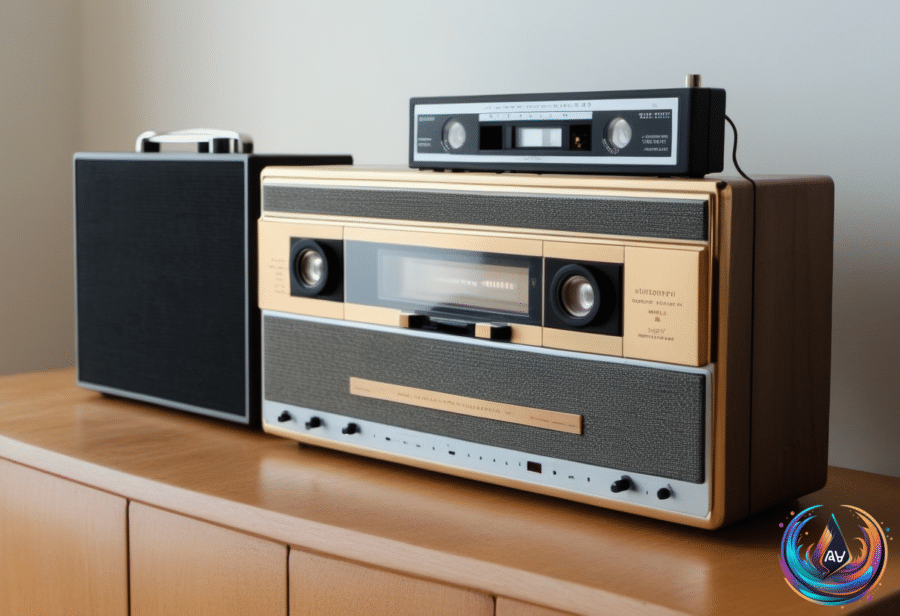
The original Sony Walkman cost more than many people remember. When the TPS-L2 reached Western markets in 1980, it carried a $200 price tag, equal to about $800 today after inflation.
That was a steep price for a 14-ounce tape player that could not record. Sony had to convince skeptics that people wanted to carry their music outside the home or car, but the idea caught on. After its 1979 debut in Japan, street-level marketing helped the TPS-L2 sell 30,000 units in two months.
Sony might not have invented the magnetic cassette player, but it made personal cassette listening popular. Tapes that once stayed in living rooms and cars could now be strapped to a belt, changing how people listened to music and giving portable audio a new place in everyday life.
The $200 player that changed personal audio
The TPS-L2 was built with a modified Sony Pressman recorder chassis and included two mini headphone jacks for two simultaneous listeners. Its blue-and-silver metal housing, orange foam earpads and bundled MDR-3L2 headphones became a familiar combination. Two AA batteries kept the music going.
The player also had a distinctive “hotline” button. Pressing it lowered the music volume and activated a microphone, letting users speak with someone without removing their headphones. That small feature showed how Sony treated the Walkman as more than a cassette deck; it was a device designed around shared, mobile listening.
The name itself took time to settle. The player was originally called Soundabout in the United States before Sony standardized the branding as Walkman. By 1986, “Walkman” had entered the Oxford English Dictionary, a sign that the product name had become part of everyday language.
Sony sold over 200 million cassette-based players before ending production in 2010. The company ruled personal audio players for about two decades, until MP3 players and the iPod took over. After the TPS-L2, Sony continued the line with Discman and MiniDisc players before moving to modern portable media players.
The original Walkman also returned to public attention in 2014, when Marvel’s Guardians of the Galaxy placed it in the hands of Peter Quill, played by Chris Pratt. In the film, Quill used the TPS-L2 to play the Awesome Mix Vol. 1 tape, a gift from his mother.
Why new Walkmans cost thousands
Sony never stopped making Walkmans, but the current range looks nothing like the $200 cassette player of 1980. The company’s digital models run from $75 to almost six grand, and the most expensive versions target listeners who already spend thousands on headphones and amplifiers.
The flagship NW-WM1ZM3 carries a listed price of $5,900, while another figure places the WM1ZM3 at $5,899. Its main chassis uses 99.99 percent pure oxygen-free copper and receives a gold plating. The rear panel changed from aluminum in the previous flagship to copper, and even the screws get low-resistance gold plating.
Sony claims that the plating creates a more stable ground connection, leading to stronger bass and a wider soundstage. Inside, the player uses thick Kimber Kable wiring borrowed from Sony’s DMP-Z1 desktop player, a second large polymer capacitor and a copper block over the digital circuitry that is 34 percent heavier than before.
All that metal adds weight. The WM1ZM3 weighs 670 grams, or around 1.5 pounds, compared with 490 grams, or around 1.1 pounds, for the 2022 model. Copper reached around $14,850 per metric ton in August, yet the copper in a 670-gram Walkman would be worth only about $10. The price comes from the engineering, construction and what dedicated audiophiles will pay, not the raw metal alone.
The new lineup opened for pre-orders on October 15. The NW-ZX900 costs $1,899, the NW-WM1AM3 costs $2,999 and the gold-plated WM1ZM3 sits at the top. Japanese retailers expect prices of around ¥215,000 for the ZX900 and ¥655,000 for the WM1ZM3. After removing the 10 percent consumption tax and converting at September’s average of about ¥156 to the dollar, those prices work out to roughly $1,250 and $3,800.
More affordable choices still exist
The $1,899 ZX900 uses a machined aluminum chassis with a gold-plated copper rear panel, matching the $2,999 WM1AM3. It also shares the same ultra-low-noise voltage regulator and crystal oscillators as its pricier siblings. All three players use Sony’s S-Master HX digital amp and produce 250mW per channel from the 4.4mm balanced jack.
Storage separates the models, running from 64GB to 128GB and 256GB. The earlier $3,699 WM1ZM2 shared much of its specifications and engineering with the cheaper WM1AM2, but its limited power output remained a weakness. The WM1ZM3 keeps the same 250mW-per-channel rating, while the less expensive model was still described as excellent value for money.
Sony’s NW-WM1Z launched in 2016 at $3,199. In 2022, the WM1ZM2 arrived at $3,699 alongside the $1,399 WM1AM2, and the ZX707 followed in 2023 at $899. The WM1ZM3’s price represents a 59 percent jump from the previous generation. Astell&Kern’s Android-based SP4000 flagship costs $4,290, about $1,600 less than the ZM3.
For most listeners, the $350 NW-A306 from 2023 remains the more sensible choice. It supports hi-res files and high-quality codecs, though its 32GB storage leaves only about 16GB usable. The $75 NW-E394 sticks to basic playback, without Android, Bluetooth or SD card expansion, and its 8GB of internal storage can run out quickly.
That leaves a striking gap between the Walkman’s past and present. The original cost $200 in 1980, or about $800 today, while current models range from $75 to $5,900. The hardware changed from cassette tapes and AA batteries to Android, Wi-Fi streaming and a 5.5-inch touchscreen, but Sony still sells the same basic promise: personal music carried wherever you go.
The world has moved to streaming apps, and the Walkman name is not as familiar as it once was. Its influence remains in the way portable devices combine music, storage and technology. Sony’s most expensive players push that idea toward luxury audio, while the NW-A306 keeps it within reach for people who want a dedicated music player without paying flagship prices.
Based on
- Here’s how much a Sony Walkman cost in 1980 vs. 2026 — engadget.com
- Why Sony’s New Digital Walkmans Cost Thousands Of Dollars — engadget.com
- What Data Storage Looked Like In The Early 2000s Vs. Today — engadget.com
- Sony’s updated turntable is an easy entry into the world of vinyl | TechCrunch — techcrunch.com
- Teenage Engineering’s First CD Player Kind Of Looks Like A Turntable — engadget.com