Exoskeletons are moving beyond laboratory demonstrations and into mountain rescues, warehouses, factories, firefighting, and military work. These powered devices attach to parts of the body and help people carry loads, move with less strain, or keep working for longer.
Members of Seattle Mountain Rescue have been testing assistive devices connected to their hips and legs. The goal is to increase lower-body strength while rescuers search for stranded people, with testing focused on speed and endurance.
From rescue teams to factory floors
The same basic idea is showing up in workplaces. IKEA has used SuitX exoskeletons for several years to help warehouse workers handle heavy materials. The IKEA device attaches to the torso and upper limbs, supporting the back and shoulders rather than powering the legs.
Ford, Boeing, and Mazda Toyota have also adopted exoskeleton technology on some assembly lines. These examples show how different designs can target different physical tasks, from lifting and carrying to supporting the upper body during repetitive work.
Finland’s ExoPELA project examined whether exoskeletons could reduce muscle load and strain during rescue and firefighting work. The project found noticeable benefits, adding to the case for using these devices in jobs that place repeated demands on the body.
Military use has added another test of their value. In early 2026, Ukrainian soldiers used Hypershell exoskeletons on the front lines to help carry artillery shells. The Hypershell device attaches to the waist and thighs, assisting hip flexion and extension.
In March 2026, Ukrainian Colonel Vitalii Serdiuk said soldiers wearing the devices “become less fatigued, work faster, and maintain combat effectiveness for longer.” That use places exoskeletons in a demanding setting where carrying weight, saving energy, and continuing physical work all matter at once.
How the machines add strength
Modern active robotic exoskeletons usually contain a lightweight mechanical frame with ergonomic attachments at the trunk, waist, and limbs. Mechanical parts called actuators convert battery power into movement, while control units define movement paths and decide how force should be applied.
Sensors help the control system adapt to the user’s needs. Assistance exoskeletons usually fall into three categories: power augmentation, assist-as-needed, or resistance. That means a device might add force, provide help only when the wearer needs it, or make movement harder for training or other tasks.
The technology has advanced over the past decade as robotic motors, sensors, and control systems have become more affordable. The basic idea, however, is much older. Nicholas Yagn received a patent for an exoskeleton-like performance device by at least 1890, and Leslie C. Kelley received a patent for a steam-powered walking support device in 1919.
By the end of the 1960s, multiple actuated robotic exoskeletons with electronic control systems had been developed. Today’s systems use batteries, sensors, software, and compact mechanical parts to turn that long-running concept into equipment people can test in real workplaces and rescue operations.
Humanoid robots bring hands into focus
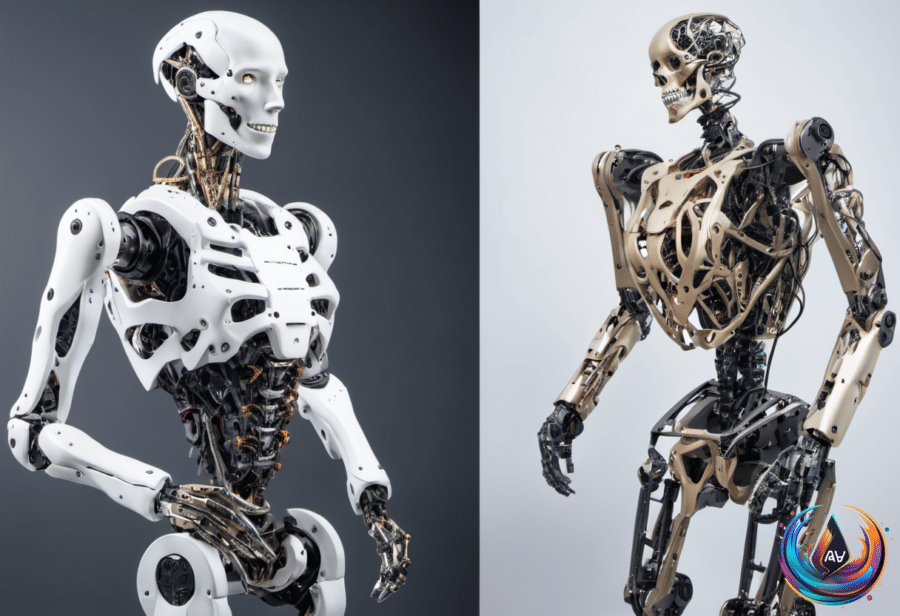
The same push toward useful physical machines is shaping humanoid robotics. Foundation Future Industries claims to have a humanoid robot soldier named Phantom, which could be one of the first of its kind. Foundation has $24 million in contracts with the Pentagon to develop humanoid robots for defense.
Hands remain one of the hardest parts of that work. A human hand has around 27 degrees of freedom, while some advanced robotic hands have about 22. Motors, rare earths, and actuators make hands costly to produce, and hands are considered the biggest single cost in building humanoids.
Robotic hands must handle tasks that demand both strength and care. A useful hand may need to grab a raspberry without crushing it, then lift a 100-pound kettlebell. Google DeepMind’s robotics team has shown progress in dexterity, including a humanoid tying a trash bag.
Not every robot needs a human-shaped hand. Some robots in hospitals use simple grippers mounted on wheels to transport supplies. A July 2023 study from German researchers found that in-hand manipulation does not benefit from anthropomorphic hand design, suggesting that simpler mechanisms can be enough for some tasks.
Chinese startups are still racing to build robotic hands. Unitree Robotics announced a new human-sized robotic hand with 22 degrees of freedom, matching the number found in some advanced robotic hands.
Data, prosthetics, and a divided industry
Psyonic, a San Diego startup, wants to give people bionic hands and pay them to collect data that can improve robotic hand technology. On September 30, 2026, Psyonic planned to deploy thousands of bionic hands in Pakistan and India, where users would perform everyday tasks while the devices recorded how hands move and interact with objects.
The hands log forces, torques, and finger positions, and those records can be synchronized with video to train robotics models. Psyonic plans to sell the resulting models to robotics companies, not the data itself. Koalaa, a London-based company, is working with Psyonic on the effort.
The consumer and clinical exoskeleton sector is valued at around $500 million and is predicted to double or triple by the mid-2030s. That forecast covers a field that now stretches from assistive equipment and prosthetic hands to military devices and humanoid robots.
Policy is also changing the shape of the market. Washington banned new models of foreign-made robots in July 2023, increasing isolation between the physical artificial intelligence sectors of the superpowers. The result is a race shaped not only by engineering, but also by defense contracts, manufacturing needs, medical applications, and national technology rules.
Based on