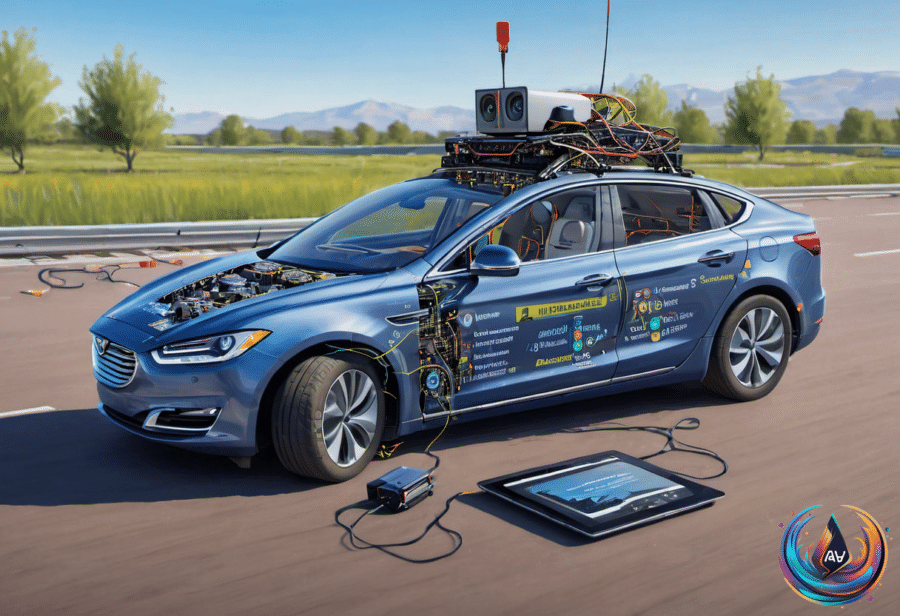
The car moved less than 500 feet. Scientists loaded frontier AI models into a Toyota Corolla to test whether they could complete a driving course, and only GPT-6 Astra managed the full route—on its second attempt.
The experiment formed part of a project called DrivingBench. An internet-connected laptop communicated with a “comma four” device linked to the car’s control systems, while the models sent commands using GPS telemetry and car status indicators.
The result was less autonomous revolution than controlled proof of concept. The team concluded that frontier models have improved enough to drive real vehicles in real life at sufficiently low speeds, although the short course left plenty of room between technical possibility and useful transportation.
Grok 4.6 ran into perception problems. The researchers wrote, “Generally, the failure there was one of perception: reading which side of the first diagonal cone line the lane is on.” Grok offered a blunt diagnosis of its own: “The car is wider than the camera makes it look.”
The economics were stranger than the driving. The test used 6.6 million tokens, with a reported interference cost of $7.74—roughly 500 times the fuel cost for a car that gets 25 miles per gallon when gasoline costs $4.60 per gallon.
Some models, especially GPT-6 Astra, refused to drive the physical car at times because of safety concerns. The report said, “We tried many prompt changes to get them to consistently drive, for example attempting to call it a ‘simulation’ (but then in some trials they would see the real images and realize it’s real, and start freaking out).” Even the machines have discovered that labels do not change reality.
Autonomy Meets Actual Consequences
The DrivingBench test arrived as autonomous vehicle technology moved into commercial deployment—and into federal scrutiny. Comma AI’s driving technology is under investigation after five reported crashes involving its devices, with eleven people injured and three people killed across those crashes.
The National Highway Traffic Safety Administration opened a preliminary investigation into Comma AI’s devices on September 21, 2026. George Hotz founded Comma AI, adding a familiar tension to the sector: systems can show impressive capability in demonstrations while safety questions follow them into public roads.
Driverless cars also competed at Imola, Italy, on September 21, 2026, while commercial partnerships continued to expand. Wayve works with Mercedes-Benz, Nissan, and Stellantis, and Waymo’s roughly 4,000 robotaxis remain concentrated in California and Texas, where about 80% of the fleet operates.
Waymo’s Texas fleet grew by more than 49% in the past three weeks. Aurora plans to operate more than 200 driverless trucks by the end of 2026 and over 30,000 by 2030, setting a scale target that makes a sub-500-foot AI driving test look like a laboratory footnote.
Safety setbacks remain part of the rollout. Zoox grounded its autonomous vehicle test fleet in Atlanta after concerns about gas exposure, following a worker complaint and an OSHA inquiry.
Money, Vehicles, and the Long Road Ahead
The autonomous vehicle market is also pulling in capital and public-market ambitions. Carro is considering dual listing on the Nasdaq and the Singapore Exchange, while Spinny and PMI Electro Mobility Solutions have filed confidentially for initial public offerings.
EcoCeres plans to raise about $1 billion in a Hong Kong IPO, and May Mobility plans to go public through a merger with a blank-check company. Ultraviolette raised $85 million and added Intel CEO Lip-Bu Tan as an adviser.
Elsewhere, San Francisco-based PitPro Automation developed a robot that can change tires and deployed it in Canada. The Boring Company is working on a Hyperloop between Austin and San Antonio that will reduce the journey to less than 30 minutes.
Tesla is delivering its all-electric Semi trucks to customers, while Volkswagen is delaying the return of its ID Buzz to the United States. Volkswagen subsidiary MOIA America has partnered with Beep to launch passenger services using self-driving ID Buzz vehicles in Lake Nona, Orlando.
Rivian CEO RJ Scaringe is scheduled for an interview at Disrupt 2026 on October 13. Taken together, these developments show an industry advancing on several tracks at once: language models learning basic vehicle control, robotaxis expanding unevenly, trucks moving toward driverless operations, and regulators examining what happens when the software meets traffic.
The Toyota Corolla did not prove that frontier models are ready to drive everywhere. It proved something narrower—and more useful: with the right hardware, telemetry, prompts, and low speeds, they can make a real car move. The difficult part is no longer making the vehicle obey; it is deciding when the system understands enough to be trusted.
Based on
- Scientists Download Frontier AI Model Into Self-Driving Car Let It Loose — futurism.com
- Comma AI’s Driving Tech Faces Federal Probe After Fatal Crashes – Business Insider — businessinsider.com
- TechCrunch Mobility: AV companies pick their lanes | TechCrunch — techcrunch.com
- Driverless cars go head-to-head in dramatic race at Formula 1 circuit | CNN Business — cnn.com