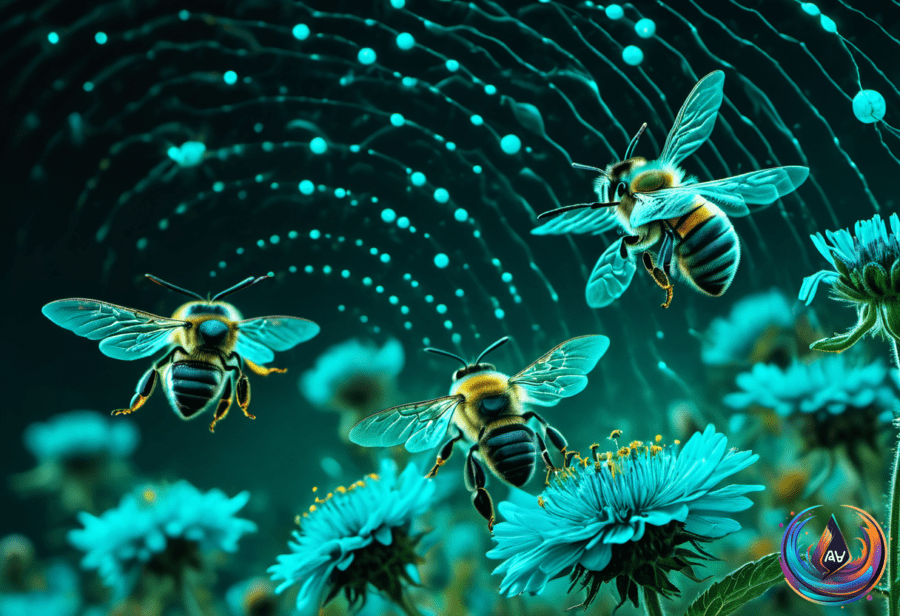
Tracking bees and other pollinators just got a huge upgrade. For years, scientists struggled to monitor these tiny but vital insects without disturbing them. Traditional methods often meant catching and even killing insects to identify the species. That’s changing thanks to new radar technology combined with machine learning.
Researchers in Europe developed a radar system that listens to the unique wingbeats of different insects. Instead of relying on cameras or nets, this system uses millimeter-wave radar to detect the subtle movements of wings. These wingbeat patterns create what’s called micro-Doppler signatures—a kind of radar fingerprint that reveals species differences.
Millimeter waves work well because their size matches insect bodies. The radar picks up detailed vibrations of their wings, even from a distance. Machine learning then analyzes these radar signals to tell species apart with about 85% accuracy. This is a big deal because it lets scientists track pollinators without capturing or harming them.
Why This Matters for Pollinators and Food Security
Pollinators like bees and wasps are crucial for crops and ecosystems. Around three-quarters of the world’s food crops rely on insect pollination. Yet, insect populations are declining fast due to habitat loss, pesticides, and climate change. Monitoring these populations helps us understand and protect them.
Counting insects doesn’t tell the full story. Different species vary in their pollination abilities. The new radar system can identify which species are present and active near plants. It even works in small areas, such as around a flower patch. This precision helps researchers see which insects are actually doing the pollination work.
Beyond counting, the technology can track changes over time. It may detect shifts in species diversity, numbers, and even behavior by spotting unusual wingbeat changes. Such detailed monitoring supports conservation efforts and guides targeted strategies to protect pollinators.
Beekeepers and Environmental Insight
Meanwhile, beekeepers are playing a new role in environmental monitoring. Their close knowledge of honeybee behavior helps gather data on pesticide exposure and habitat quality. Honeybees act as bioindicators, collecting contaminants like pesticides and heavy metals as they forage.
Scientists analyze beeswax and pollen to detect environmental pollutants. This non-invasive method provides valuable information about the surrounding ecosystem’s health. Beekeepers become citizen scientists, contributing to surveys that help track environmental risks and guide better land management.
This collaboration between researchers and beekeepers builds community awareness. It also strengthens efforts to protect pollinators and the ecosystems they support. Together, they form an important front in the fight against pollinator decline.
Technological Advances Beyond Pollinators
Radar technology itself is evolving rapidly. New developments in programmable metasurfaces allow radar systems to track drones and other small flying objects without sending out their own signals. These passive radar systems use ambient radio waves and tag them to detect targets with high precision.
Such advances could improve insect radar systems too, making them more sensitive and energy-efficient. Quantum metasurfaces are pushing terahertz detection forward, which could lead to better sensors for all kinds of small objects, including insects. This shows how breakthroughs in physics and engineering can cascade into environmental science.
Even beyond tracking, bees inspire artificial intelligence and robotics. Their tiny brains manage complex tasks like navigation and decision-making with minimal energy. Researchers study bees to design smarter, more efficient AI systems that can handle real-world challenges without massive computing power.
In short, bees are teaching us about nature and technology. Radar and AI tools are learning from bees and helping us watch over them. This partnership of biology and tech offers hope for better understanding and protecting the tiny creatures that support our food and ecosystems.
Based on
- Radar Can Tell the Difference Between Insect Species — spectrum.ieee.org
- Bees: a new radar is changing the way pollinators are monitored — resoilfoundation.org
- Programmable metasurface enables passive radar to track drones without transmitting — nanowerk.com
- How Bees Are Revolutionizing AI and Robotics: Lessons from Nature (2026) — facepaintforum.com
- Quantum Metasurface Enhances Terahertz Detection: Breakthrough in THz Technology (2026) — pixolwey.com
- Study Reveals Beekeepers’ Role in Environmental Surveys
– Life Technology™ — lifetechnology.com