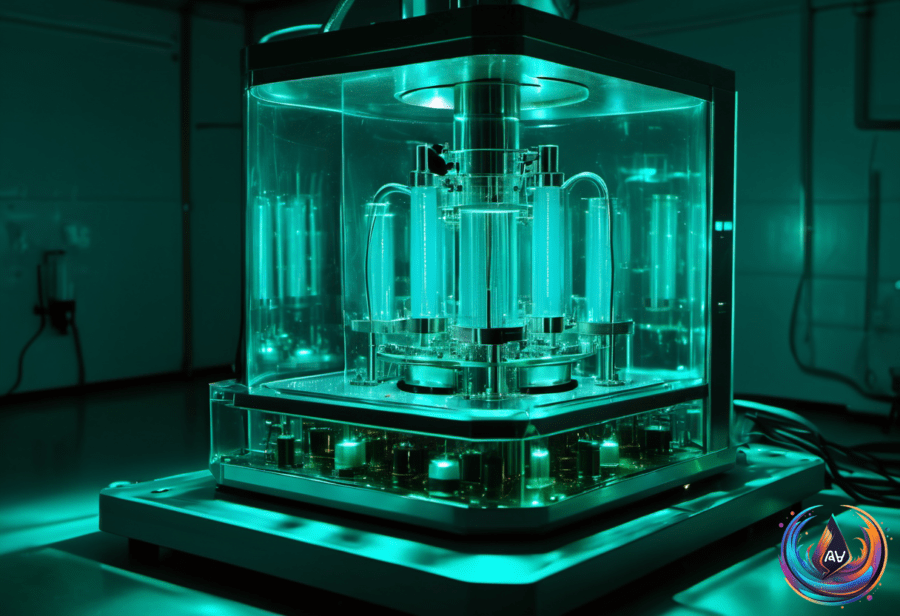
The search for dark matter is entering a thrilling new phase. For decades, scientists have chased this invisible substance that makes up most of the universe’s matter. But the usual methods haven’t revealed the answers they hoped for.
Deep underground, in places like South Dakota’s former gold mines and beneath mountain ranges, massive detectors filled with liquid xenon have hunted for a particle called a WIMP. These weakly interacting massive particles were the prime suspects for dark matter. The idea was simple: if a WIMP bumped into a xenon atom, it would produce a tiny flash of light and electric charge. But after years of searching, no WIMPs have shown up.
Instead, the detectors have started picking up neutrinos. These ghostly particles stream from the sun and stars, passing through Earth and the detectors almost unnoticed. Their presence now creates a “neutrino fog” that drowns out any faint dark matter signals. Because neutrinos can’t be blocked, this fog sets a hard limit on how far we can push traditional WIMP searches.
The Limits of Traditional Searches and New Directions
Hitting the neutrino fog doesn’t mean giving up. It means the hunt must change. Scientists now look beyond WIMPs. The truth is, dark matter could be many things. It might be heavier than Earth or lighter than a radio wave. It could be one particle or a whole family. The possibilities are vast.
This uncertainty has sparked fresh ideas. Some teams explore quantum sensors that use ultracold atoms and lasers to detect tiny changes in space and matter. Others look to new environments, like the atmosphere of Jupiter, or experiment with liquid helium to find elusive particles. The hunt is no longer narrow; it’s a wide-open field.
At Imperial College London, researchers recently demonstrated a breakthrough with quantum sensors. They built a prototype using two clouds of ultracold strontium atoms held apart and measured how they reacted to the same laser. This setup cancels out noise from the laser itself, revealing faint signals that might come from gravitational waves or dark matter interactions. This advance proves a key technique for future large-scale quantum detectors.
Listening to the Universe in New Ways
These quantum sensors could open a new window on the cosmos. They might detect gravitational waves in frequencies that current observatories can’t reach. Gravitational waves are ripples in spacetime caused by massive cosmic events like black hole mergers. Recently, scientists spotted unusual ripples that could hint at dark matter’s fingerprint. If confirmed, this would change how we study the universe’s hidden mass.
Meanwhile, Fermilab and other labs push experiments at ultracold temperatures. Their detectors, cooled near absolute zero, aim to remove all sources of noise except the faintest particle signals. These extreme conditions help scientists “listen” closely to rare events and interactions that could reveal dark matter particles or new physics beyond what we know.
Such advances require patience and precise calibration. Scientists simulate dark-matter-like signals using neutron beams underground to understand how detectors respond. This careful groundwork ensures that when real signals appear, they won’t be mistaken for background noise. It’s a slow process, but it builds a solid foundation for discovery.
These efforts show that dark matter research is not just about finding a particle. It’s about expanding what we can measure and understand. The technology developed could lead to breakthroughs in other fields, including quantum computing and materials science.
At the same time, astronomers keep mapping the cosmos. They study how dark matter’s gravity shapes galaxies and bends light. These observations confirm that about 85% of the universe’s matter is unseen. While this doesn’t tell us what dark matter is, it shows how crucial it is for the structure of everything we see.
The search for dark matter has turned from a focused chase into a broad exploration. It challenges our ideas and tools. It pushes collaborations across physics, cosmology, and quantum technology worldwide. Whether the next big discovery comes from underground detectors, quantum sensors, or cosmic ripples, the journey is reshaping how we see the universe. And that makes the next decade one of the most exciting in the history of science.
Based on
- The search for dark matter has been blown wide open — technologyreview.com
- Strange Ripple in Spacetime May Reveal First Dark Matter Fingerprint (2026) — makochestore.com
- 85% Of Matter Remains Unseen, Scientists Uncover Clues – Archynewsy — archynewsy.com
- Breakthrough Quantum Experiment Advances Quest for Dark Matter and — scienmag.com
- Dark Matter Experiment Reaches Ultracold Milestone (2026) — gibsonami.com