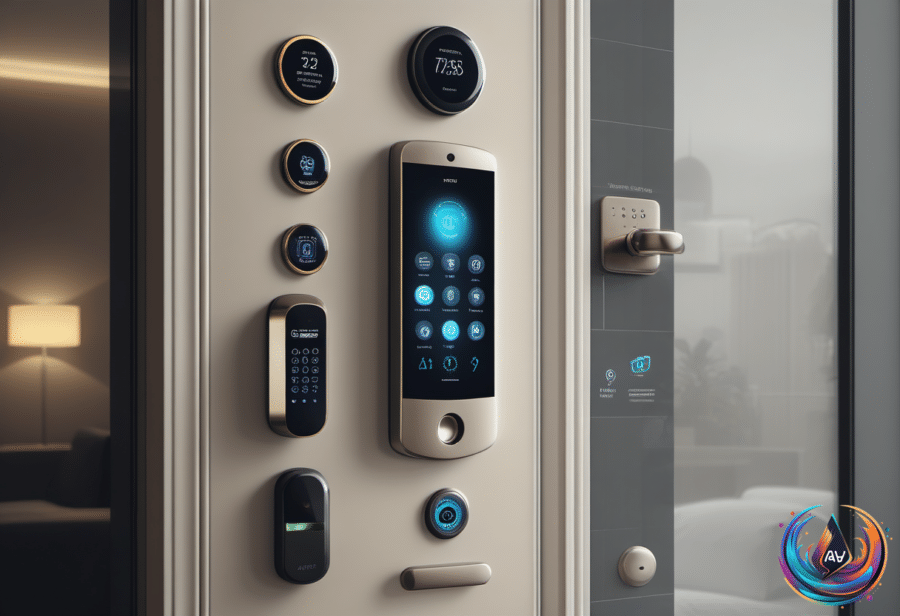
If you have stayed at a hotel in the past five years, you may have noticed that room keys have changed. Some hotels now use credit-card-sized pieces of wood that communicate with the door, while others let you unlock the room with your phone. Some offer both options.
This works because of NFC, or near-field communication. NFC lets devices exchange information over an extremely short distance, and its tags are now thin and cheap enough to buy in packs of several dozen for just a few dollars. They may look simple, but they can trigger useful actions with a single tap.
What NFC Is and How It Works
NFC is a wireless radio standard that allows different devices to exchange information. It is related to RFID, since both technologies use radio waves to send information, but the two systems work at different distances. Depending on the type, RFID signals can be read from up to hundreds of feet away. NFC only works over a very short distance under an inch.
An NFC tag contains a tiny chip, a small amount of memory, and an antenna. It has no battery, so it cannot power itself or send out a signal on its own. Instead, the tag draws power from the device reading it through magnetic induction, the same technology used to charge a phone wirelessly.
When the tag gets close enough to a reader, the reader energizes it and pulls the stored data in a blink. The tag can hold a simple command or a small piece of information, which the phone or another reader then uses. NFC can also communicate in both directions, depending on how the devices are being used.
That two-way ability explains why NFC works in several different ways. With a sticker on a poster, business card, ski lift pass, elevator, or restaurant table, you bring your NFC-enabled phone close to the tag. The phone reads it and can open a webpage, activate a feature, connect to Wi-Fi, or open a menu.
What NFC Tags Can Do
Because NFC tags are cheap and simple, people often use them to store commands that run automatically. Many smart-home owners use the stickers as physical switches. A tag placed near the exit could start a “leaving the house” routine that turns off the lights, closes the blinds, and turns on the alarm.
Restaurants can place NFC stickers on tables so customers can connect to Wi-Fi and open the menu on their phones. The tag does not need its own battery or a separate power cable. The phone supplies the energy needed to read it when the two are almost touching.
Tap-to-pay, transit gates, and hotel room keys work in the opposite direction. In those cases, your phone functions as the NFC tag. When it reaches the reader, the phone activates and sends the information stored on it.
Apple opened the iPhone’s NFC chip to third-party developers with iOS 18.1, which means apps beyond Apple Wallet can use this capability too. That gives developers more ways to build features around tapping a phone against a reader, though the phone still needs to be close enough for the NFC exchange to happen.
NFC Tags Are Not Tracking Devices
Some people think NFC tags are just thin AirTags, but they are not. An Apple AirTag has its own battery and sends out a Bluetooth signal that nearby Apple devices can pick up and report back to the owner. An NFC tag has no battery and cannot send a signal on its own.
An NFC tag activates only when it is almost touching a reader. A sticker slipped into your luggage or placed on your jacket cannot tell anyone where you are. It has no way to track your movements because it stays inactive until a reader provides power.
NFC also does not hand over your card details to a stranger brushing past your pocket. Both Apple and Android phones need to be unlocked before they activate NFC capabilities. The exception is Express Mode for transit cards, which skips that check so you can get through a gate faster.
Most people leave NFC turned on because it uses very little power and activates only at very close range. If you still want to disable it, Android lets you switch NFC off in Settings, under Connections or Connected devices, depending on the phone brand. On an iPhone XS and newer, NFC is always on and cannot be turned off.
Why the Short Range Matters
NFC’s short range is one of its defining features. RFID can work from much farther away, with some signals readable from hundreds of feet, but NFC requires the reader and tag to be under an inch apart. That makes NFC useful for deliberate actions such as tapping a phone at a payment terminal, opening a hotel door, or touching a sticker with a phone.
The result is a technology that feels almost invisible. A tag can be hidden inside a card, attached to a table, placed beside a door, or built into a room key, yet it remains simple to use: bring the reader close, let it energize the tag, and allow the stored command or information to do its job.
Based on
- What is an NFC tag and how does one work? — engadget.com
- The Pros And Cons Of Using Your Phone As A Mobile Hotspot — engadget.com
- What’s The Meaning Of The “A” On Your USB-A Ports? — engadget.com
- 5 Emerging Technologies That May Soon Become Part Of Everyday Life — engadget.com
- Should You Keep Your Smart Home Gadgets On A Separate Home Network? — engadget.com