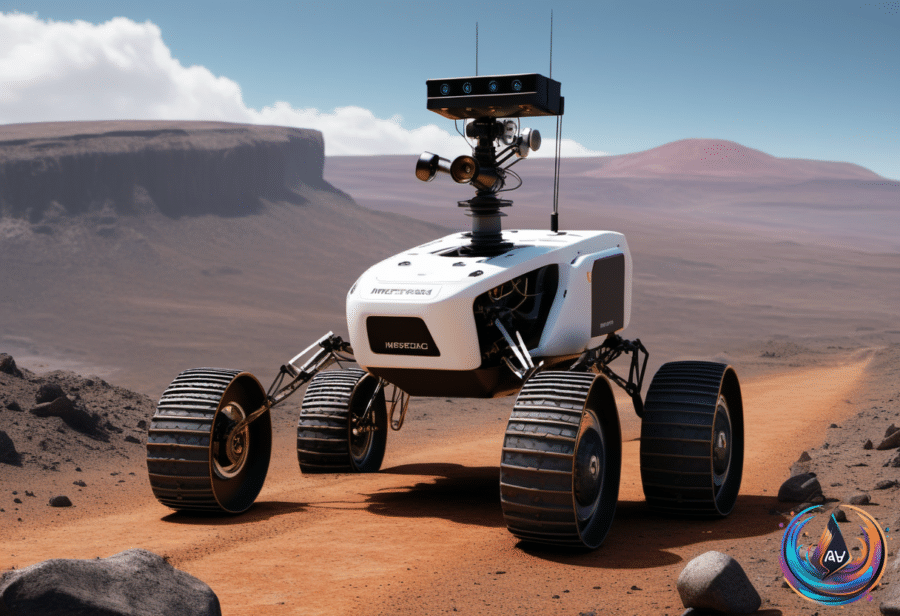
NASA’s Perseverance rover has set a new record for the farthest distance driven by a vehicle on another planet. As of October 11th, 2026, the rover had traveled 28.10 miles, or 45.22 kilometers, across Mars.
That distance edges past the previous record held by NASA’s Opportunity rover, which covered 28.06 miles, or 45.16 kilometers, between 2004 and 2018. Perseverance has now traveled farther than any other vehicle on the surface of another world, even though its maximum speed is only 0.1 mph.
A record built one careful drive at a time
Perseverance arrived on Mars in 2021, and its original mission called for just 20 kilometers, or 12.4 miles, of driving. The rover has already traveled more than twice that distance while its scientific instruments focused on Jezero Crater, the region where it is exploring.
The rover is now moving through a region called Idubi and investigating a feature named “Lac de Charmes.” NASA says the rocks and terrain there are so ancient that their Earthly equivalents have long since disappeared through erosion and plate tectonics. Mars does not have tectonic plates, and the science team hopes Idubi will preserve traces of ancient hydrothermal systems.
Those locations matter because they add to Perseverance’s search for evidence about Mars’s past. Steven Lee, NASA’s Jet Propulsion Laboratory project manager for Perseverance and Curiosity, said the areas may once have provided “a warm, watery subsurface environment conducive to life.”
Lee also described the rover’s discovery of a potential biosignature, or possible sign of ancient microbial life, as Perseverance’s biggest achievement. That discovery was unveiled last year, adding a scientific milestone to the rover’s growing driving record.
How Perseverance drives across unfamiliar ground
Perseverance does not need instructions for every wheel movement. Its autonomous AutoNav system lets the rover image terrain, identify hazards in real time and drive automatically between waypoints. The system can process 600,000 measurement points with each glance.
Lee said, “Perseverance takes stereo images of the terrain ahead, generates a 3D software map, and selects the safest path towards a drive goal.” The rover can handle 90 percent of its driving autonomously, which allows it to cover ground while responding to the terrain in front of it.
Its driving methods have also changed as the mission has continued. Perseverance can now roll more and steer less, reducing wear on its parts, and it can check its position against orbital maps in the middle of a drive. NASA has tested the hardware and mechanisms behind its mobility system across a range of 93 miles to 186 miles, or 150 to 300 kilometers.
That testing range is far longer than Perseverance’s original 20-kilometer driving plan. The difference shows how the rover’s mission has expanded from a carefully defined route into a long-running exploration effort across Jezero Crater.
A record with more miles ahead
Perseverance is not the only NASA rover still represented in the distance comparison. Its companion rover Curiosity, which explores Gale Crater, has traveled 23.7 miles, or 38.15 kilometers, to date. The Apollo 17 rover traveled 22.21 miles, or 35.74 kilometers, the farthest distance among the Apollo lunar rovers.
NASA recently approved an extension of Perseverance’s mission until roughly the end of 2028. The rover’s plutonium-based power system is performing as expected, with many years of useful energy remaining, giving the mission room to continue its work after the record reached on October 11th.
Perseverance’s engineering hardware and instruments are in excellent shape, with all redundant systems still available, Lee said. A recent assessment of all systems concluded that they are capable of operating well into the 2030s, likely beyond.
That assessment puts the new distance record in perspective. Perseverance has already exceeded its planned driving distance, passed Opportunity’s mark and moved beyond every other vehicle that has driven on another world. Its next miles will carry the rover through Idubi and Lac de Charmes while its instruments continue examining the ancient history of Mars.
Based on