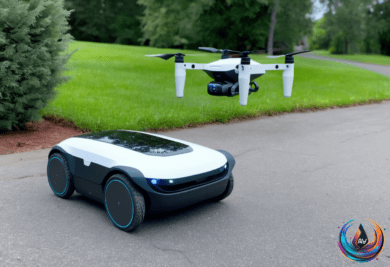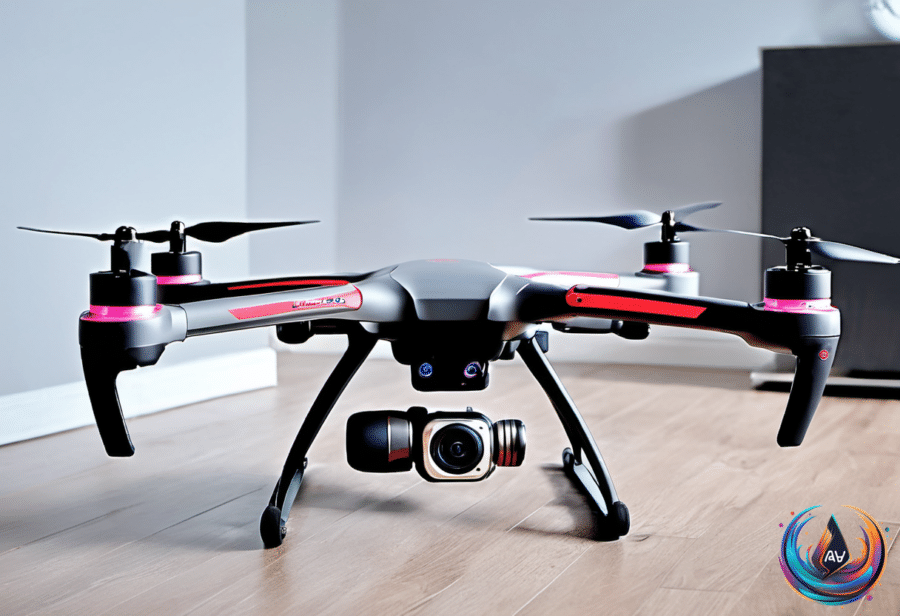
Ring is putting cameras on the move. Amazon has unveiled the $250 Ring Drone Cam and the $999.99 Ring Rover Cam as the first products in its new Ring Robotics category of autonomous, mobile security devices. The Rover Cam is scheduled to begin shipping on December 16, while the Drone Cam is scheduled to ship on January 27, 2027, pending approval from the Federal Communications Commission.
The Drone Cam is a 165-gram quadcopter designed for indoor patrols. It carries a 2K camera and two LEDs on the front, plus a 1080p camera and an additional light underneath, giving it a view of the home and enough illumination for dark corners.
Ring also wants those lights to act as a deterrent. Executives said the moving lights can resemble a security guard raising a flashlight and checking a darkened home—an expensive way to recreate a familiar bit of theater, but potentially useful when a motion or leak sensor raises an alert.
A flying camera with a short battery leash
The Drone Cam can follow preconfigured schedules, respond to a motion or leak sensor, or launch when a user taps a destination on the Alexa Home Map. Amazon first announced that 3D map view last month, and it lets the drone chart its own path instead of requiring users to steer it through every room.
Users cannot manually control the drone. They can create flight routes and patrol schedules, and the device can respond to motion, door, or window sensors, but it must stay inside because it relies on Wi-Fi and the Alexa Home Map to navigate.
Amazon says the battery supports about eight to 10 minutes of flight, depending on the altitude of the route. Other specifications put flight time at five to eight minutes per charge. When the battery runs low or the drone loses its Wi-Fi connection, it lands or returns to its dock; eight minutes of charging provides one minute of flight time.
The Drone Cam runs a motor health check before every takeoff and will not fly if it detects a problem. Its propellers produce a loud buzz by design, which Ring says would make remote snooping difficult without alerting people in the home. The device will not fly outdoors, and its weight falls below the 250-gram threshold referenced for Federal Aviation Administration registration.
Ring has been working toward this product for years. Jamie Siminoff says he had the idea for a flying sentry in 2016, while Ring previewed the Always Home Cam in 2020 and announced another drone in 2021. Products went into boxes but never shipped, and another false start arrived in 2025.
Earlier designs added sensors and computing hardware, increasing weight, power use, and safety concerns. Larger propeller shrouds then reduced flight performance, while Siminoff said a fully equipped version could have pushed the price beyond $5,000. Cloud processing changed the equation by moving most of the intelligence away from the aircraft.
Astro returns as a business security robot
The same AI Pilot system powers both products. Ring says it “maps the space, suggests patrol points, and autonomously navigates around obstacles,” allowing the devices to avoid people and objects without carrying a local AI model and the processors needed to run it.
The Rover Cam applies that approach to warehouses, factories, offices, and other large facilities. It rolls on two large wheels, handles small obstacles or uneven terrain, and can travel to a room, a point on a patrol route, or a location where another Ring device has triggered an alarm.
While moving, the Rover Cam streams and records video. At its destination, it performs a 360-degree scan, while its telescoping 4K camera can rise to programmed heights to see over counters, shelving, and other obstacles. A built-in siren and flashing red light provide deterrence, and a blue ring projected onto the ceiling helps workers locate the robot across a warehouse.
The Rover Cam borrows much of its hardware from Astro, Amazon’s home robot first debuted in 2021. Astro’s cupholder is gone, replaced by a stubby tower, while the screen now shows status messages such as when recording is active; microphones and speakers support two-way talk, and Alexa is not available through the robot.
The Rover Cam has an estimated 30-minute battery life and covers facilities up to 5,000 square feet on a single floor. It returns to its charging dock after a patrol, and multiple floors require multiple robots or a pairing with the flying Drone Cam.
That history gives buyers a reason to study the fine print. Amazon launched Astro for Business at $2,349.99 in 2023, then discontinued it a year later; another account says the business robot was bricked 10 months after launch. The Rover Cam costs less, but the risk of Amazon abandoning another robot has not vanished.
Privacy remains the larger question. Amazon says, “Privacy isn’t just a feature of Ring Robotics; it is the default.” When docked, the drone powers down and turns off its camera, recording only when “a flight is triggered,” while both products use TAKE, or Throw Away the Key Encryption, to protect video.
TAKE encrypts video in transit and rotates keys every few minutes, but Ring temporarily holds a key to run cloud-based AI features before deleting its copy. That creates a brief server-side access window, so the system is not as foolproof as true end-to-end encryption. Every Ring account requires two-factor authentication.
Thorin Klosowski, a senior security and privacy activist at the Electronic Frontier Foundation, says people should “think through” how mobile cameras will affect household members and visitors. Ring’s new category makes security more active, mobile, and harder to ignore—which is exactly why the technology needs more than a charging dock and a reassuring slogan.
Based on
- Amazon finally launches the $250 Ring Drone Cam and also the Ring Rover Cam — engadget.com
- Ring’s Indoor Drone Camera Is Back—and Now Powered by AI | WIRED — wired.com
- Amazon’s Ring unveils flying drone, robot to patrol homes, businesses — cnbc.com
- Amazon turned its Alexa robot into a Ring security patrol bot | The Verge — theverge.com
- Eufy’s Clever Outdoor Security Camera That Lives Inside Is Now Available To Buy — engadget.com