Dolby Atmos can make a movie night feel more immersive without turning the living room into a full home theater. The format adds a sense of height and space to sound, helping viewers feel surrounded by what they hear. The catch is that a television’s built-in speakers rarely deliver the experience they promise.
Many TVs include speaker arrays that support Dolby Atmos, but most built-in speakers remain compact and point downward or toward the back of the set. Even top-of-the-line TVs with internal Atmos support can struggle to push sound forward into the room. That leaves dialogue, effects, and music sounding thinner than they should.
Why a soundbar can make a big difference
A soundbar offers a simple way to improve that situation, and immersive sound does not have to break the bank. Some Atmos-compatible soundbars from Amazon, TCL, LG, and others cost under $200, putting a noticeable audio upgrade within reach for many TV owners.
That price comes with a tradeoff. Many budget Atmos soundbars create the effect with virtualized Dolby Atmos instead of genuine up-firing speakers. Virtual sound processing can make audio feel wider and more spacious, but it does not recreate the same physical effect as sound coming from speakers aimed toward the ceiling.
Many soundbars with Dolby Atmos do include internal drivers pointed upward. Those drivers bounce sound off the ceiling before it reaches the listener, creating a greater sense of height than a basic television speaker can provide. The ceiling reflection will not match a full speaker system, but it can still change how movies and shows fill the room.
As Yoni Yardeni put it, “While the level of immersion is virtually incomparable to actual upward-firing drivers, it still offers a clear upgrade over most internal TV speakers.” That distinction matters because a soundbar does not need to match a dedicated theater to be useful. It only needs to solve the weaknesses of the TV sitting in front of you.
Soundbar convenience versus full surround sound
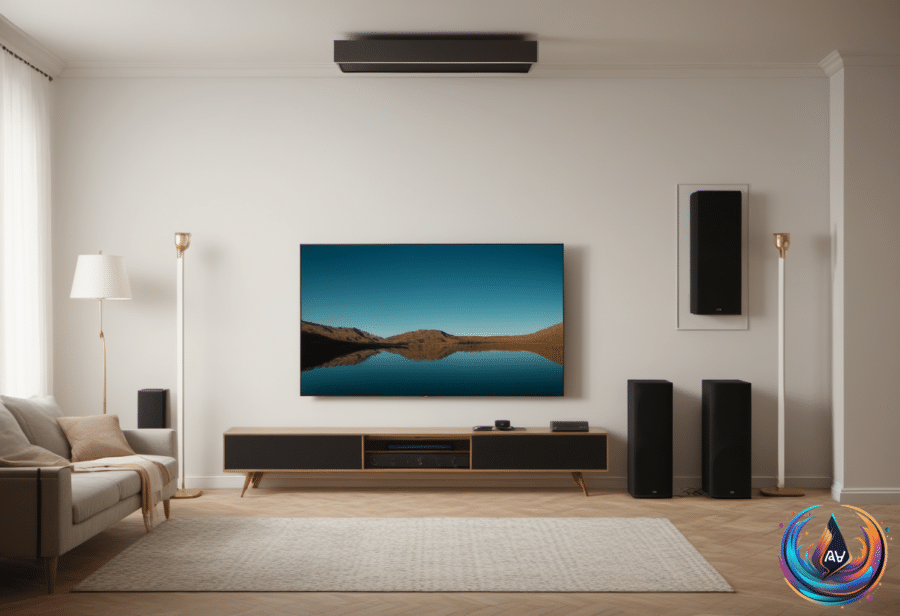
A real surround sound system remains the strongest choice for maximum immersion. Modern formats such as Dolby Atmos and DTS:X use object-based mixing, which requires sound sources overhead to create a convincing three-dimensional sound field. Separate speakers can place those sounds around the room with more precision than a single bar below the TV.
A soundbar cannot fully match that performance. A blind test found that participants could distinguish between a high-end soundbar and a surround sound system. Participants were better able to understand dialogue and to feel, well, surrounded by sound.
Still, the best technical result is not always the best choice for a real living room. Few participants said they would buy a surround sound system over a soundbar because of the space and setup concerns. A full system needs room for several speakers, along with the patience and expertise required to connect and position them.
That makes a soundbar most useful in rooms that cannot accommodate multiple speakers or for people who want a simple setup. It can improve clarity and add a wider, more immersive presentation without filling the room with equipment.
The middle ground for stronger Atmos sound
For shoppers who want more than a basic bar but do not want a full surround setup, a 5.1.2 soundbar with rear speakers and a subwoofer offers a middle ground. The bar handles the front soundstage, the rear speakers add sound behind the listener, and the subwoofer brings more weight to low-frequency effects.
This kind of setup still demands more space than a single soundbar, but it can deliver a closer approximation of surround sound without the full cost and complexity of a receiver-and-speaker system. It also avoids relying on the TV’s small internal speakers for the entire experience.
Price is the other major dividing line. An entry-level surround sound system can cost close to a thousand dollars, while a bargain or overperforming system might cost around $700. Mid-range or higher systems can reach the mid four-figures, which places them far beyond the budget of a soundbar costing under $200.
If space, money, and expertise are available, investing in a receiver and speakers remains the recommendation for detailed home theater audio. That route delivers the most control and the strongest sense of position, but it asks more from the room and the person setting it up.
For everyone else, an affordable Atmos-compatible soundbar offers a practical starting point. It will not turn a television into a full surround system, and virtualized Atmos cannot equal genuine upward-firing drivers. But it can make dialogue easier to follow, give effects more room to move, and bring a clear upgrade over most built-in TV audio.
Based on