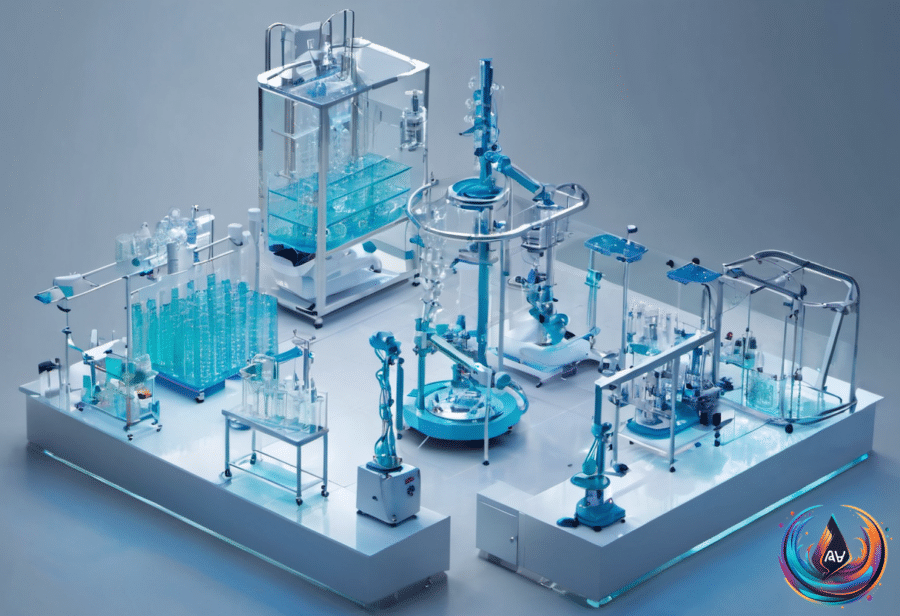
Warp Sciences has raised $215 million to bring AI and robotics into the drug discovery laboratory, giving pharmaceutical and biotechnology companies a new way to make and test molecules. The startup, founded by former leaders from OpenAI, Meta, Terremoto Biosciences, and Devoted Health, now carries a valuation of $865 million.
Its first move is clear: automate lead optimisation through analogue synthesis. Warp will combine chemists, robotic systems, and AI models trained on laboratory experiments to produce molecular variations for drug candidates, then test those molecules as part of customer-led research programmes.
A Chemistry Lab Built Around the Experiment
Warp Sciences will operate as a chemistry contract research organisation, or CRO. That means it will make and test molecules for pharmaceutical and biotechnology companies rather than develop medicines under its own drug pipeline.
Customers will decide which molecules to pursue, while Warp provides the chemistry services and laboratory systems needed to move those programmes forward. The company says its initial offering will focus on lead optimisation through analogue synthesis, a process that creates and evaluates related molecular versions of a drug candidate.
The company plans to train AI models on data generated through physical experiments. Each round of molecular design and laboratory testing will feed the next stage of research, creating a feedback loop between the model, the lab, and the scientists directing the programme.
Manohar Paluri captured that goal in a simple line: “Every experiment should make the next one smarter.”
That approach places the laboratory at the centre of the AI system. Instead of treating AI as a separate software layer, Warp intends to connect molecular design, robotic execution, testing, and the next research decision in one cycle.
Former OpenAI, Meta, and Health Leaders Join Forces
Warp Sciences was co-founded by Kevin Weil, Solomon Reisberg, Manohar Paluri, and DJ Patil, bringing experience from AI, medicinal chemistry, technology, healthcare, and public-sector data science into one company.
- Kevin Weil is a former Chief Product Officer and Vice-President of Science at OpenAI.
- Solomon Reisberg held medicinal chemistry leadership roles at Terremoto Biosciences.
- Manohar Paluri is a former Vice-President at Meta Superintelligence Labs.
- DJ Patil is a founding executive at Devoted Health and the first US Chief Data Scientist at the White House.
Weil says the opportunity remains wide open beyond software and mathematics: “AI has dramatically accelerated software engineering and mathematics, but it has yet to make the same impact in the physical sciences.”
Warp’s model responds to that gap by pairing AI systems with physical chemistry work. The company is not promising to choose its own medicines or build a private drug pipeline; it is building services for customers that want to control their own discovery programmes.
Funding Targets US-Based Chemistry Services
Lightspeed led Warp Sciences’ $215 million funding round, with participation from Premji Invest, Mayfield, IVP, Lux, Conviction, Menlo Ventures, 01 Advisors, and other investors. The round also drew angel backing from Coinbase CEO Brian Armstrong, Databricks co-founder Ion Stoica, and Figma CEO Dylan Field.
The funding will support Warp’s plan to offer US-based chemistry services focused on research speed, intellectual property protection, and pricing. Its facilities are intended to give pharmaceutical and biotechnology companies greater control over where sensitive research takes place.
Warp also says its facilities will protect intellectual property and reduce costs compared with US boutique CROs. That combination puts the company’s value proposition beyond automation: customers get a physical research environment, chemistry expertise, robotic systems, and AI models connected to data from real experiments.
The strategy also reflects the limits of a software-only approach to drug discovery. Molecules must be made, tested, and refined in the physical world, and each experiment can produce the data needed to improve the next design. Warp wants that loop to become the engine of its service.
With $215 million behind the effort and a $865 million valuation, Warp Sciences is positioning itself at the intersection of AI, robotics, and drug research. Its customers will choose the medicines to pursue, while Warp builds the systems intended to help them explore molecular possibilities with greater speed, control, and protection for sensitive research.
Based on