AI is changing how scientists discover new medicines and materials. It speeds up processes that once took decades. Drug discovery now benefits from machine learning models that solve problems no one could before.
AstraZeneca is a leader in this AI-driven push. They use AI to design biologic drug candidates faster. Their approach follows a build-measure-learn cycle. AI generates or ranks molecules, then the lab tests them. This loop repeats to find the best candidates.
Puja Sapra, head of biologics engineering at AstraZeneca, says, “Everything we do, whether it’s design, make, test, or analyze, is now computationally enhanced.” She adds, “Data is our differentiator.” AstraZeneca’s datasets include molecular structures, safety profiles, and manufacturing results. This data feeds AI models to improve drug discovery.
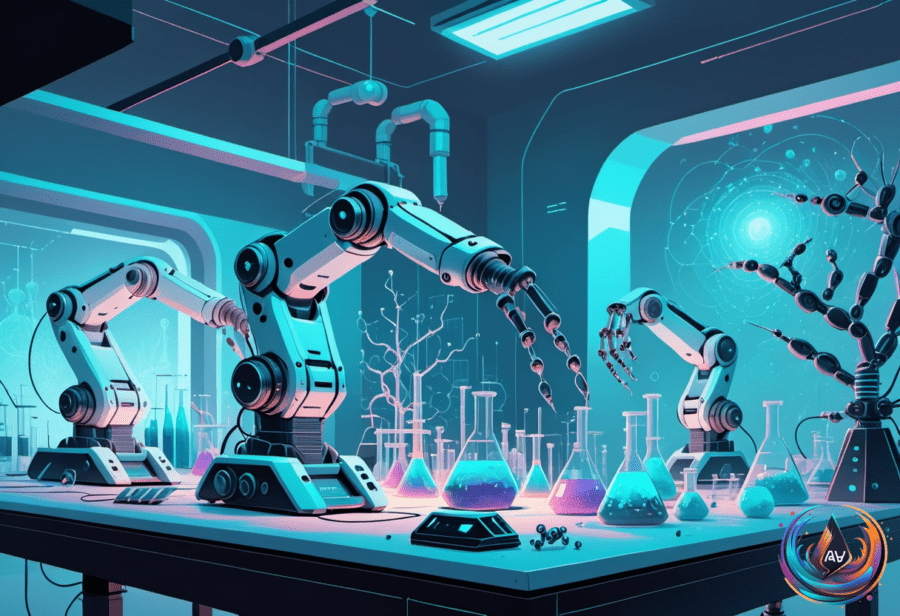
McKinsey estimates AI could cut drug discovery time by half. That means treatments could reach patients much faster. AstraZeneca is building a “lab of the future” in Cambridge, Massachusetts. It combines AI with robotic automation. This setup will make and test thousands of molecular interactions every week in a closed loop.
Breaking New Ground Against Antibiotic Resistance
AI also helps fight antibiotic resistance—a global health threat. Researchers at MIT, led by James Collins, developed a deep learning model to screen antibiotics against the bacteria Neisseria gonorrhoeae. The model virtually screened over 5 million compounds and found two strong candidates, MP20 and A1. These had activity comparable to ceftriaxone, a last-resort antibiotic.
This breakthrough comes from high-throughput virtual screening. The AI model screened nearly 40,000 small molecules quickly. It found protein binders with impressive strength, such as one with a dissociation constant (Kd) of 80 picomolar. Another molecule, EPIC, had a Kd of 120 nanomolar, and a modified version, EPIC(Q51N/M97L), improved to 1.2 nanomolar.
These results show AI can identify powerful drug candidates that traditional methods might miss. The future of drug discovery will rely on AI to spot patterns in biological data rather than testing every hypothesis manually.
AI’s Role in Advanced Materials and Computing
Beyond healthcare, AI drives innovation in materials science. Advanced materials like polymers, elastomers, and specialty fluids are crucial for AI hardware. They enable faster chips, better data storage, and improved thermal management in data centers.
Syensqo develops next-gen perfluoroelastomers without fluorosurfactants. They stress that “Progress is earned. Every new generation of technologies raises the bar, and every new material must prove it can deliver the performance, reliability, and efficiency needed before it earns its place.”
Making semiconductor chips involves thousands of precise steps. AI helps control these processes for higher purity and stability. As computing density grows, data centers need better power architectures and faster data transmission. AI tools like Microsoft’s Discovery platform speed up finding promising materials for these uses.
Advances in AI depend on better algorithms, more powerful chips, and larger infrastructure. But materials innovation plays a key role too. Without new materials, AI hardware cannot reach its full potential.
New Scientific Approaches Powered by AI
Experts say traditional knowledge can limit AI and biology progress. Richard Sutton, a computer scientist, says, “The most successful AI breakthroughs involved humans getting out of the way and allowing increasingly powerful computers to take over.” He adds, “The actual contents of minds are tremendously, irredeemably complex.”
AI and nanotechnology enable new drug discovery methods based on pattern recognition in biological data. Biohub unveiled an AI “world model of protein biology” in May. Nvidia introduced BioNeMo, an AI toolkit for scientific discovery.
These AI models will soon operate in agentic loops. They will conduct physical experiments and analyze results automatically. This industrialized trial-and-error will drive new breakthroughs faster than ever before.
One scientist described this process as “an unfathomable amount of spaghetti being thrown against the biggest wall ever by computers and robots.” The goal? To find the way forward by industrializing experimentation until breakthroughs appear.
AI is not just a tool. It is becoming a key player in designing medicines, developing materials, and reshaping how science itself works.
Based on
- How AI helps scientists design the next generation of medicines — technologyreview.com
- Advancing next-gen AI with materials science innovation | MIT Technology Review — technologyreview.com
- AI teaches a bitter biology lesson | Semafor — semafor.com
- Outracing antibiotic resistance with deep learning | Nature Biomedical Engineering — nature.com
- Designed to bind | Nature Chemical Biology — nature.com