Amazon now has over 1 million robot workers moving through its operations, yet more than 1.5 million human employees still work for the company. That creates a striking question for the future of work: will robots replace people, or will they reshape what human employees do?
The answer is taking shape inside warehouses, factories, and other work environments where machines and people operate near one another. Amazon’s robotic fleet keeps expanding, and most of those machines are wheeled mobile robots rather than humanoids. The company’s next challenge is not simply adding more robots, but connecting them to systems that can work across more tasks and locations.
Amazon’s Million-Robot Workforce
Amazon is the second-largest corporate employer in the world, with more than 1.5 million full-time and part-time human workers. Its robotic workforce has now passed 1 million, giving the company a huge machine population alongside its human employees. Amazon also has 200 million Prime subscribers, adding scale to the operations supported by this combination of workers and robots.
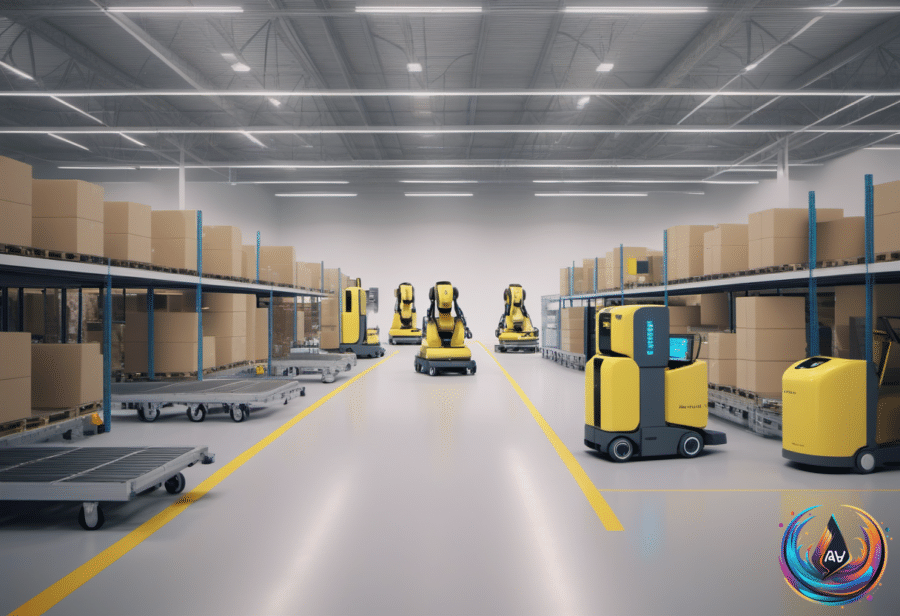
The company’s robotics story began with its acquisition of Kiva Systems in 2012. Amazon renamed the robotics company Amazon Robotics, and its fleet has grown far beyond the original systems that moved items across fulfillment centers. Today, most of Amazon’s million-robot fleet consists of wheeled mobile robots that transport goods and support warehouse work.
Amazon says its Sequoia robotic system can identify and store items up to 75 percent faster at fulfillment centers. That claim points to the practical value of automation: robots can help move products through a facility while human workers handle other parts of the operation.
Scott Dresser, vice president of Amazon Robotics, described the company’s progress as a series of difficult technical steps: “Each step of the way, [we are] tackling a hard or deep set of technical challenges to achieve that goal.” The goal is not just a larger robot count. It is a more capable system that can perform useful work across complex environments.
Physical AI Moves Beyond Fixed Machines
The next stage reaches beyond wheeled warehouse robots. Nvidia’s Halos system launched in 2025, and Nvidia expanded its safety architecture to more physical AI technologies by announcing Nvidia Halos for Robotics in June 2026. Agility Robotics’ Digit humanoid robot uses Nvidia’s Halos system, linking the safety architecture to a machine designed for work in human environments.
Nvidia’s physical AI business was already driving nearly $10 billion in annual revenue for the company as of March 2026. The company is also connected to a market that includes Boston Dynamics, Hyundai, KION Group, LG, Unitree, Tesla, and UBTech. Hyundai is planning to deploy Atlas robots, KION Group is deploying autonomous mobile robots, and LG is developing humanoid robots.
The market is not limited to machines with human shapes. About 7,000 full-size humanoids were sold in 2025, but the latest push by the United States, China, and Europe extends well beyond humanoids. Robots are being tested in many new environments, with wheeled systems, autonomous mobile robots, and humanoids each taking different roles.
Amit Goel, head of robotics ecosystem and edge computing at Nvidia, described the change in physical AI with a sharp image: “Now the robot is literally unchained—the safety goes with the robot wherever it goes.” That portability could let robots move between tasks without relying on a separate safety setup for every location.
Goel also said, “Now they can operate everywhere in a factory or a warehouse without having to set up a brand new infrastructure every time they want to do a new task.” That flexibility brings a tradeoff, he added: “Because giving flexibility can come at the cost of losing some control over the stack.”
What Comes Next for Human Employees?
Amazon’s numbers show that robots and people are expanding side by side, at least for now. More than 1.5 million human workers remain part of the company’s workforce, even as its robot population moves past 1 million. The central change may come from how those workers interact with machines that can travel, identify objects, store items, and take on tasks across a facility.
Brian Greenwood, a professor of business at George Mason University, contrasted this shift with older forms of automation: “For the last 100 years, most of the automation that we’ve seen usually happens away from workers—you’re taking that high-risk task away from the worker, and you’re doing so in a way that is not physically proximate.”
That distance is shrinking. Robots are moving into spaces where human employees already work, and safety systems are being designed to travel with them. The result is a workplace where the key question is no longer whether automation exists, but how people and machines divide responsibilities.
Amazon’s Sequoia system shows what this division can look like today, with the company claiming up to 75 percent faster item identification and storage. Nvidia’s Halos systems point toward a broader future in which robots operate across factories and warehouses without new infrastructure for every task.
The robot workforce has already crossed a landmark, but the bigger transformation is still ahead. Amazon’s million-plus machines, its more than 1.5 million human employees, and the expanding physical AI business around them are creating a new test for work: how much more can people accomplish when robots move from tools in the background to active partners on the floor?
Based on