What happens when an image can look true, false, or both at once? Jess and Morgs take that question onto the stage with Deepfake, a theatrical dance work that confronts the politics of deception through cameras, green screens, live performance, and artificial intelligence.
The work arrives at a moment when trust can fracture around a single image. Its story follows the shifting relationship with the landscape of truth, asking what happens when people believe false images and disbelieve true ones. That danger turns deepfakes from a technical trick into a crisis of confidence.
A Stage Built Inside the Image
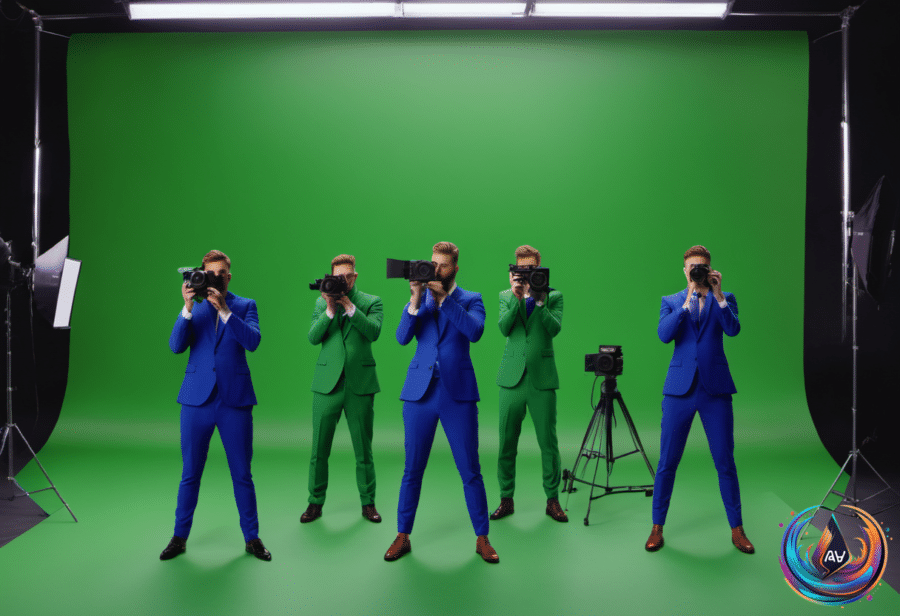
Deepfake takes place in a green-screen studio, where a journalist interviews a politician live. Four cameras film the interview as it happens, while background footage is edited into the scene. Seven dancers in green-screen suits manipulate the environment, turning the stage into a space that can change around the people at its center.
The setup makes the mechanics of image-making visible. Viewers can see the cameras, the performers, and the green-screen suits, yet the surrounding world keeps shifting through edited footage. The show does not hide the process behind a polished digital surface. Instead, it places the machinery of representation in full view and makes that machinery part of the drama.
Green-screen technology can look lo-fi, with a silent movie quality that exposes its own construction. AI deepfakes create the opposite challenge. They can look hyper-real, making an image feel complete and convincing even when it does not show what truly happened.
That contrast drives the work’s central tension. One kind of image reveals its trick, while the other can bury its uncertainty beneath realism. The audience is left to consider how much trust a picture deserves when technology can shape the setting, the evidence, and the story around it.
When Proof Stops Feeling Solid
The danger of deepfakes is not only that false images may persuade people. It is also that true images may lose their power. Once viewers know that images can be fabricated, any image can become a target for doubt, and that doubt can spread beyond one disputed moment.
That is the political pressure at the heart of Deepfake. A live interview between a journalist and a politician carries the familiar promise of direct questioning, yet the cameras and edited backgrounds keep challenging that promise. What looks like a record of events can also become a constructed environment.
The work connects this tension to Jeremy Paxman’s 1997 grilling of Michael Howard, when Paxman asked the same question 12 times. That exchange stands as a powerful image of political questioning and the demand for a clear answer. Deepfake places that search for clarity inside a world where the image itself can no longer settle the argument.
What follows is not a simple warning about new technology. The show explores how truth changes when people must judge images that may have been altered, edited, or generated. It asks whether skepticism protects people from deception or leaves them unable to trust anything at all.
From AI Cautionary Tale to Deepfake Reality
Jess and Morgs have explored technology and its consequences before. Their 2022 piece Coppélia, made for Scottish Ballet, turned a 19th-century ballet into a cautionary tale about AI and tech egos.
Deepfake carries that interest into a more direct confrontation with the politics of images. The duo, Jess, also known as Jessica Wright, and Morgann Runacre-Temple, made their debut at the Paris Opera Ballet earlier in 2026. Their new work continues a path through technology, performance, and the stories people tell about machines.
Both Wright and Runacre-Temple describe the piece in the same terms: “It’s really about the strange shifting relationship with the landscape of truth.” That landscape is no longer fixed behind the camera. It can be edited, extended, replaced, or made to look convincing through technology.
The result is a stage where the question of truth never settles. Four cameras capture the interview, seven dancers reshape the environment, and the green screen exposes the gap between what viewers see and how that image comes into being. The production turns that gap into its most urgent subject.
The article carries timestamps of Thu 24 Sep 2026 10.03 BST and Thu 24 Sep 2026 14.20 BST. Those markers place the discussion in the present, but the question reaches beyond one date: how will people decide what to trust when images can persuade them in opposite directions?
Deepfake does not offer a neat answer. It stages the uncertainty itself, making doubt move through the cameras, the dancers, the interview, and the changing landscape behind them. As AI-generated images become harder to separate from recorded reality, that theatrical question will only grow louder.