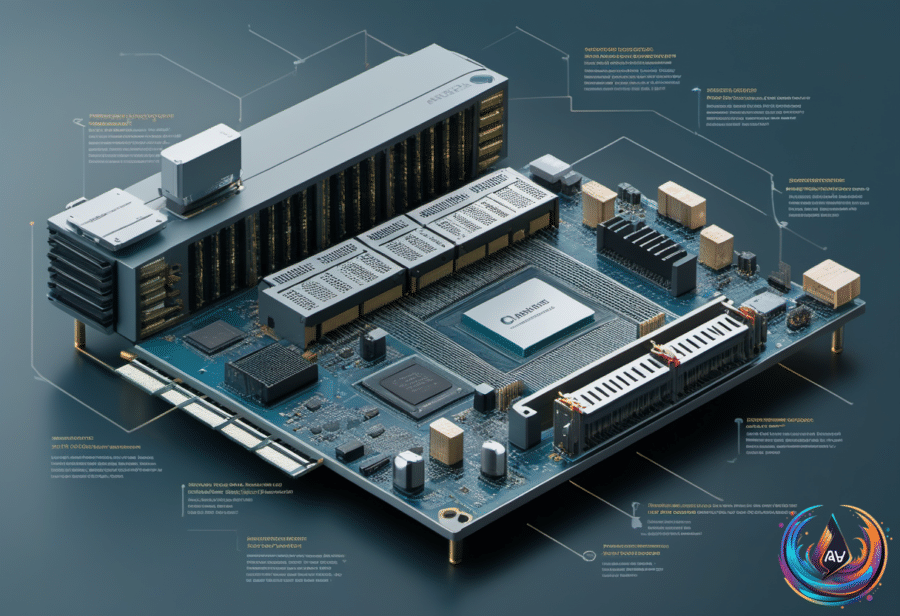
Google added two systems to its eighth-generation TPU lineup. Announced today, TPU 8i Max targets massive context windows and rack density, while TPU 8tx focuses on secure, confidential inference for regulated enterprises and governments. These are new system configurations, not new chips—Google is reusing its existing eighth-generation silicon and changing the packaging, hosts, memory and networking around it.
The additions arrive alongside TPU 8t and TPU 8i, which Google announced in April. That brings four new TPUs in one year, although the more useful distinction is what each configuration does with the silicon already on hand. Hardware announcements love a new name; this one comes with a new arrangement instead.
TPU 8i Max doubles down on memory
TPU 8i Max combines two low-latency TPU 8i chips in one package. Google positions the design as an attack on the memory wall, giving applications more room to handle agents working across whole codebases or hours of video without changing the existing rack footprint.
Each TPU 8i chip is rated at 10.1 PFLOPS of FP4, 288 GB of HBM and 8,601 GB/s of HBM bandwidth. It also carries 384 MB of on-chip SRAM. By placing two chips in one package, TPU 8i Max doubles compute, SRAM and HBM bandwidth compared with TPU 8i.
That implies about 20.2 PFLOPS of FP4 compute, 768 MB of SRAM and 17.2 TB/s of bandwidth per package. The package fits twice the silicon into the existing rack footprint, giving Google a direct answer to workloads whose problem is not only compute but the distance between computation and data.
TPU 8tx brings confidential computing to inference
TPU 8tx uses the same silicon as TPU 8t, pairing it with 5th Gen AMD EPYC CPU hosts and the Boardfly network adopted from TPU 8i. Its target is different from TPU 8i Max: regulated businesses and government agencies that need sensitive data and model weights protected during active use.
Normally, data must be decrypted in memory during processing. Google says TPU 8tx keeps data and model weights protected while they are in use, delivering hardware-enforced confidential computing in a cloud Tensor Processing Unit system for the first time.
Google claims up to two times lower latency than TPU 8t, with a near-zero security penalty. Teams can fine-tune, distill and run reinforcement learning on one system, avoiding the need to move sensitive data between separate clusters. AMD says its 5th Gen EPYC processors provide the host infrastructure and combine host processing, security capabilities and x86 software compatibility.
The software layer is expanding around both configurations. TorchTPU, open-sourced last month, runs PyTorch and Hugging Face models natively, while vLLM and SGLang are getting TPU backends. The TPU agent suite, now in preview, plugs into Claude Code, Cursor and Antigravity for onboarding and kernel tuning.
Google also introduced TPU Sync, an open-source C++ library that tiers KV cache across HBM, host DRAM and storage. Agent Compute Engine suspends idle agent sessions and moves working memory off-chip. The preview is targeted for the coming months, which is a polite way of saying the parts that matter to developers are not all finished yet.
Cloud Pathways and GKE dynamic slicing are now generally available. Dynamic slicing cuts job startup time by up to five times and speeds fault recovery by up to 4.5 times, addressing the less glamorous delays that can make expensive accelerator capacity sit idle.
Google cites tests on Qwen3 235B showing TPU Sync reduced median KV transfer latency from several seconds to about 230 milliseconds. TTFT fell by 60% on average for 235B and 90% for 480B under low concurrency, but those tests ran on Ironwood, the TPU v7x platform—not the new TPU 8i Max or TPU 8tx systems.
That qualification matters. TPU 8i Max is a packaging and density play for large-context workloads; TPU 8tx is a confidential-computing system built around TPU 8t silicon and AMD hosts. Google is not presenting one universal accelerator, because the market has stopped pretending that one configuration can solve every expensive problem.
Based on
- Google Unveils TPU 8i Max and TPU 8tx: A Dual-Chip TPU and a Confidential TPU — marktechpost.com
- Google announced two new versions of its eighth-gen AI chips. | The Verge — theverge.com
- AMD EPYC Expands Its Leadership at the Foundation of AI | Markets Insider — markets.businessinsider.com
- How to run open models in production without owning the serving stack | VentureBeat — venturebeat.com
- VMware releases vSphere Express for virtualization on up to 128 cores | Ars OpenForum — arstechnica.com