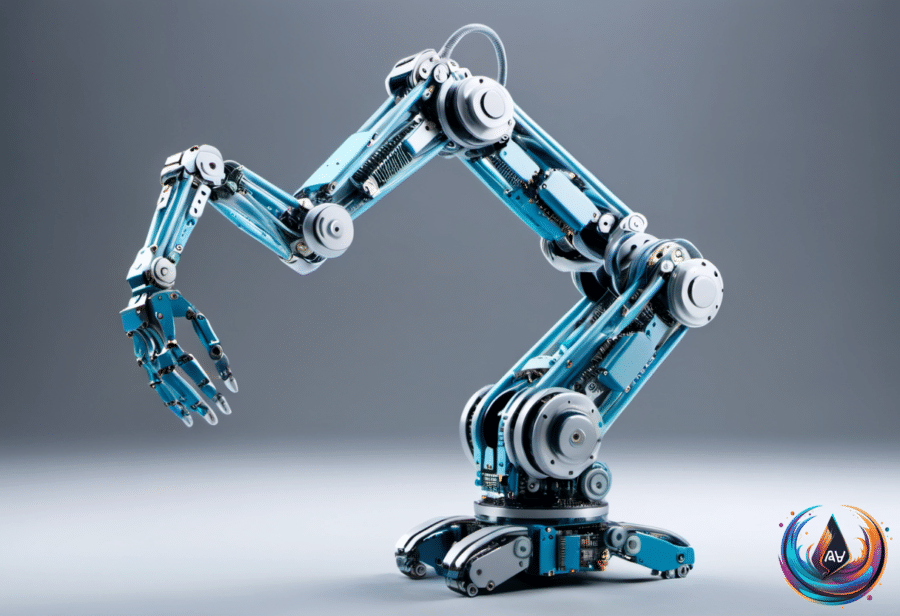
Robots are getting a new training argument. NVIDIA introduced GR00T 2 on November 9, 2026, at the Conference on Robot Learning in Austin, presenting a model that learns from human video instead of relying only on robot demonstrations. The company also outlined simulation tools and joined UC Berkeley in announcing “agentic robotics,” a separate approach that treats robot control as a coding problem.
GR00T 2 uses a 2-billion-parameter transformer built on Cosmos-Predict2.5-2B. It combines recent camera views, robot state and a written instruction to generate expected future views and the next action sequence, with one pretrained checkpoint covering parallel-gripper arms, dexterous hands and a humanoid.
NVIDIA reported 40% zero-shot success on 50 tasks absent from the target robot’s training data. The model trained partly on human video, and its pretraining mix includes 402,730 hours of first-person human video, 10,184 hours of handheld-gripper demonstrations across 2,897 tasks and 23,500 hours of robot teleoperation.
The Human-1M-100K release opens 100,000 hours of that human data, including video, language annotations and head and hand motion data, under a CC BY 4.0 license that permits commercial and noncommercial use. NVIDIA calls GR00T 2 open, though its research page says the code will become available in December — open, with a short waiting room.
Cross-embodiment tests measure how skills transfer between robot bodies and adapt with limited robot data. NVIDIA reported 65% success on a filter-paper setup learned from human demonstrations without task-specific teleoperation, and 60% on toy dump-truck assembly transferred from a handheld gripper to a YAM arm.
On the Dexter evaluation, GR00T 2 completed at least one trial on 40 tasks. Average success reached 71% with one demonstration per task and 95% with five; those five demonstrations provide under three minutes of robot data per task, followed by an approximately 30-minute adapter fine-tune on one RTX 5090.
That 95% figure needs its footnote. The technical whitepaper says NVIDIA selected tasks the model could learn with five episodes at a success rate of at least 80%, so the average is high partly by construction.
Simulation Becomes the Other Training Ground
NVIDIA’s simulation foundation is Isaac Lab 3.0, generally available since October 20, 2026. It provides one task API across physics, rendering and visualization backends, while Newton supports rigid bodies, deformables and particles; many workflows can run without a full Isaac Sim installation.
In a vision-based dexterous-manipulation benchmark, Isaac Lab 3.0 with Newton delivered up to 2.5 times the training throughput of Isaac Lab 2.3 with PhysX. AlphaNIST applies simulated practice to 20 NIST Assembly Task Board tasks, including parts as small as 4 millimeters, using one shared policy and only a yes-or-no success reward.
NVIDIA reported 98.2% training success for that shared policy, compared with 81.4% for separate per-task policies, while using roughly 39 times less GPU time. These are simulation-training results, not proof that a robot can walk into a factory and immediately outperform an engineer.
Behind AlphaNIST is Success-Guided Sampling, developed by the University of Washington and NVIDIA. The method directs practice toward configurations near the policy’s capability frontier, especially situations it solves about half the time; its authors report scaling beyond one million simulated environments and zero-shot transfer of RGB-based assembly policies to real UR5e hardware.
Agentic Robotics Recasts the Data Problem
At CoRL this week, UC Berkeley and NVIDIA are jointly announcing agentic robotics for everyday practical tasks in industrial environments. The approach uses AI coding tools to build a working understanding of how a robot operates, then writes human-readable code without requiring task data or human demonstrations.
Ken Goldberg says, “The imitation learning paradigm has hit a plateau.” He describes imitation learning as promising for home robots, where speed and reliability matter less, but says industrial applications demand reliability that data alone has not delivered.
“You get good performance from data initially, but then things go wrong,” Goldberg says. “It’s not clear that adding more data is going to get you there.” There is no robotics dataset approaching the scale of the Internet, so agentic robotics attempts to turn robotics from a data problem into a coding problem that can use the scale of language models.
Spencer Huang, NVIDIA’s Director of Product for Robotics, says existing tools already cover object classifiers, pose estimation, task and motion planning and trajectory generation. Coding agents can combine those tools into code for specific tasks, run it in simulation and revise it based on what happens; one UC Berkeley example asked a robotic arm to pack groceries into a bag.
The method still depends on simulation quality. Goldberg says simulations are non-trivial to build, while Torsten Kroeger of Alphabet’s Intrinsic warns that no physics engine accurately models physical contact with the world. To reduce bad output, Huang says one agent designs a solution and another uses an adversarial setup to find flaws.
UC Berkeley testing reached success rates of up to 99%, compared with 20% for baseline imitation learning techniques on the same kind of tasks. Goldberg says the appeal is practical: “You don’t need to collect any data,” and the generated code can be understood and fixed.
Huang places the near-term opportunity in industrial manufacturing and manipulation. Semiconductor partners need placement within 0.3 mm, while Wistron in Taiwan takes a minimum of 8 hours to retask one robot for a new product; agentic robotics, he says, can reduce that to a minute or two.
That promise comes with a familiar liability. Kroeger asks how anyone can know agents are doing the right thing all the time, calling it the alignment problem. NVIDIA’s Huang argues that general intelligence for robotics will first look like an agent coordinating conventional technologies and specialized policies — less robot mind, more very capable foreman.
The surrounding hardware and data ecosystem is moving in parallel. Noitom Robotics introduced ITW-Ego Plus at CoRL, pairing egocentric video with full-body motion and other modalities captured with its in-house Sol and Jupiter systems; its NEAR Lab, introduced under Dr. Han Lei, presented HiPHI, OmniContact and AdaPT on Nov. 10.
NEAR Lab’s Unified Motion Retargeting research was validated on five humanoids, while HiPHI-Hand was released on Hugging Face as 11 hours of egocentric video with marker-based 3D hand ground truth. NXP also announced a unified robotics platform built on its Neural Axis Architecture, with an open-source SDK and reference designs connecting sensing, real-time control, AI processing, connectivity, motor control, security and energy management.
NXP says the platform can deliver initial drone functionality in 30 minutes out of the box, with support expanding to service robots and autonomous systems. NVIDIA, meanwhile, is pairing software with more robot hardware: Agile Robots’ Agile One SN uses Isaac robotics software and the Jetson Thor computing platform, with hands from Wuji and a body from Agile Robots.
Stanford and ETH Zurich could begin using Agile One SN in early 2027. NVIDIA’s earlier reference humanoid design, announced May 31 and scheduled for delivery from late 2026, uses a Unitree body and Sharpa hands.
Hands remain a bottleneck. JoyIn’s Zhu Mingxuan said Wuji’s hands are light and good at completing tasks but can heat up, while Sharpa’s perform better at a higher price; Xiaomi has also tested its robotic hand in a car factory and found that many tasks require only a specific range of movement.
GR00T 2 shows NVIDIA pushing toward reusable robot intelligence through human video, demonstrations and simulation. Agentic robotics attacks the same problem from another direction — write, test and repair the behavior instead of collecting another mountain of examples. The industry now gets to discover whether the bottleneck was data, code, physics or the usual answer: all three.
Based on
- NVIDIA Introduces GR00T 2 for Robots Learning From Human Video — unite.ai
- Are We Ready for Robots That Code Their Own Skills? — spectrum.ieee.org
- Noitom Robotics Introduces ITW-Ego Plus at CoRL 2026: In-the-Wild Egocentric Data With Full-Body Motion | Markets Insider — markets.businessinsider.com
- NXP Unveils Unified Robotics Platform to Speed Trusted Physical AI Deployment | Markets Insider — markets.businessinsider.com
- CNBC’s The China Connection newsletter: Nvidia’s humanoid push relies on China-made robot hands — cnbc.com