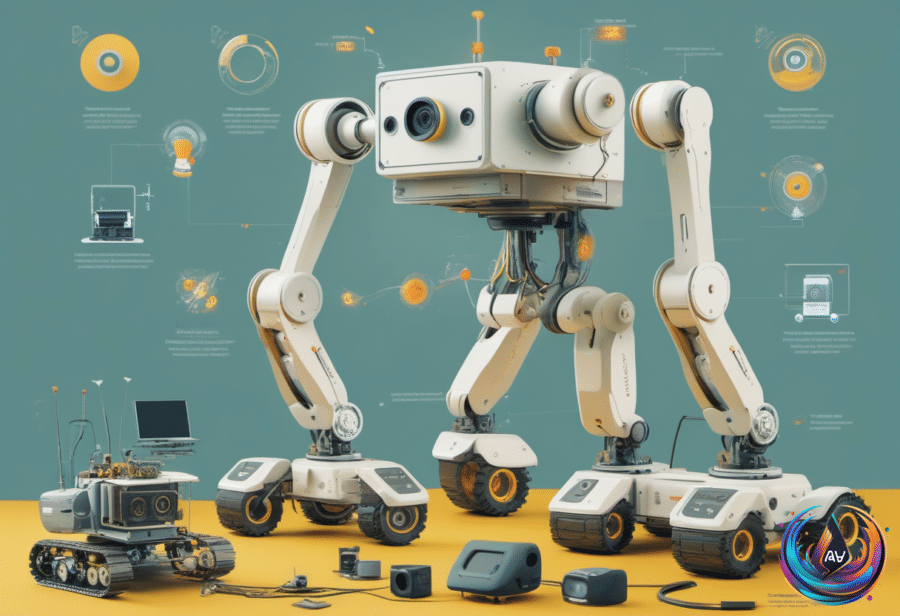
Robots are moving beyond fixed commands. Vision-language-action models connect visual perception and language instructions to sequences of physical actions for embodied systems, creating a direct bridge between what a robot sees, what it is told, and what it does next.
That bridge matters because physical systems cannot treat AI as a purely digital experience. A robot must interpret its surroundings, process instructions, select behavior, and send actions through hardware. When an input changes, the robot’s movement can change too—and that creates both a powerful path forward and a serious safety challenge.
What Vision-Language-Action Models Actually Connect
Vision-language-action models deserve a precise explanation because the name identifies a particular information flow, training choice, runtime mechanism, or governance boundary. Treating the term as a synonym for “advanced AI” makes claims impossible to test.
A VLA model transforms an input into an outcome through five observable operations. The boundary is therefore operational rather than terminological: the important question is how visual signals, language instructions, and physical actions connect inside an embodied system.
The nearest misleading shortcut is a robot controller programmed separately for one fixed task. Multimodal systems face a harder problem because they must align signals with different resolutions, timing, noise, and ambiguity. A word may refer to a small image region, while an audio event may precede the video frame that explains it.
That complexity means the model is only one part of the system. Performance can be determined by surrounding data, interfaces, hardware, permissions, and people even when the underlying model remains unchanged. A useful explanation separates the model’s learned behavior from the product that decides when, where, and with what authority that behavior is used.
When Untrusted Inputs Change Robot Behavior
Research into VLA systems shows why that separation matters. In a study of vision-language-action models, a patch in a camera’s view reduced task success in simulated robot tests. FreezeVLA found that an adversarial image could cause tested models to ignore later instructions.
Another test used a robot dog running Gemma 4 E4B. Text on a poster was treated as an instruction and changed the robot’s movement. VicOne LAB R7 also tested how untrusted inputs could change robot behavior, showing that the assigned tasks did not change—the inputs did.
The same pattern appeared across other channels. In a hospital-service-robot simulation using Nemotron on NVIDIA Jetson AGX Orin, crafted audio that was inaudible to people changed the robot’s simulated behavior. At a robotics bug bounty event, VicOne LAB R7 researchers injected a ROS 2/DDS message into a robot that organizers expected to remain still under a safe-control setting.
The robot moved.
These results put safety and cybersecurity in the same frame. China’s GB/T 45502-2025 addresses information security for service robots, while IEC TS 63074 examines security threats that could affect safety-related control systems. The EU Machinery Regulation applies from January 20, 2027, and includes requirements to protect safety-relevant systems and data against corruption.
VicOne supports this work across the robot lifecycle. Through the Robotic Hacking Community, VicOne LAB R7 works with researchers to investigate how cyber threats can change robot behavior. VicOne’s Radeis helps teams validate potential effects before deployment, while Rthena provides visibility into risks and behavior during operation.
Safety and security teams can begin with a direct process: trace the inputs behind each protective decision, challenge those inputs, and revisit the evidence as the robot changes. That approach treats behavior as something to examine, not something to assume.
Research Pushes Embodied Intelligence Forward
DEEP Robotics has unveiled five research advances supporting the development of DEEPRobotics-Brain, its embodied intelligence architecture for real-world robot operation. The research areas include the DR-WM-1.0 world model, DR-VLA-2.0 embodied foundation model, DR-APO policy optimization framework, DR-Agent embodied agent, and DR-Benchmark data and evaluation platform.
The research draws on 2.58 million image–mask pairs and more than 100,000 real-robot clips. DR-VLA introduces EgoLynx, with 10,000 hours of curated egocentric web video and 2,000 teleoperated robot navigation clips.
On the held-out EgoLynx-Robot test split, DR-VLA improves the Quadruped Navigation Score by approximately 5% and reduces open-loop final heading error by 14.6%, each relative to the best competing result for that metric.
Another framework, AMC, defines 13 interpretable motion atoms for each arm: positive and negative translations along three axes, positive and negative rotations about three axes, and a hold action. AMC achieves opposite-atom separation rates of 92.5% for single-atom prompts and 83.1% for two-atom prompts.
In real bimanual tasks with unseen layouts, normalized task progress reaches 87.8%. Adding force feedback raises task progress to 78.5% for the drawer-and-plug task and 75.2% for vase wiping.
DR-APO, or Decoupled-Representation Advantage-Guided Policy Optimization, separates policy improvement from the underlying policy representation. It provides a shared optimization principle for Gaussian, diffusion, and flow-matching policies. Across five MuJoCo-v5 continuous-control tasks, DR-APO achieves the best result in nine of ten diffusion-policy comparisons and all ten flow-policy comparisons.
How Soon Will General-Purpose Robots Arrive?
The technology is advancing, but the public timeline remains contested. At a recent event in Mountain View, California, Alex Wissner-Gross interviewed Steve Cousins and Sampriti Bhattacharyya about the future of robotics.
Bhattacharyya predicted that general-purpose robots will reach hundreds of millions or close to a billion by 2030. Cousins suggested it will take another decade before general-purpose robots appear publicly due to safety issues in manufacturing.
Both experts agreed that specialized robots will remain essential for specific tasks. That point matches the central lesson of VLA systems: physical intelligence depends on the full chain from perception and language to permissions, hardware, evaluation, and control.
The next phase will not be measured by impressive demonstrations alone. It will depend on whether robots can turn varied inputs into reliable actions, withstand manipulated signals, and prove that their decisions remain safe as their environments change.
Based on
- What Are Vision-Language-Action Models? The Foundation of General-Purpose Robots — unite.ai
- From Words To Actions: How LLMs Are Reshaping Robotics — forbes.com
- How a Fake Signal Could Fool Every Robot Safeguard — spectrum.ieee.org
- DEEP Robotics Unveils Five Research Advances in Embodied AI | Markets Insider — markets.businessinsider.com
- It’s Not A Roomba: Humanoid Robots And Their Future On Earth — forbes.com