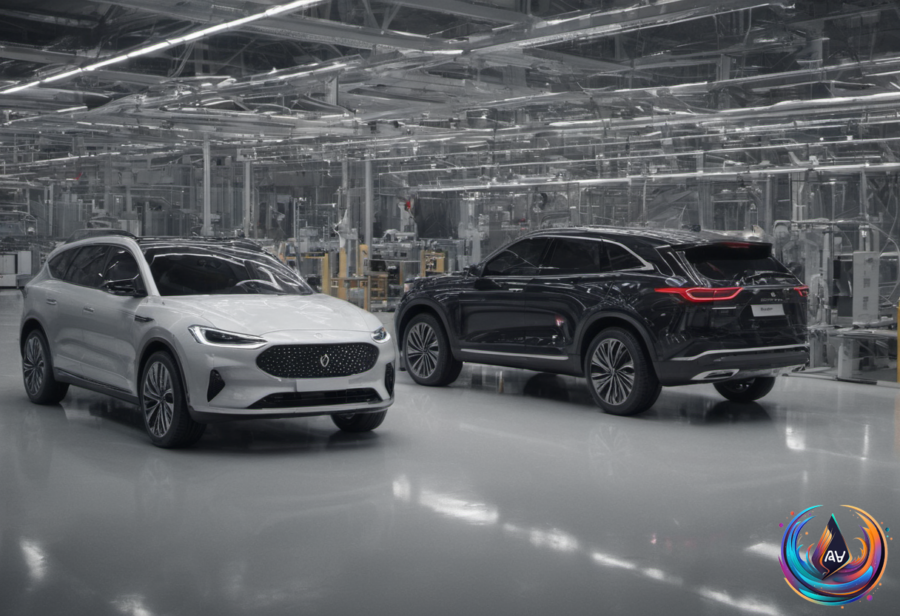
Saudi Arabia is building an EV contender with an awkward benchmark. Ceer Motors revealed two electric car models on September 21, promising deliveries for March 2027 and positioning its Exobot sedan and SUV as high-powered premium vehicles. The benchmark is Lucid, another electric-car company backed by Saudi Arabia’s Public Investment Fund.
Ceer launched in November 2022 with the PIF as its majority owner. Its planned factory can produce as many as 240,000 vehicles a year, a target that gives the brand ambitions beyond a small domestic experiment. Ceer also aims to make almost half of its car components in Saudi Arabia by 2034.
The Exobot models will enter the premium EV segment, with the most powerful versions promising more than 1,100 horsepower. That figure puts Ceer near Lucid’s performance territory: the fastest Lucid, the Air Sapphire sedan, has 1,234 horsepower.
Bill Russo, founder and CEO of Automobility, described the strategic overlap clearly: “Lucid is an existing global technology and luxury-EV company in which Saudi Arabia has invested heavily.” He added, “That does put the initial products closer to Lucid’s premium territory than to BYD’s mass-market center of gravity.”
One investor, two EV bets
The PIF has put about $8 billion into Lucid and owns about 58% of the company. That makes Ceer’s arrival more than a new brand launch; Saudi Arabia is backing a homegrown rival while holding control of an established premium EV maker.
Lucid’s market value has shrunk to about $1.6 billion, and its sales in Saudi Arabia fell 57% during the first seven months of 2026. Ceer therefore enters a market where the government has money, industrial plans and a clear reason to want a stronger result than Lucid has delivered so far.
The PIF has tested EV investments before. It bought about 5% of Tesla in 2018, then sold almost all of that stake by the end of 2019. Ceer gives the fund a different kind of position: not just an investment in an electric-car company, but ownership of the Saudi brand meant to build the country’s own EV industry.
That domestic industry still faces a modest market. Saudi Arabia’s EV sales are estimated at 10,000 to 20,000 vehicles a year, although Joseph Salem, senior partner at Arthur D. Little, estimated a figure of 35,000 to 40,000 in 2025. Saudis buy almost 1 million new vehicles annually, leaving plenty of room for electric cars if buyers move away from traditional models.
Ceer faces a market led by China
Ceer will not enter an empty showroom. BYD’s sales in the Middle East rose 369% during the first seven months of 2026, and 60% of the electric cars sold in the region came from China’s BYD.
Hashim AlFatayerji, CEO of Cararak, warned against treating the two companies as simple rivals: “BYD and Lucid serve very different segments, so comparing their volumes directly can be misleading.” Ceer’s premium pricing and high-output Exobot models place it closer to Lucid than BYD, but the regional sales figures show where electric-car momentum is already building.
Ceer’s 240,000-vehicle capacity will look enormous beside Saudi Arabia’s current EV demand. The factory’s scale only makes sense if the brand reaches beyond early adopters and develops enough local production to support a larger business. Salem put the strategy in one sentence: “The domestic market is the proving ground, not the end goal.”
That leaves Ceer with two tests. It must prove that Saudi Arabia can produce premium EVs with local components, then persuade buyers at home and abroad to choose them over Lucid’s technology, BYD’s regional momentum and the many conventional vehicles already sold in the kingdom.
Based on