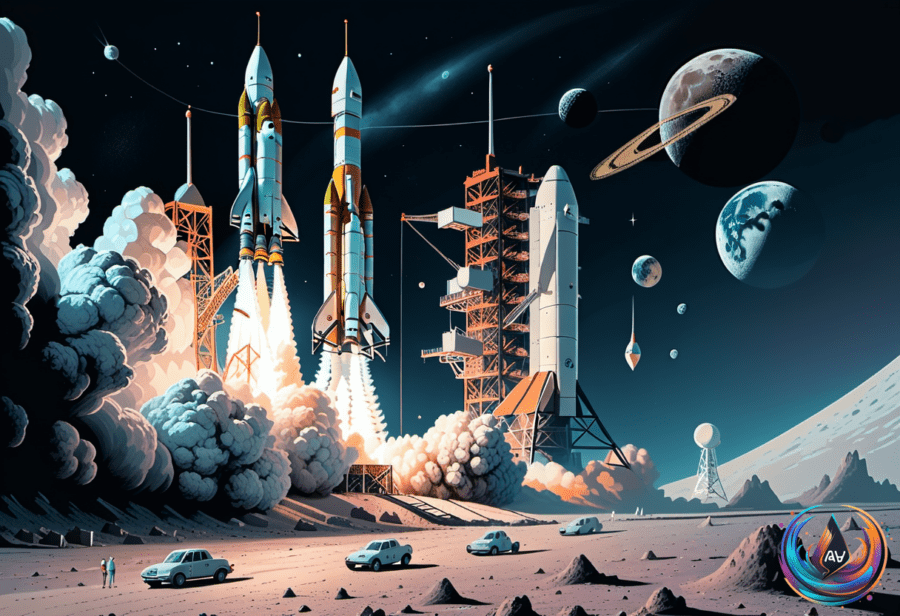
Space launch rules are shifting fast. For decades, payloads dictated how rockets flew. Now, rockets are shaping how payloads reach orbit and beyond. New milestones and missions prove the space race is heating up on multiple fronts.
Starship’s Massive Lift Changes Everything
SpaceX’s Starship stands out with a jaw-dropping payload capacity. It can haul more than 100 metric tons—220,000 pounds—to low-Earth orbit. That’s a game-changer. No longer do payloads have to limit themselves to small, lightweight packages. Starship’s power lets companies dream big.
NASA is betting on Starship too. The Artemis II mission took off in April 2026, marking a key step toward returning humans to the moon. NASA plans to use Starship’s first lunar landing in 2028 as part of this Artemis program. The heavy lifter opens doors for moon missions and deep space exploration.
New Players and Bold Plans Make Waves
The launch scene is crowded with fresh energy. Skyroot Aerospace, a rising star from India, aims to test its Vikram-1 rocket between July 12 and August 4, 2023. This rocket packs enough punch to put nearly half a ton into low-Earth orbit. Skyroot has raised around $160 million and boasts a valuation above $1 billion. That’s serious momentum.
Meanwhile, Isar Aerospace in Germany pushes an all-German mission using the Spectrum rocket. Their first launch in March 2025 failed, but the company is undeterred. New attempts will follow as Europe steps up its space ambitions.
Rocket Lab is busy too. NASA chose them to launch a pair of science missions on three Electron rockets in 2027. One mission, PolSIR, will fly two suitcase-sized satellites to track ice crystals in tropical clouds. Another, TSIS-2, will launch early in 2027 atop a SpaceX Falcon 9, continuing vital Earth science research.
SpaceX and Commercial Innovation Race Ahead
SpaceX isn’t just about big rockets. They hit a milestone in 2024 by producing the 1,000th Merlin 1D engine for Falcon rockets’ first stages. These engines have powered over 6,000 flights. It shows SpaceX’s engine technology is reliable and battle-tested.
The Falcon 9 also launched the world’s first commercial nuclear-powered satellite, BOHR. Built by Miami-based City Labs, BOHR lifted off from Vandenberg Space Force Base. Its mission: prove nuclear power can fuel space missions commercially. “This is a historic step for commercial nuclear power in space,” said Peter Cabauy, CEO of City Labs.
SpaceX’s Transporter-17 mission took 80 payloads into low Earth orbit, expanding access for small satellite operators worldwide. SpaceX praised these rideshare missions as key to supporting customers and opening space to more players.
Lunar Cargo Dreams Take Flight
Moon ambitions are heating up. Ispace, a Japanese lunar transport startup, plans a lunar cargo business using Starship and moon landers. They bought 500 kilograms of capacity for $50 million on a Starship mission aiming to land on the moon by 2030. Ispace wants to build a lunar surface vehicle that hosts payloads from clients globally, sharing rides on Starship.
The company has faced setbacks with unsuccessful lunar touchdown attempts in 2023 and 2025 using Falcon 9 rockets. Undeterred, Ispace plans to soft-land three Ultra landers on the moon by 2030. CEO Takeshi Hakamada said, “While we can’t rule out other companies entering the market, few might be able to integrate cargo and keep providing services after touching down on the moon.”
NASA supports these efforts. Stephanie Bednarek, SpaceX VP of commercial sales, said Ispace’s integration services offer a valuable path for smaller payloads to reach the moon. U.S. lunar rover startup Astrolab has also booked space on a future Starship flight, signaling growing commercial interest in lunar missions.
Offshore Launches and Final Atlas V Flights
The U.S. government is eyeing over 3 billion acres of offshore territory for space launches. The Bureau of Ocean Energy Management seeks public input on using submerged land formations and offshore facilities for space activities. This could reshape where and how rockets lift off.
Meanwhile, the last Atlas V rocket launched from Cape Canaveral recently. It carried 29 satellites for Amazon Leo, a satellite network. This marked the ninth Atlas V flight for Amazon Leo and the fourth Atlas V launch in under three months. The final flight used the most powerful Atlas V configuration: five strap-on solid rocket boosters and a payload fairing.
What’s Next in Space Launch Innovation?
The future looks explosive. Rockets are growing bigger, smarter, and more flexible. Payloads no longer dictate launch terms. Instead, rockets like Starship and new players like Skyroot and Rocket Lab control the game.
Commercial nuclear power in space is here. Offshore launch zones could open new frontiers. Lunar cargo services aim to make the moon a business hub. Space technology is breaking barriers and rewriting the rules.
Get ready for a new era where space launches serve dreams, not limits. The countdown to the future is on!
Based on
- Payloads used to dictate the terms of launch. That’s finally changing. — arstechnica.com
- Rocket Report: Indian startup nears first launch; SpaceX’s millenary milestone – Ars Technica — arstechnica.com
- Trump team weighs launching space ships and allowing returns off the US coast | The Independent — independent.co.uk
- SpaceX launches first ever nuclear-powered commercial satellite | The Independent — independent.co.uk
- With SpaceX Starship, Japan’s Ispace provides ride-share to the moon – The Japan Times — japantimes.co.jp