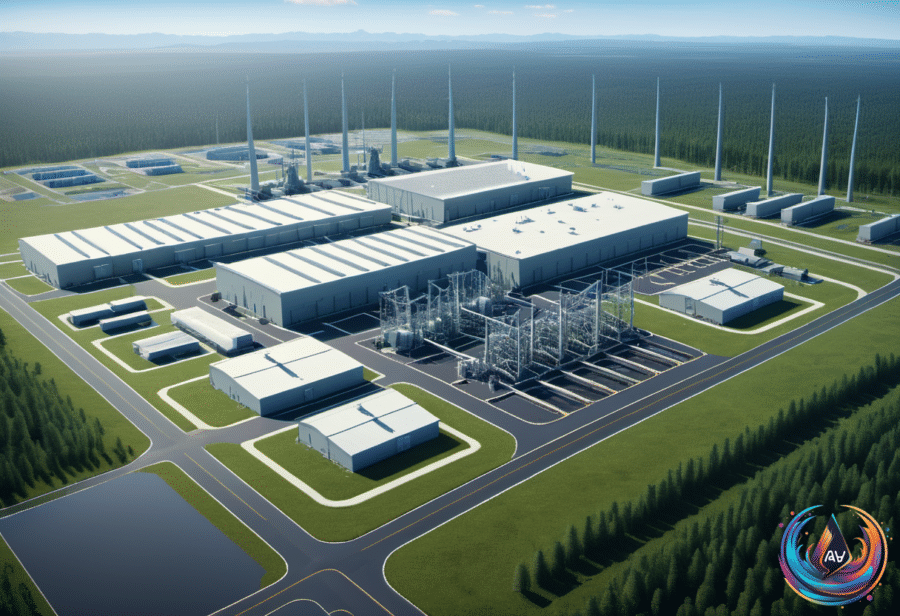
The US Army is opening military land to a new kind of commercial infrastructure: data centers paired with their own power plants. The plan reaches across nine bases, bringing private computing capacity and dedicated electricity generation into the heart of the country’s defense network.
But there is a firm condition. Companies cannot propose a data center by itself and expect consideration. The Army wants integrated projects that generate power and run computing facilities together.
Military Land Meets Private Computing
The Department of the Army announced on November 20 that it was seeking “competitive proposals from private, public and/or not-for-profit entities” interested in leasing military land under “long-term lease agreement(s).” The proposed developments would include commercial power generation facilities and data centers.
The opportunity is tied to the Strategic Capital Initiative, a program initiated in February 2026 to inject private equity and investment banking money into the country’s defense infrastructure. The Army hopes to partner with commercial data center developers at nine bases across the US.
The locations include Fort Bragg, Fort Hood, Fort Rucker, Blue Grass Army Depot, Pine Bluff Arsenal, and Tooele Army Depot. The Army also described long-term lease opportunities at several military installations, including Fort Bragg, Fort Rucker, and Blue Grass Army Depot.
The announcement makes the preferred structure clear: “The Army’s preference is for integrated power generation facility and commercial data center projects.” Entities can also “propose power generation only,” but the Army draws a bright line around computing-only plans.
“Proposals for a data center-only will not be considered.”
Why Power Has Become the Centerpiece
The Army’s requirement arrives as data centers consume a growing share of the US power system. Power demand from data centers has risen an average of 19% a year, while US grid capacity has expanded only 2% annually. Data centers used about 5% of US grid capacity in 2025, up from 1.9% in 2018.
Lawrence Berkeley National Laboratory projects that data centers could use as much as 12% of US electricity by 2028. Another estimate says data centers would need roughly 110 gigawatts of additional power, and holding their share through 2030 at current growth rates could require sourcing up to 58% of their power off the grid.
The pressure is already moving beyond utility planning. In 2025, data centers were estimated to lift wholesale prices by nearly 20% in California’s southern Bay Area, while the increase approached 17% around Dallas–Fort Worth. Across four studied grids, data centers paid only 38% of the infrastructure costs tied to their growth, leaving a $3.12 billion share of an $8.25 billion bill elsewhere.
Wholesale prices make up only about 30% to 50% of a household electricity bill, but the fight over new facilities is reaching local communities. A survey found that 70% of adults under 30 oppose new data centers in their area, compared with 61% of all adults. On Nov. 3, voters rejected data center development in 40 of 41 local ballot measures, while Ohio already has 125 local data center moratoriums.
Commercial demand now exceeds residential demand in 23 states and Washington, D.C. Virginia sells 59% of its electricity to commercial customers, including data center clients. In August, Delaware became the first state to enact a “bring your own generation” policy, a model that mirrors the Army’s preference for projects with dedicated power.
Gas Generation, Microgrids, and the Next Buildout
On-site generation is already becoming part of the data center race. As of March, only 2 gigawatts of on-site gas generation operated at data centers worldwide, but 181 gigawatts of announced gas-fired generation had been proposed alongside data centers. More than 90% of that planned capacity is in the US.
One proposed project at Starbase, Texas, combines a roughly $24 billion supercomputing facility with a gas-fired power plant. Planned gas plants for data centers could raise US power-sector emissions by 20%, adding another layer to the debate over how new computing capacity should receive its electricity.
The Army’s own infrastructure work also includes microgrids. AZIO AI Holdings highlighted two US Army projects under Operation Fortress: an approximately $45 million Fort Buchanan microgrid in Puerto Rico and an approximately $99.6 million Lake City Army Ammunition Plant microgrid and combined heat and power project in Independence, Missouri.
Prime contractor Energy Resilience Partners, LLC holds approximately $144.6 million in awarded contracts connected to the work. AZIO has a contractual right to 41.5% of ERP’s net profit, as defined under its profit-participation agreement, and serves as general contractor and project-management support for the highlighted projects.
The broader investment race is also accelerating. Citigroup projects that Big Tech will spend more than $2.8 trillion on AI infrastructure through 2029, while a Brookings study puts US investment at $10.3 trillion between 2025 and 2032. Amazon, Google, Meta, Microsoft, OpenAI, Oracle, and xAI signed the Ratepayer Protection Pledge in March, and President Donald Trump is associated with the pledge.
The Army’s proposal turns that national race into a real-estate and energy opportunity on military land. With the power requirement built into the deal from the start, the next wave of defense-linked computing may arrive not as a standalone server campus, but as a complete package of land, generation, microgrids, and data infrastructure.
Based on
- US Army Declares Plan to Build Private AI Data Centers on Military Bases — futurism.com
- Fort Bragg and Other Military Bases Could Soon Get an AI Data Center – Business Insider — businessinsider.com
- A ‘mismatch in timing’: Data center power demand is growing 19% a year. The grid is growing 2% | Fortune — fortune.com
- AZIO AI Holdings (NASDAQ: AZIO) Highlights Concurrent Army Microgrid Projects Under Operation Fortress | Currency News | Financial and Business News | Markets Insider — markets.businessinsider.com
- Directors Corner – Korea Regional Review – UPI.com — upi.com