The internet’s most important Europe–Asia connection is running through one of the world’s narrowest and most contested waterways. Now Google, Meta, Microsoft, and Amazon are preparing expensive land routes and new undersea cables because a single break near Yemen could disrupt data flows for months.
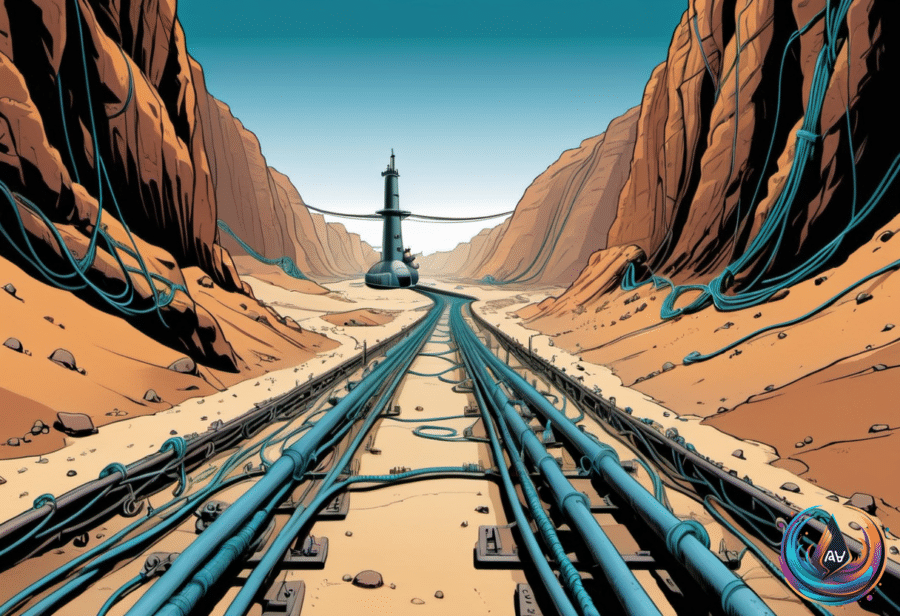
More than 90% of data capacity between Europe and Asia travels through cables under the Red Sea. Those cables enter the water at Bab al-Mandab, a strait less than 32 kilometers, or 20 miles, wide between Yemen and the African nations of Djibouti and Eritrea.
A Narrow Gateway With Global Consequences
The Houthis, a U.S.-designated terrorist organization, seized Yemen’s side of Bab al-Mandab in September, including the island of Mayyun. On October 5, Saudi-backed government forces said they had retaken key positions around the strait and the port of Mocha, but the Houthis denied those claims.
That uncertainty has turned the Red Sea into a major test for internet resilience. Switching to another submarine cable does not solve the problem when almost all of those cables pass through the same narrow gap. As Paul Brodsky put it, “You can have capacity on multiple cables, but if they’re all routed through the same tight expanse of water, suddenly your route resilience isn’t looking so resilient.”
Three Red Sea cables were damaged in September 2024, most likely by the anchor of a drifting cargo ship disabled by a missile launched by the Houthis. Repairs took months because crews had to wait for permits, and a new break could face the same permission and safety problems.
Depending on the availability of a repair ship, a cable repair might take one to two weeks, Doug Madory said. “The last time there were cable cuts in this body of water, repairs took months.”
Cloud Giants Move Data Onto Land
Almost all major cloud companies are looking for backup routes around the Red Sea, and Google and Meta have started sending some live traffic across Iraq through a land route they had previously held in reserve. Since the start of September, cloud companies have been telling operators the minimum number of fiber strands they will use and when they will begin using them.
Iraq signed a contract with Qatari telecom company Ooredoo on September 10, 2023, to carry data toward Europe through an underground route from the southern port of Al-Faw. That path gives cloud companies another option when the sea route becomes too risky, although submarine routes remain far cheaper.
“Submarine cable routes are much cheaper, which is why they are so preferred,” Madory said. The price difference explains why companies built their networks around the Red Sea in the first place, but geopolitical instability is now forcing them to pay for paths that were once backup plans.
Google bought a pair of fiber strands running along Turkish state pipelines in September 2023, paying two to three times the roughly 6 million euros, or $7 million, expected for newer lines crossing Turkey. Long-distance fiber is usually sold with a single upfront payment covering 15 years or more of use, plus a separate annual maintenance fee.
Microsoft announced plans on September 23, 2023, to invest more than $400 million in subsea and land links across the Middle East by 2030. Google, Meta, Microsoft, and Amazon use about three-quarters of the world’s international internet bandwidth, giving their route decisions consequences far beyond their own systems.
The stakes became clear in March 2024, when Iranian drones struck Amazon’s data centers in the United Arab Emirates and Bahrain. Bank and payment apps in the region stopped working, and Snowflake reported service disruptions.
Cloud companies will likely test their land backups before they need them, making sure the routes can carry traffic if a sea cable breaks. The concern is no longer limited to a single incident; Yemen’s situation is being viewed as a potential “Afghanistan scenario,” in which the international community accepts a new normal on the ground.
Meta Builds A Bigger Map For Data
Meta is tackling the same risk with a wider push into submarine infrastructure. On October 3, 2026, the company announced Petal, a roughly 4,300-mile subsea cable connecting the United States and France, with service expected in 2029.
Petal will carry 1 petabit per second, or about 125,000 gigabytes per second. Meta says that capacity could let three-quarters of the world’s population stream music at the same time. The cable uses two-core fiber, placing two light paths inside each strand so it can double capacity without a proportional increase in power or infrastructure.
Petal is being developed with Japan’s NEC and Sumitomo Electric Industries, while Orange will handle the landing on France’s Atlantic coast. The project expands a cable portfolio that already includes more than 20 subsea projects touching every continent except Antarctica.
Meta’s Project Waterworth, announced in February 2025, will stretch more than 31,000 miles and connect the United States, Brazil, South Africa, India, and other regions across five continents. Some sections will sit roughly 4.3 miles below the surface. Unlike the MAREA cable between Virginia and Spain, which was completed in 2017 and is jointly owned with Microsoft and Telxius, Waterworth will be wholly owned by Meta, making it only the company’s third solely owned cable.
Meta’s 2Africa system, completed last year, circles Africa and connects to Europe, the Middle East, and South Asia. It lands in 33 countries and can reach 3 billion people.
The cost of Petal or Waterworth has not been disclosed, but it could top $10 billion. Meta expects capital expenditures of $130 billion to $145 billion in 2026, nearly double the $72.2 billion spent in 2025.
Meta also launched its AI agent Muse on September 8, 2026, as the company continued expanding its technology footprint. Taken together, its AI systems and global cable plans point toward the same reality: future digital services will depend not only on computing power, but on routes that can survive conflict, accidents, and political change.
“From what I see and hear, I would say that this scenario is getting more and more priced in by the day,” Martin Frank said. The next phase of the internet will be shaped by that calculation, with cloud giants spreading traffic across land and sea before the next cable break forces their hand.
Based on
- Conflict in the Red Sea is forcing cloud giants to find a new route for the internet — restofworld.org
- Google, Meta said to be paying premium for land routes amid Red Sea clash – Rest of World — restofworld.org
- Meta is building one of the world’s biggest undersea cable networks | Fortune — fortune.com