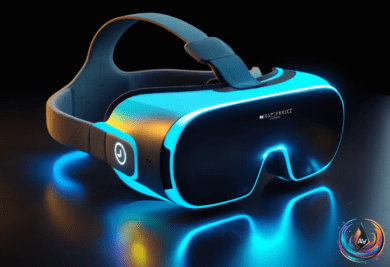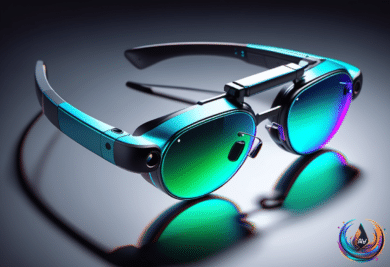
Xreal’s Aura puts Android XR on your face. The smartglasses are now available for pre-order starting at $1,279, making them $20 cheaper than Meta’s VR Glasses, which cost $1,299. Aura will ship this year for early adopters who made a reservation, because apparently even futuristic eyewear now has a queue.
Aura is a tethered model that connects to a separate compute puck rather than packing every component into the glasses. The puck runs Android XR, includes Google Play for apps, and brings Gemini for AI capabilities. It also uses Qualcomm’s Snapdragon Reality Elite chip, giving the system a dedicated foundation for its XR functions.
The glasses weigh less than 95 grams and feature see-through lenses, allowing users to view their surroundings outside the projected virtual screen. Aura has a 70-degree field of view, while its visuals are described as extremely sharp and bright, including in sunny outdoor conditions. That combination gives the device a practical advantage for walking around, since the lenses make it easier to see what is in front of you.
Aura also includes cameras for precise hand tracking and uses Bose-engineered technologies for audio. The compute puck has a built-in trackpad and fingerprint sensor, and users can carry it on a lanyard or clip it to clothes or belongings. The glasses can also connect to a computer and work as an external monitor, which is a more useful trick than another demo where a floating cube exists for no reason.
Two configurations and limited early access
The $1,279 starting price covers Aura with 12GB of RAM and 256GB of storage. A second configuration raises those specifications to 16GB of RAM and 512GB of storage, with a price of $1,499. Aura will be available in medium and large sizes: medium fits 60-66mm, while large fits 66-72mm.
Both configurations ship with the compute puck. The first 2,000 Founder’s Edition pairs are necessarily coming at launch, and the first transparent Android XR glasses are “weeks” away for people who made a reservation. Orders will open to the general public in the coming weeks, though the initial launch remains limited to the US, Canada, Japan, and South Korea.
Xreal plans to release Aura in more markets in 2027. For now, the company is positioning the device as a lighter alternative to the headset-style approach represented by Meta’s VR Glasses, while still asking buyers to spend well over a thousand dollars on an early Android XR product.
A lighter alternative to Meta’s headset
Meta’s VR Glasses are expected to launch in spring 2027, following a September 2026 demo at Meta’s Connect event. They use a heavy, hot headset design with eye tracking, passthrough vision, and a 5K micro-OLED screen. Meta’s model also has more cameras than Aura and supports hand tracking features that feel very precise.
That hardware gives Meta’s VR Glasses a different focus. They are better suited to sitting, experiencing content, or typing, while Aura’s see-through lenses are designed to support movement and awareness of the real world. Aura still offers precise hand tracking through its cameras, but its interaction experience is described as more like hunting and pecking than Meta’s version.
The comparison leaves buyers with a clear tradeoff. Aura is lighter, ships with a separate puck, offers Android XR with Google Play and Gemini, and reaches early adopters before Meta’s expected spring 2027 launch. Meta’s VR Glasses bring a 5K micro-OLED screen, eye tracking, more cameras, and a stronger hand-tracking experience—but also the heavy, hot headset design.
At $1,279, Aura is not cheap, and the $1,499 configuration pushes the price higher. Still, Xreal has made its pitch straightforward: transparent Android XR glasses, a 70-degree field of view, computer-monitor support, and a carrying setup that keeps the main computing hardware off the wearer’s face. The market will decide whether that is the future of XR—or simply a very expensive way to avoid carrying a laptop screen.
Based on