Metal detector apps have been around for quite a while, and their basic trick is simpler than their name suggests. They do not turn your phone into a full metal detector. Instead, they use a piece of hardware already inside many smartphones: the magnetometer.
Since the late 2000s and the arrival of the iPhone 3GS, magnetometers have become standard smartphone technology. They measure Earth’s magnetic field, mainly so your phone can power its compass. A metal detector app simply asks the phone to read those measurements and alert you when the field changes.
How a phone metal detector works
A magnetometer watches the magnetic field around the phone. When certain metals enter its range, they can affect that measurement, and the app can respond with a ping or another alert. The app is not creating a powerful scanning field around the phone; it is reading data from a magnetic-field instrument that already has another job.
That distinction explains why these apps can work without special accessories. The phone already contains the magnetometer, while the app provides the instructions and the alert. There are plenty of free metal detector apps on both Android and iOS, and they all rely on the same magnetometer technology, so their basic service should be similar across the board.
Still, the phone can detect only certain metals. It is looking for ferromagnetic metals, including iron, steel, nickel and cobalt. These materials respond to magnetic fields in a way the phone can measure.
That list leaves out a lot of objects people might expect a metal detector to find. A phone will not scan for every kind of metal, and the app cannot change that hardware limit. The phone is reading magnetic-field changes, not carrying out the broader search performed by a commercial metal detector.
Why gold detector promises are a red flag
Regular metal detectors use a different approach. They generate an electromagnetic field and look for metals that can conduct electricity, rather than limiting their search to ferromagnetic metals. That gives commercial detectors access to a far broader range than a smartphone app can manage.
So if an app promises to find gold, silver or high-end jewelry, it is yanking your chain. A phone’s magnetometer does not suddenly gain the ability to locate those materials because an app uses a convincing name or makes a bold promise.
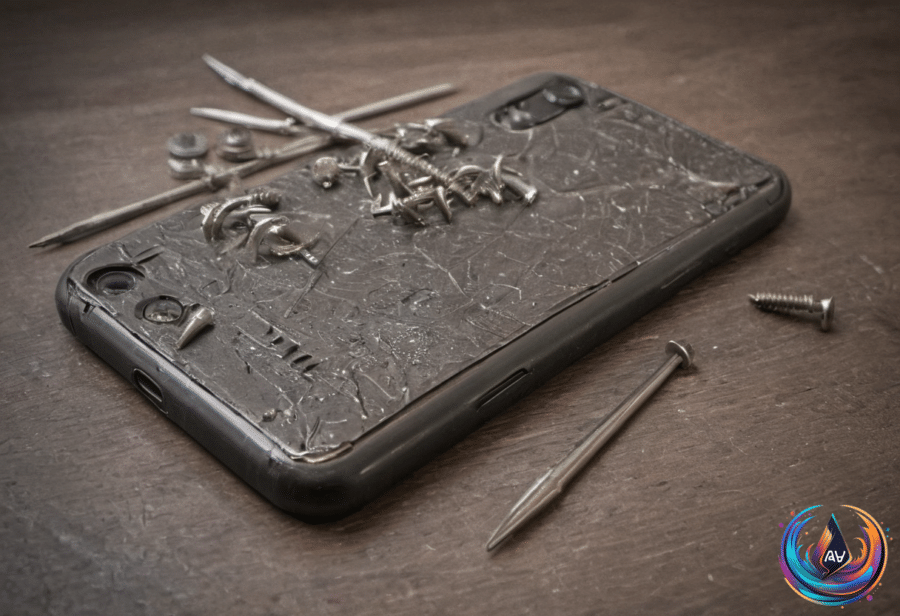
The useful cases are much less glamorous, but they can still save time. These apps are best for finding small lost pieces such as a screw, blade or nail. If one drops somewhere nearby, the phone may help you narrow down the spot instead of searching every inch of the floor by hand.
That makes a metal detector app a handy finder for ferrous objects, not a replacement for a commercial detector. Its range and results depend on the phone’s magnetometer and the metal itself, so the app works within the limits of the hardware inside the phone.
Metal detection is not the same as NFC
Phones also use another short-range technology that can seem mysterious: NFC, which stands for near-field communication. NFC is a wireless radio standard that lets devices exchange information, much like RFID. Both use radio waves, but NFC works over a much shorter distance than RFID.
RFID signals can be read from up to hundreds of feet away, depending on the type. NFC works only over a distance under an inch, and it can communicate in both directions. An NFC tag contains a tiny chip, a small amount of memory and an antenna, but no battery.
Instead, the tag draws power from the device reading it through magnetic induction, the same technology used to charge a phone wirelessly. When the tag gets close enough, the reader energizes it and pulls its data in a blink. Because NFC tags are cheap and simple, packs of several dozen stickers cost just a few dollars.
People use them as physical switches, and restaurants can place stickers on tables that connect customers to Wi-Fi or open a menu. NFC tags also appear on posters, business cards, ski lift passes and elevators. A scan can open a webpage or activate a phone feature, but this is separate from metal detection.
An NFC tag cannot track you. It has no battery, cannot send a signal by itself and works only when almost touching a reader. An Apple AirTag is different because it has its own battery and sends a Bluetooth signal that nearby Apple devices can pick up and report to its owner.
The same short-range system supports tap-to-pay, transit gates and hotel room keys, where the phone functions as the NFC tag. Apple opened the iPhone’s NFC chip to third-party developers with iOS 18.1, so apps beyond Apple Wallet can now use those functions too.
What to expect from your phone
For metal detection, the rule is simple: trust the magnetometer, not the marketing. A free app can help locate a missing iron nail or steel screw, but it cannot turn a smartphone into a detector for gold, silver or every metal object.
For NFC, the rule is just as clear: the technology is built for close contact and small commands. These tools are useful because phones already contain the hardware they need, but each tool has a narrow job. Knowing that limit is the best way to avoid expecting a phone app to do something its hardware cannot do.
Based on
- How do those ‘metal detector’ apps for your phone actually work? — engadget.com
- What Is An NFC Tag And How Does One Work? — engadget.com
- The Pros And Cons Of Using A Dumb Phone Over A Smartphone In 2026 — engadget.com
- 5 Gadgets You Should Never Buy Used — engadget.com
- Spotting A Fake SD Card Is Easier Than You Think — engadget.com