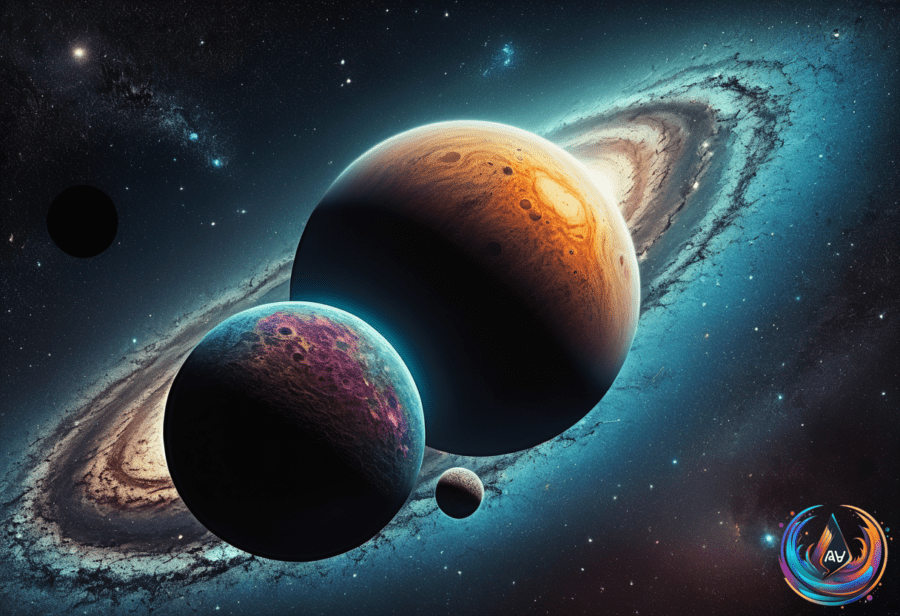
NASA’s TESS spacecraft has found two extraordinary planets that are almost like cosmic cotton candy. These worlds, named TOI-791 b and TOI-791 c, sit in the same star system, about 1,113 light-years away in the constellation Volans.
What makes these planets special is their incredibly low density. TOI-791 b is nearly the size of Jupiter but has only three percent of Jupiter’s mass. TOI-791 c is even larger than Jupiter, yet it has just 5.9 percent of its mass. To put this in perspective, Jupiter is up to 35 times denser than these two planets.
These densities are so low that they compare to cotton candy. In fact, they are less dense than candy floss, which has a density of about 0.05 grams per cubic centimeter. Earth’s density, by contrast, is 5.5 grams per cubic centimeter—more than 100 times greater than these planets.
Only a few super-puff planets like these exist. Among nearly 6,300 confirmed exoplanets, fewer than 40 are super-puffs. Most known exoplanets fall into two groups: small rocky worlds or dense gas giants. These two planets break that mold.
How the Planets Were Found
The discovery came after TESS collected 1,122 days of data over seven years. A team led by George Dansfield of Oxford University analyzed this data carefully. They noticed that the planets orbit their star with long periods—139 days for TOI-791 b and 232 days for TOI-791 c.
The orbits are locked in a 5:3 mean-motion resonance. That means TOI-791 b completes five orbits in the time TOI-791 c completes three. This gravitational dance causes variations in transit timing, which helped scientists calculate the planets’ masses.
“These super-puffy planets form in distant, cold regions in the disks of gas and dust that surround their parent stars,” said George Dansfield. This low density suggests the planets took shape far from their star, where it is colder.
Why These Planets Matter
Planet formation models didn’t predict planets this large with so little mass. Jon Jenkins from NASA Ames Research Center said, “These planets stand out because existing models of big planet creation did not account for things this huge with such little mass.”
Scientists want to study their atmospheres and spins next. Steve Howell from NASA Ames explained, “Studying these lighter equivalents provides new insights into that influence, despite the fact that the planets themselves are significantly lighter than Jupiter.”
Amaury Triaud of the University of Birmingham added, “Further investigation of TOI-791 b and c could help sort between this formation route and other birth mechanisms for super-puffs.”
Future studies may use the James Webb Space Telescope to analyze the planets’ atmospheres in detail. This could reveal how their chemical makeup and spin affect their shape and evolution.
These two cotton candy planets offer a rare chance to understand how planetary systems form and change. Their unique size and mass challenge what we know about planets. They remind us that the universe still holds many surprises.
Based on
- NASA’s TESS spacecraft finds two ‘cotton candy’ planets in one system — engadget.com
- NASA’s TESS Discovers Record-Breaking “Puffy” Planets – Newsy Today — newsy-today.com
- » Two ‘super-puff’ cotton candy exoplanets are the lightest gas giants ever discovered — india.timesofnews.com
- NASA’s TESS Spots Two Jupiter-Sized Planets Lighter Than Cotton Candy – WordUp News — wordupnews.com
- Giant ‘super-puff’ planets as big as Jupiter but lighter than cotton candy found | The Independent — the-independent.com