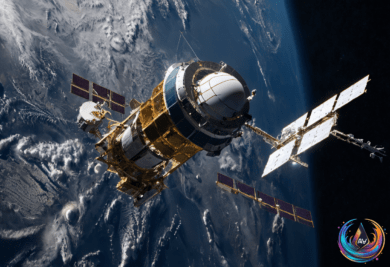
A new report from Europe is raising serious concerns about the growing number of satellites and the risk of collisions in orbit. The number of active satellites has climbed from about 1,000 in 2013 to approximately 17,000, changing the scale of activity around Earth in little more than a decade.
The European Space Agency released its annual Space Environment Report a week ago, and its projections now point to an even busier orbital environment. The agency increased its estimates for future satellites based on current trends, while its projection for the total number of objects in orbit has gone up dramatically.
That growth is already tied to large satellite constellations. SpaceX’s Starlink constellation has approximately 11,000 satellites in orbit. Amazon has launched hundreds of satellites, with thousands more planned, and multiple Chinese Internet constellations are in progress.
More satellites, less room for error
The concern is not limited to the satellites already in orbit. Orbital data centers may produce hundreds of thousands of satellites, adding another possible source of congestion to an environment that has already changed sharply since 2013.
More objects in orbit create more chances for satellites and debris to come into conflict. The report raises fears about collisions and the potential for a Kessler syndrome scenario, in which debris becomes a growing problem for the use of orbital space.
Moriba Jah, a professor at the University of Texas at Austin, predicts that satellite debris could lead to the loss of usable orbits and the potential loss of human life. His warning points to a problem that extends beyond individual spacecraft: debris could affect whether certain orbits remain available for use at all.
Eric Berger, the author of the report, put the concern in direct terms: “I think we are going to lose the ability to use certain orbits.” That statement captures the central issue raised by the new projections. The question is not only how many satellites can be placed in orbit, but whether parts of orbit will remain usable as the number of objects continues to rise.
A widening gap over orbital congestion
Elon Musk, SpaceX’s founder, has offered a different view of the problem. “Space is really big. It’s not like space is gonna get crowded. Space is enormous. If you actually look at it relative to the Earth, the satellites are so tiny you can’t even see them.”
His comment presents space as vast enough to absorb a growing number of satellites. The European report and the warnings from Jah and Berger focus on another part of the picture: even a huge environment can face limits when more satellites, debris, and planned constellations share usable orbits.
Those two views describe the issue from different angles. Musk emphasizes the size of space and the small size of satellites, while the report highlights the number of objects that may occupy orbital paths around Earth. The increase from about 1,000 active satellites in 2013 to approximately 17,000 today gives the concern a clear measure.
The scale of planned growth adds to the pressure. Starlink alone accounts for approximately 11,000 satellites in orbit, while Amazon has thousands more planned and multiple Chinese Internet constellations are in progress. Orbital data centers could push the number of satellites far higher still.
Why the new projections matter
The European Space Agency’s updated projections show that the orbital environment is changing faster than earlier estimates suggested. The agency has raised its expected number of future satellites based on current trends, and its projection for objects in orbit has also gone up dramatically.
That matters because every new constellation adds to the same shared environment. The report does not describe orbit as an empty space with unlimited room; it presents a system where satellite debris could reduce usable orbits and create risks for human life.
The warnings do not say that a collision has already caused the predicted outcome. They show why the growing number of satellites has become a serious concern. With approximately 17,000 satellites in orbit, hundreds of Amazon satellites already launched, multiple Chinese Internet constellations in progress, and possible orbital data centers ahead, the pressure on orbital space is moving in one direction.
The central warning is simple: the number of objects in orbit is rising, and the projections are rising with it. Whether space proves large enough to handle that growth will depend on how the satellite environment develops from here.
Based on