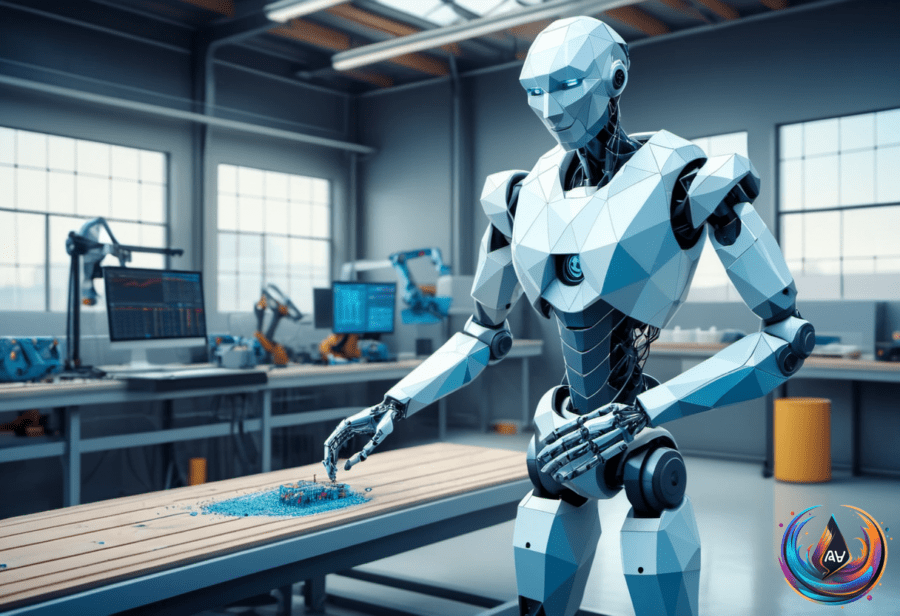
Robots are stepping into jobs once thought too complex or delicate for machines. They don’t just follow commands. They think, adapt, and move with human-like skill. This is not science fiction. It’s happening now, and it’s shaking up factories, offices, and even homes.
Meet Flexion Robotics’ R-Noid: The Future of Labor
Flexion Robotics, a Swiss startup led by ex-Nvidia engineers, has built a humanoid robot that can do more than simple chores. Named R-Noid, this 1.7-meter tall machine weighs about 90 kilograms and uses powerful onboard Jetson modules for perception, planning, and control. It’s designed to handle tough, repetitive tasks with ease.
R-Noid can open doors, climb stairs, and carry boxes. Each arm supports up to four kilograms, and it can work at heights up to 1.9 meters. Best of all, it runs on battery power for up to three hours straight.
Flexion’s secret sauce lies in AI. Their system trains robots in simulation with very limited human help. The robots learn through reinforcement learning, a process where they master tasks by trial and error. CEO Nikita Rudin calls this the software’s “secret ingredient.”
R-Noid comes in five different configurations. It can work as a restaurant assistant, packer, picker, folder, or host. It’s built to automate labor-intensive jobs in industries like logistics, healthcare, food service, and lodging. Plus, it fits right into existing workplaces without any structural changes.
Figure’s Robots: Real Factory Work Without Humans
Across the ocean, a US-based company called Figure is rewriting the rules of factory work. Their Helix-02 robots have completed full 8-hour factory shifts without any human intervention. They unload and reload dishwashers, transform rooms, and even make beds—all autonomously.
Figure’s robots use the Helix AI model, which processes visual input to understand and adapt to their environment. This model combines vision, touch, proprioception, and whole-body control into one learning system. The result? Robots that move with human-like precision and navigate dynamic spaces effortlessly.
At BMW, Figure’s robots have supported 10-hour shifts. They moved over 90,000 parts and helped produce more than 30,000 vehicles. These robots don’t just work alone; they coordinate and communicate with human coworkers, showing real teamwork potential.
AI Models Powering the Robot Revolution
Experts say the humanoid bodies aren’t the revolutionary part—it’s the AI models behind them. ABI Research analyst George Chowdhury explains, “The humanoid itself isn’t the interesting, revolutionary thing, rather it’s the AI models that back them.”
These AI models bridge the “sim-to-real” gap by training extensively in randomized simulations. This approach lets robots learn tasks in virtual worlds before performing them flawlessly in the real one. Reinforcement learning drives this progress, enabling robots to improve by trial and error.
Both Flexion and Figure rely on powerful onboard computing and AI ecosystems. Flexion’s R-Noid uses NVIDIA’s Jetson modules, while Figure integrates stereo camera input for navigation and manipulation through its Helix System AI model. These advances allow robots to run autonomously or via teleoperation through virtual reality.
Robots Redefining Work and Society
Humanoid robots are no longer just experimental gadgets. They’re taking on real jobs—factory sorting, housekeeping, massage therapy, even bartending and traffic control. This shift promises to relieve humans from hazardous or tedious tasks and foster new forms of human-robot collaboration.
But this rise in robotics also challenges how society views work. Questions about employment, ethics, and technology’s role loom large. The Chinese government aims to lead this market globally by 2030, backing training centers where robots learn from human-guided repetitive actions.
Elon Musk himself acknowledges China’s aggressive push in this field and highlights the difficulty of mastering robotic hands, a key hurdle. Meanwhile, the market for robot foundation models could reach $150 billion by 2036, signaling enormous growth and investment potential.
What’s Next for Humanoid Robots?
The future is clear: robots will become essential partners in workplaces worldwide. They’ll handle the repetitive, the dangerous, and the mundane. Humans will shift toward higher-level roles that require creativity, empathy, and complex decision-making.
As AI and robotics evolve, expect more robots like R-Noid and Figure’s Helix-02 to enter factories, hotels, restaurants, and even homes. The line between human and robot work is blurring fast. And one thing’s for sure—this revolution is only just beginning.
Based on
- This Humanoid Robot Is a Terrifyingly Competent Office Intern — wired.com
- China’s Robot Workforce: Training Humanoid Robots to Take on Jobs | Future of Work (2026) — sucessminded.com
- New Humanoid Robot Targets Labour-Intensive Tasks – Electronics For You — electronicsforu.com
- Humanoid Robots Take on Household Chores: A Step Towards Autonomous Living (2026) — gamixoapp.com
- Humanoid Robots: Revolutionizing Factory Work with 8-Hour Shifts (2026) — etcdc.org